Best ways to lose belly fat

Why it's impossible to target belly fat

Contrary to popular belief, there are unfortunately no specific exercises you can do to target stubborn belly fat. You can do crunches all day and have very little to show for it. This is because where we lose fat is genetically redetermined so trying to focus solely on your stomach will only leave you frustrated. Focusing instead on losing weight overall will however help you in your pursuit. However, this is no simple process. 

5 Ways diet and nutrition play a role in belly fat

Diet and nutrition is the most important first step to take for stomach fat loss. You can never compete with an unhealthy diet no matter how much exercise you do. Here are 5 tips you should start doing:

  1. Curb your intake of alcohol and sweetened beverages.  Calories from alcohol add up fast, which can quickly put you into a caloric surplus. Increased regular alcohol consumption has also been linked to increased belly fat likely due to an increase in visceral fat. Sugary beverages act the same way in that they spike your blood sugar and insulin levels resulting in more belly fat storage.
  2. Avoid foods that contain trans fats, which have been linked to inflammation, heart disease, insulin resistance, and abdominal fat gain. Trans fats are found in processed foods such as pre-packaged foods, margarine and spreads, fast foods, and fried foods. To help avoid trans fats start eating more whole foods and pay attention to food labels. Trans fats can also be labeled as partially hydrogenated fats.
  3. Eat a high protein diet. This doesn’t mean you have to cut out carbs, it just means approximately 30% of your calories should be coming from protein. Protein is important for weight management because it raises your metabolic rate, which allows you to burn fat more efficiently. Protein also keeps you full longer to keep you from overeating and helps you retain muscle mass during weight loss to improve your overall body composition.
  4. Cut back on carbs, especially refined sugars. Replacing simple carbs with unprocessed complex carbs such as whole grains can be enough to trigger belly fat loss. Refined carbs are void of most fiber, minerals, and vitamins so they are considered “empty calories,” These foods include: white flour, white bread, white rice, pastries, sodas, snacks, pasta, sweets, breakfast cereals and added sugars. Due to their high glycemic index, simple carbs lead to rapid spikes in blood sugar and insulin levels after meals. High levels of insulin over time result in fat storage, specifically around the abdomen. 
  5. Eat more soluble fiber, which is slow to digest, keeping you full longer to prevent you from overeating. Good sources of soluble fiber include flax seeds, Brussel sprouts, avocados, blackberries, and legumes. Soluble fiber also helps with weight loss by blocking fats that would otherwise be digested and absorbed.

Other beneficial ways to target stubborn belly fat

Belly fat isn’t only caused by what you eat. Your lifestyle also plays a role. Here are other ways you can lose your belly fat:

  1. Lower your stress levels. Chronic stress causes a spike in the hormone, cortisol. There has been shown to be a strong link between uncontrollable stress and bell fat. You can learn to manage your stress levels through exercise, meditation, and sleep.
  2. Exercise, specifically resistance training. Strength training promotes muscle growth, which increases your energy expenditure. You end up burning more calories throughout the day. Resistance training also helps reduce visceral fat, which tends to store around the mid-section.
  3. Stay active. It’s important that you don’t remain too sedentary. Aside from exercise, you should spend less time sitting and more time moving. Spend more time outdoors. Get more steps in.
  4. Get more sleep. Believe it or not the amount and quality of your sleep has an effect on your weight. Aim for at least 7 hours of restful sleep per night.
  5. Drink more water. Dehydration causes your body to retain more water causing bloat. It can also lead to poor digestion and constipation.

Lose belly fat and live healthier too

Although you can’t magically melt belly fat away, with the right diet and lifestyle changes you can achieve your desired results. Give yourself time and recognize how these changes not only help you get rid of stubborn belly fat but also help you feel better too! When you live a healthier lifestyle you’ll look and feel better on the inside and out!

Postpartum exercise: Must know dos and don’ts

Knowing when your postpartum body is ready for exercise

The general rule of thumb for postpartum exercise is to wait until your 6 week postnatal doctor’s visit before resuming an exercise program to ensure your body has had adequate time to heal. This is usually when your doctor will clear you to resume exercise.  If you’ve had a c-section you may require more healing time. However, it is advised to begin walking and performing your kegal exercises very soon after pregnancy to promote recovery.

It’s also important to check in with yourself and see when you feel ready. There are a lot of physical and emotional changes that come after pregnancy. It’s absolutely normal to not feel yourself as you learn to care for this tiny human. You may experience mood swings, depression, fatigue and a general feeling of overwhelm. Take this process slow and don’t overdo it too soon. Always listen to your body and what feels right for you. If you feel any pain or uncomfortable pulling particularly in your abs don’t push through. Dial back the intensity of your workouts until your body has recovered fully.

Rebuilding your core post-pregnancy

Your core after pregnancy is going to be both an area of increased weakness and an area that requires a lot of attention. Most women will experience at least a mild case of diastasis recti as a result of pregnancy due to the increased demand put on the abdominal muscles during pregnancy and in labor. In some cases, this muscle separation in the abdominals can be so severe that surgery is required to correct it. However, most times this can be resolved with the proper training. It’s a good idea if you’re currently pregnant to do prenatal exercises to begin strengthening your transverse abdominis before delivery. This can help decrease your risk of developing severe diastasis recti. 

Here are three core exercises that are great for postpartum exercise to help with strengthening and rebuilding your core.

  • Pelvic tilt: For this exercise, you want to lie on your back with your feet planted and arms at your sides. Focus on inhaling as you tilt your pelvis forward forming an arch in your lower back and exhaling while contracting the core and pulling the pelvis in towards the floor. Repeat this sequence for 10-15 reps. This exercise is great for working on regaining proper pelvic alignment and strength and stability in your transverse abdominis.

pelvic tilt for strong abs postpartum

  • Side plank extension: For this exercise, you want to start on your side resting your bottom arm on your forearm. From here stack your feet and extend the legs. Then, drive the hips up towards the ceiling keeping your hips stacked on top of each other. Repeat this exercise for 10-15 reps on each side. This exercise is great for strengthening and stabilizing your transverse abominis and your oblique. 

side plank for strong core postpartum

  • Dead bug: To perform this exercise first lie on your back with your legs elevated above your hips and your arms above your shoulders. Then slowly lower the opposite arm and leg towards the floor while exhaling and contracting your core. Inhale and relax the core as you bring the arm and leg back up to the starting position. Repeat this exercise for 10 reps on each side. This exercise is great for strengthening and stabilizing your core as well as your spine and back muscles. 

dead bug for strong core postpartum

When to start postpartum exercise after normal delivery

Where to start with postpartum exercise will in large part depend on how active you were prior to and during pregnancy. If you never did strength training before or if it’s been several months you should start by using very light weights or doing body weight strength training only. If you are accustomed to weight training you should start by regressing down at least in the amount of weight you are using and start slow to see how your body feels.

Tips for safe strength training after pregnancy:

  • Form is most important here. Never compromise your form in order to lift heavier.
  • Don’t overdo it. Less is more. Only do what your body feels comfortable with and rest if you feel any pain or discomfort in your core. Be particularly mindful of this if you had a c-section.

Safe postpartum exercises to target total body

Here are four functional postpartum exercises you should be doing to work on building total body strength and conditioning.

  • Push-ups: To modify this exercise you can start by doing wall push-ups and gradually work up to doing them from a lower incline until you can do them from the floor. To perform this exercise make sure your hands are positioned shoulder width apart and feet are hip width apart. Starting from a straight arm plank slowly lower your chest towards the wall or surface you’re on while bending the elbows back at 45 degrees. Make sure to keep a long neck and shoulders down and back. Try to perform 5-8 reps to start out. This exercise is great for targeting your chest, triceps, shoulders, core and serratus anterior muscles.

elevated pushups

  • Squat into overhead press: To modify this exercise you can start with body weight air squats or box squats. Gradually as you get stronger you can start doing weighted squats and then add in the overhead press. Start by standing with your feet hip width apart and practice squatting over a chair to ensure correct form. As you add in the weight make sure you’re keeping your chest open, shoulders down and back and core tight. You should press the weights overhead directly in alignment with your ears. Make sure to fully extend your elbows at the top of the press. You should aim for at least 8-1o reps with this exercise. This exercise is great for hitting hamstrings, glutes, quads, core and shoulders. 

squat into overhead press

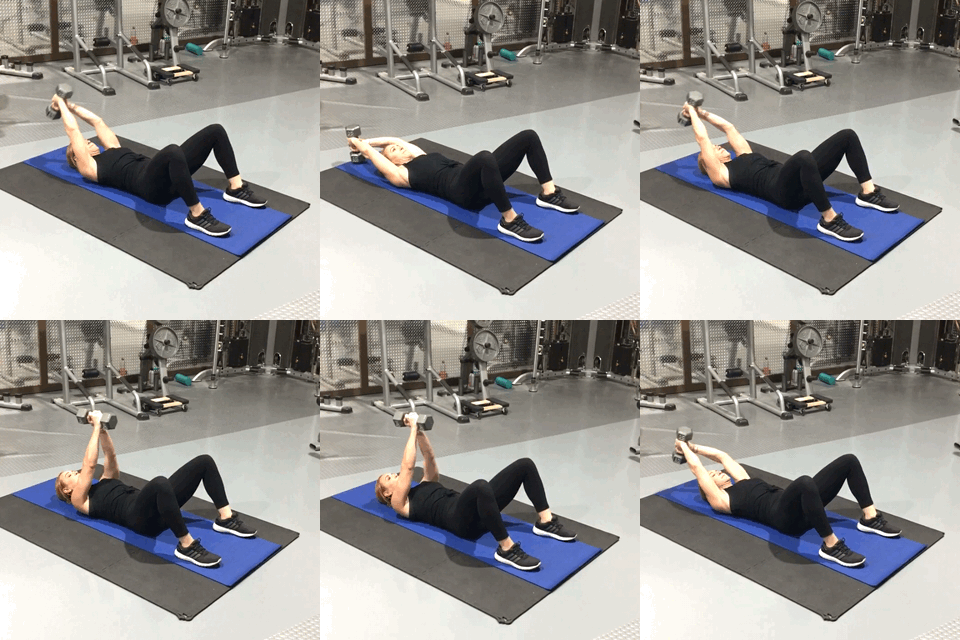
  • Pull-overs: To modify this exercise start by using a light weight while lying on your back on the floor. Start with your feet planted and arms holding the weight above your chest. Slowly bring the weight overhead to tap the floor while flaring your elbows and keeping only a slight bend in the arm. As you bring the weight overhead pull your pelvis back by contracting your core and pressing your back into the floor. As you progress you can do this exercise from an elevated surface such as the bench to gain a bigger depth and stretch at the bottom of this motion. Aim to perform 10-15 reps of this exercise. This exercise is great for targeting the upper back including your lats, chest, triceps, serratus anterior and core muscles. 

dumbbell pull-overs

  • Romanian deadlift with a row: This exercise can be modified by standing with your feet turned out slightly and using lighter weights. As you get stronger you can slowly increase the amount of weight you’re using and the number of reps and sets you’re doing. Start by standing with your feet about hip width apart and arm hanging down in front of the body. Then, slowly hinge forward with your chest by sitting back into your hips until your back is at a 45 degree angle. While keeping a flat back row the arms back towards your hips driving your elbows past your back. Repeat this exercise for 10-15 reps. This exercise targets your glutes, hamstrings, core, back and biceps. 

romanian deadlift with a row

Showing yourself grace post-pregnancy

Getting your body back to where it was pre-pregnancy is going to be a process that takes time. Be patient with yourself and learn to love and appreciate your body along the way. Your body just went through a ton of changes and created a human life, which it deserves recognition for. The female body is truly a miracle worker!  The best thing you can do for yourself is help your body recover and get back to its strongest self by being consistent in your training, eating a well-balanced macro-friendly diet and listening to your body’s needs.

If you need help getting started we have trained prenatal and postpartum professionals who are here to help. We work a ton with moms and often times we work with our moms through multiple pregnancies. We understand the delicate balance between wanting to get back to your pre-pregnancy body and showing yourself some grace through this transition period. The important thing to remember with postpartum exercise is that there’s nothing your body can’t do with the right training and proper guidance.

6 Strength exercises for beginners to improve how their body functions

Where to start with strength training

If you’ve never done strength training before it can be confusing to know where to begin. It’s always better to value form before function so start with basic strength exercises for beginners. For most people this means starting off with some body weight movements to understand form, muscle engagement and how to activate your core properly. This means that the use of weights or other forms of added resistance will come later in your training. If you get ahead of yourself you risk injury or compensation. 

How to choose the right strength training exercises

When you think about strength training you want to make sure you’re picking exercises that are functional, meaning movements you perform in everyday life outside of the gym. You also want to think about choosing exercises that will help you improve your posture and how you move. This is important so that you can shield yourself against injury and improve the overall functioning of your body

To know which exercises are right for you it’s recommended that you perform a postural assessment.

You can do this by either having someone take a picture of you standing facing the camera, in profile and with your back to the camera or you can assess yourself in the mirror. You want to be looking for any alignment issues or compensation that is happening in your body. If you drew a line down the center of your body both sides of your body should mirror each other both from side to side and front to back. In using this midline you also want to be looking to see if your joints are stacked on top of each other. If your shoulders round forward or your pelvis tilts forward you will see that your joints are not stacked on top of each other following this midline. Any deviations in how you stand will need to be addressed in your strength training routine. 

Basic strength exercises for beginners

Once you’ve performed your self-assessment we can begin selecting the right exercises for you based on your needs.

Basic strength exercises for beginners with weak back and core muscles.

If your shoulders round forward and you slouch you should be doing strength exercises to train your back and core muscles. To do this perform 3 sets of 10-15 reps of each of the following exercises:

Lying prone scapular retractions doing superman pull-downs.

To perform this exercise focus on contracting your abdominal muscles to stabilize your spin and then depress and retract your scapulae (shoulder blades) by pulling your shoulders back and down. Maintain this squeeze between your shoulder blades as you drive your elbows back towards your sides. Then repeat and remember to keep your feet elevated. This exercise targets your transverse abdominal muscles, glutes, upper trapezius, middle trapezius, levator scapulae, rhomboid minor, serratus anterior (muscles that move the scapulae), and erector spinae muscles.


Bird dog.

To perform this exercise start by kneeling on all fours and slowly extending the opposite arm and leg away from your body. Be sure to keep the core tight and shoulders down and back. You also want to fully extend through the arm and leg that are elevated so that the arm and leg are straight. Hold for 10 seconds and then repeat on the other side. This exercise targets the erector spinae, rectus abdominis, glutes, anterior deltoid, upper trapezius, middle trapezius, levator scapulae, rhomboid minor, serratus anterior (muscles that move the scapulae).


Basic strength exercises for beginners with weak hips and glutes.

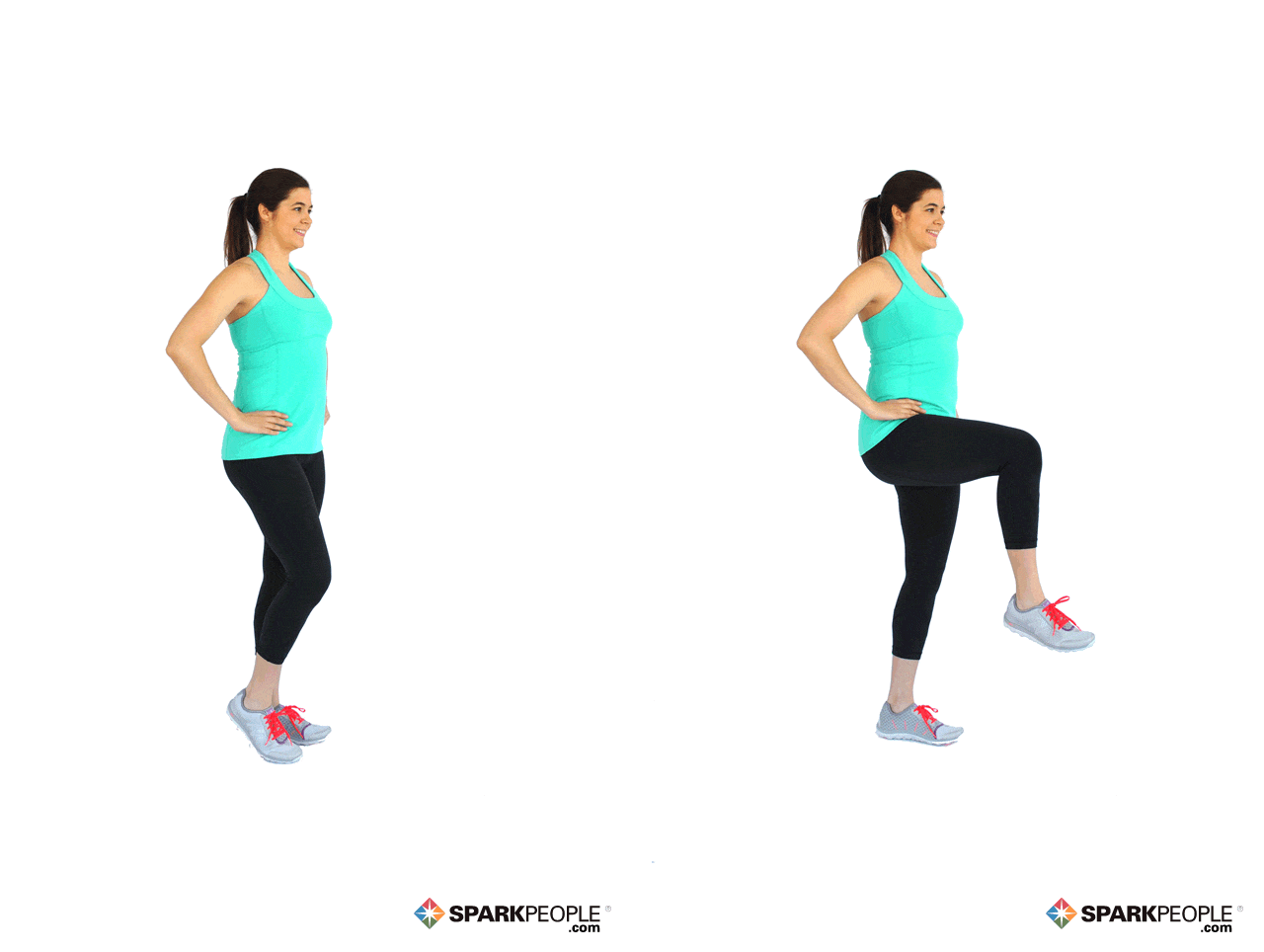
Standing hip flexion.

To perform this exercise start by standing upright and raising one knee to the height of your hip at a 90-degree angle. Squeeze your glutes to help you stabilize at the top. Hold that contraction for 5-10 seconds and lower your leg and repeat. This strength exercise targets your hip flexors, glutes, core, calves and the muscles of your feet.


Standing hip abduction.

To perform this exercise start by standing upright and shifting your weight to one leg. Slowly lift the opposite leg off the floor away from your body keeping the leg fully extended and the toes flexed. Make sure your toes are pointed ahead at all times to prevent your hip from externally rotating. The muscle primarily targets the hip abductor muscles located on the outside of the hip. This helps to promote strength and stability in the hip when walking or running.


Basic strength exercises for beginners with weak quads or hamstrings and glutes.

Lying glute bridges.

To perform this exercise start by lying flat on your back with your legs bent at 90 degrees and feet planted on the floor. Pull your pelvis into a neutral position by contracting your core and pulling your navel in towards your spine. From this position contract your glutes and lift your hips towards the ceiling. This exercise targets your erector spinae, transverse abdominis, glute medius and minimus (abductors), hamstrings and adductors.

Wall sits.

To perform this exercise start by standing upright with your feet shoulder-width apart and about 1 foot from the wall. Bring your back and shoulders against the wall and lower your body against the wall until your knees are at or near 90 degrees from your hips. Keeping your back, shoulders, arms and head against the wall hold this contraction for 10-15 seconds. Then release and repeat. This exercise targets your glutes, quadriceps, hamstrings and calves.

Strength exercises should improve function

Regardless of whether you are a beginner or experienced, strength training should always aim to improve your body’s function. When approached in this way, strength training can protect you against injury, heal muscular imbalances, improve your mobility, reduce your musculoskeletal aches and pains and greatly enhance your quality of life. The best part of all is it’s easy to get started. You can start off strength training from home without the need of any equipment. 

9 Most common workout mistakes & how you can avoid them

Workout mistakes may be hindering your progress

If you find yourself getting frustrated that you’re not seeing the results you desire from your training chances are there is something you’re doing wrong. Oftentimes people will jump into a new exercise routine without first assessing themselves to avoid any common workout mistakes. If you don’t know what you’re doing you can hinder your progress and even put yourself at risk for injury or set-backs.

9 Common workout mistakes to avoid

To figure out what you’re doing wrong check to see if any of these common workout mistakes apply to you:

  1. Inconsistency in your training. One of the most important factors in seeing results is maintaining consistency with your program. If you have a tendency to frequently start and stop a program or only periodically train you’re going to be hard-pressed to see progress. Without consistency, your body can’t adapt and master new skill-sets, which is what allows you to gain foot ground in your program. The more consistent you train per week the more volume you gain over time. This is what leads to progress. Ideally, you should aim to train at least 2-3x per week to gain the most benefits. However, it’s more important to train at a consistency you can maintain even if it’s only 1x per week. 

  1. Overtraining. Overtraining can lead to burn-out and injury. If you are seeing declines in your performance or if your muscle soreness recovery seems to linger chances are you are overtraining. To avoid overtraining schedule rest days in between your workouts and don’t do too much too quickly. When you put excessive demands on your body it could lead to muscle strain or injury.

  2. Improper form. If you’re doing an exercise with the improper form you risk targeting unintended muscles and putting your body in a compromised position. This can lead to injury. If you aren’t engaging the muscle correctly you’re not gaining the full benefit of the exercise. Always check yourself in the mirror or film yourself to ensure your form is correct.

  3. Not doing enough strength training. Strength training is important for improving motor skills, your body composition, your joint health, metabolism, muscular strength and endurance and more. By not following a consistent strength training program you are missing out on these many benefits to your health.

  1. Poor nutrition. It’s important to note that while exercise is key for making progress you are doing yourself a disservice if you aren’t also incorporating a well-balanced macro-friendly diet. No matter how hard you train, you can never outperform a bad diet. Calorie consumption is equally important here as it aids in having an optimal metabolism, which we break-down for you under our nutrition guide.

  2. Not progressing in your program. If you have been doing the same workout routine for weeks or months on end without adjusting your rep scheme, your level of resistance or exercise routine you have probably plateaued by now. Your body responds and adapts quickly to a consistent exercise program so it’s important that you make your exercises more demanding overtime. This forces your body to get stronger as it adapts to these new demands.

  3. Not incorporating a good stretching and mobility routine. Active and passive stretching is important for improving your ability to move each muscle through its full range of motion. Moving the muscle and joint through a full range of motion helps prevent injury and allow for maximum recruitment of muscle fibers. This allows you to train more efficiently.

  4. Not sleeping enough. Sleep is when your body recovers. When you’re not getting enough uninterrupted hours of rest per night it puts added stress on the body. Your muscles can’t build back up stronger if they haven’t first had the chance to recover. Lack of sleep can also contribute to joint pain and stiffness.

  5. Doing too much too soon. Always aim to master the basics in your program first. Start with building your foundation. Training calisthenics is important for understanding proper form and being able to manage your body weight in space. Bodyweight training teaches you coordination, balance, proprioception and self awareness.

Other key points to remember when training

If you’re avoiding all these common workout mistakes and still struggling to see results keep in mind results take time. Set realistic expectations for yourself. Give yourself at least 4-6 weeks following a consistent weekly program before you start evaluating any changes happening to your body. 

If you have hefty goals like to lose 40 lbs or being able to do an unassisted pull-up you should be thinking long-term. With long-term goals reevaluate yourself in 6 months. Real change does not happen overnight. Be patient with yourself and learn to trust the process. You should also keep in mind that success is not linear. Expect to face set-backs. This is a fact of life. The more you can enjoy the journey the more success you will find in the long run.

Hire a professional to help

If you are questioning whether you’re effectively avoiding these common workout mistakes you should seek help from a professional. Our certified trainers are equipped to design a program specifically to fit your needs. We are here to guide you through each workout to make sure you’re executing each exercise correctly. We also serve as your accountability partner. Having our support and expertise will help set you up for success and take the guesswork out of the equation for you. If you are interested in learning more about our services contact us today for a free phone consultation. 

Is strength training enough for fat loss

Strength training effects on fat loss

Strength training as we know helps us build muscle and get stronger, but that’s not all. Through this process, we are also reshaping our metabolism enabling our bodies to burn more calories at rest. The more muscle we have on our body the more energy output we have, which allows our body to break-down our fat stores in order to meet this new demand. Also having a higher muscle mass percentage improves our body composition. This is our lean mass to fatty mass ratio. Having a lower body fat percentage helps us better manage our weight in the long run. Strength training can often lead to a higher after-burn effect. This means that the body continues burning calories even after the workout is over. 

Calorie consumption is equally important for fat loss

While you will gain benefits in fat loss from strength training alone, it will only get you so far. Diet and calorie consumption are equally as important. Being in a calorie deficit will help you lose some weight because it means you’re burning more calories than you are consuming. However, working to heal your metabolism by slowly increasing your calories until you’ve reached a slight surplus before then going into a calorie deficit will help you not only lose fat, but improve your body composition. It’s much easier to manage your weight in the long run when you have a body composition comprised of more lean mass vs fatty mass and thus a higher basil metabolic rate.

Here’s how it works. When you are in a slight calorie surplus you’re able to focus on building more muscle since muscle requires a more substantial calorie supply. Then when you put yourself in a calorie deficit you’re able to lean out burning more fat, but also while carrying a higher percentage of muscle mass. This is how you achieve a lean strong physique without becoming “skinny fat.”

Why protein is so important for fat loss

Another important factor to consider when it comes to diet is protein intake. Consuming a diet that is higher in protein will help improve your fat loss and here’s why:

  • Protein keeps you more satiated thus keeping you from overeating. A recent study found that “increasing protein from 15% to 30% of calories made overweight women consume 441 fewer calories each day without intentionally restricting anything.”
  • Protein is the building block of muscle so more consumption promotes new muscle growth while also maintaining your current mass. The more muscle you have on your body the more efficient your body is at burning fat.
  • Protein has a higher thermic effect than fat and carbs so it boosts your metabolism and increases your calorie burn. A higher metabolism and calorie burn allows you to burn fat more efficiently.

Strength training alone is not enough

If you want to focus on losing fat while maintaining a healthy metabolism and most importantly keeping the weight off then you want to couple strength training with a high protein calorie deficit diet.

Tracking your calorie consumption and your weight is very beneficial so you can see if you’re already in a calorie deficit. If you are then you may want to take the extra time to reverse diet out of the deficit to pack on more muscle before going into a calorie cut. If you’re already in a calorie surplus you can spend some time here strength training first to build more muscle before going into a cut. Bottom line, if you have the time it’s always useful to delay going into a calorie deficit to improve your metabolism and body composition first. Do this while maintaining a high protein diet with at least 30% of your calories coming from protein. 

Fat loss isn’t the only thing you should be concerned about. This process is how you can guarantee lasting fat loss results while also maintaining a healthy optimal metabolism and healthy body composition.

Beware of skinny fat: A health epidemic

The risks of being skinny fat

It’s easy to assume you’re healthy when you’ve never struggled with your weight before and you have a body mass index (BMI) that falls within the “normal range.” However, as it turns out, up to one-fourth of normal weight people may fall into the category of being skinny fat. This is also sometimes termed “normal-weight obesity.” This goes to show that how you look and how much you weigh aren’t the only things you should be concerned about. High levels of fat and inflammation can fall under the disguise of being skinny. This puts you at an increased risk of type 2 diabetes, heart disease, stroke, high cholesterol and even low bone density. These are the same health concerns we generally associate with obesity.

Skinny fat signs to watch out for

  • A muffin top is a tell-tale sign of being skinny fat. This is when you have excess fat that collects around your midsection. Even if you don’t noticeably see a big difference in your waistline, if you find that your pants are fitting tighter, take it as a warning sign. Carrying excess fat around your waistline is more dangerous than carrying it anywhere else because it puts you at an increased risk for cancer and heart disease. Researchers from Harvard and the Institute of Health found that women with a waist size equal to or greater than 35 inches were approximately twice as likely to die of heart disease and cancer as were women with a waist size less than 28 inches, regardless of their body mass index.
  • Lack of exercise, particularly resistance training is another risk factor. Chances are without regular exercise you lack lean muscle mass and have a higher body fat percentage. 
  • A family history of diabetes, high blood pressure, heart disease or high cholesterol regardless of weight or size can make you predisposed to the same health issues even if you are skinny. 
  • An unhealthy diet also puts you at risk. If you eat a lot of processed foods high in sugar and saturated fat and not enough fiber, lean protein and micronutrients you’re putting yourself on track for developing major health issues at an earlier age.
  • Extreme diets are dangerous because they cause you to pack on fat when you overeat and then lose muscle mass when you drastically cut calories.

How to avoid becoming skinny and unhealthy

The best way to reduce your risk of becoming skinny fat is to focus less on your BMI and more on reducing your body fat percentage and improving your metabolic rate. The reason why the BMI test is not an accurate measure of health is that two people can weigh the same but have very different body types. One person can have a much higher body fat percentage and the other could have more lean mass, however there is no way to tell which one you are from the scale because fat and muscle weigh the same. 

To achieve a faster metabolism and lower your body fat percentage you should:

  • Do regular resistance training to build more lean muscle mass. Strength training is an effective way to shield against the natural regression in muscle mass as we age. The more muscle you have on your body the faster your metabolism will become because it takes more energy to sustain lean mass on the body. 
  • Consume more lean protein. Your body burns calories just by breaking down the protein you consume.
  • Eat less processed foods. This isn’t just referring to fast foods. Anything you buy that is precooked or that doesn’t grow from the ground is considered a processed food. These foods are low in nutrients and fiber and high in sugar, high fructose corn syrup and  trans fats, which leads to more visceral fat in the body. This type of fat is dangerous because you can’t see it on the outside. It collects deep within your body around your vital organs, which can negatively impact how your hormones function and lead to disease. Since it collects deep beneath the skin you could have a pretty flat stomach and still have a lot of visceral fat. 
  • Consume less alcohol. Alcohol is also a contributor to visceral fat gain because it contains a lot of empty calories.When you consume alcohol the liver burns the alcohol for energy instead of fat.

Why normal weight obesity has become a growing concern

This steady rising trend in the number of men and women who aren’t necessarily overweight, but are classified as skinny fat has mounted growing concerns. According to a study published in the Journal of American Medical Association, nearly 1 and 4 thin people have prediabetes and are “metabolically obese.” That is roughly 25 percent of the population. 

This is why it’s important to be proactive about your health. When you put yourself at risk for prediabetes you’re also putting yourself at risk for heart disease and even early death.  Dr. Hyman, an author, and  internationally recognized leader, speaker, educator and health advocate, says “If you are a skinny fat person and get diagnosed with diabetes you have twice the risk of death than if you are overweight when diagnosed with diabetes.” A healthy body isn’t just about being a healthy weight, it’s also about how well your metabolism is performing and how healthy you are on the inside.

Like what you read? Be the first to know about our latest guides by joining our Facebook Group! 

Discover the 10 best benefits of group exercise classes

What are group exercise classes?

Group exercise classes is one style of training, which involves training in a group with other people. This service can be offered virtually or in person and can cater to all types of exercise such as yoga, HIIT, strength training and more. We offer virtual small group training as an affordable way to connect with others as you train from the comfort of your home!

Difference between individual and group classes​

Training in a group offers a community atmosphere for working out. Instead of working out solo with an instructor you have other peers to offer additional support and motivation.

Class settings also usually attract a diverse crowd. They can range broadly in size from two to hundreds of people of all different ages and fitness levels.

Because classes cater to a variety of fitness types workouts are less personalized, but instead are designed to match everyone’s fitness needs.

In a group setting the instructor leads the class oftentimes by doing the workout along with you to keep the energy up and everyone on pace. With solo training, all the focus is on you so the instructor is more attentive and hands-on critiquing your form and being attentive to your fitness needs.

Benefits of group exercise classes

  • Opportunity to meet new people: Training in a group allows you to connect with like-minded people. These are people who share common interests, struggles and goals. This connection makes you feel as if you are on this journey together.

  • Provides healthy competition: Working out with other similar types of people pushes you to work harder. You feed off of each other’s energy. When you see your peers doing extra reps you’re motivated to keep up.

  • More affordable: If you can’t afford a personal trainer for yourself, group classes is a great way to still hold yourself accountable at a cheaper cost.

  • Fun and entertaining: Group exercises classes are high energy, which makes working out fun. You cheer each other on! When you’re having fun you forget how hard you’re working.

  • Challenging way to learn and grow: You may not know what exercises you should be doing on your own and how hard to push yourself. Working out in a class teaches you about proper form and challenges you to do exercises you didn’t think you could do.

  • Combats exercise boredom: When you workout on your own it’s easy to become bored. Group classes provide variety to always keep you focused and engaged.

  • Bigger than yourself: Working out in a group provides community. It reminds you that you’re on this journey together. If you give up on yourself you’re not just letting yourself down, but the whole group.

  • Keeps you accountable. When you’re relying on your own motivation to workout it’s easy to fall off track. Enrolling in a group exercise class helps you build a  routine so that you  can remain consistent with your workouts.

  • Gives you variety in your workouts. Classes offer a unique variety to your workouts because every class is different. You can choose classes to match your goals and preferences such as HIIT, spin or yoga.

  • Builds self-confidence and camaraderie. Training in a group setting can make you less self-conscience because you have other people around you who are at a similar fitness level. It also allows you to lean on each other for support when you need it.

Why group training might be for you?

Group exercise classes can be a  great way to workout while making new friends. It’s a fun way to stay active and also work on improving your fitness. By working out in a group you also get to learn from and motivate each other!

We offer a virtual small group training class that meets every Wednesday at 5pm EST. You can join us from the comfort of your home! All of the workouts are tailored towards all fitness levels and we focus on total body functional, mobility and strength training. No equipment is needed to join. 

Sign up today to subscribe and save! You can unsubscribe at any time.

Protein powder: Why it’s the supplement everyone is using

Protein powder has many benefits

Protein powder is the one nutritional supplement that everyone can benefit from.  It is an essential macronutrient that helps to make-up the organs, tissues, bones, skin and hair of the body. Protein also helps to build muscle, repair cells, fuel your body with energy, carry oxygen throughout your blood, make antibodies to fight off infections and illnesses and make enzymes and hormones. It is also known that having a sufficient supply of protein in your diet helps with weight management, body composition, recovery after a workout, muscle growth and better nutrition. 

The challenge is how do you source enough protein in your diet especially if you are vegan or vegetarian?

Protein powder is a great option because it comes in both dairy and plant-based form. One serving of powder can give you up to 40+ grams of protein, which equates to about one-third of the daily goal for most people. Your daily recommended intake of protein should range from .7 to 1 gram per pound of your body weight. Protein powder can easily be mixed into a shake making it easy to consume without feeling stuffed after. You can also add any other ingredients to your shake such as fruit or yogurt to give it the flavor you like.

Choosing the right powder for you

Protein powder is not a new phenomenon, but it has gained in popularity in recent years as more and more companies compete to bring you more options to choose from. Every brand is striving to bring you the best tasting powder that appeals to your dietary preferences. This very saturated market has left a lot of consumers confused as to how to choose the best one. You first need to decide the following:

  • Do you prefer an animal or plant based powder?
  • What flavor do you like?
  • Which powder has the fewest artificial sweeteners and chemical additives?

When it comes to deciding on the best animal protein powder our co-founder Kern Alexander recommends Now Sports Whey Protein Isolate, which is unsweetened. When interviewed by NY Magazine, he said “ it contains whey isolate and isn’t loaded with artificial sweeteners.” Whey isolate is viewed as better than whey concentrate because it contains less fat and carbs so it’s less caloric. If you are lactose intolerant it’s also the better choice for you.

Now Sports also makes a pea protein powder if you prefer plant based. Pea protein is often see as the best alternative to whey. The only ingredient here is pea protein isolate, which also gives you the most protein per serving. 

Best time to consume protein powder

When you are exercising it is suggested that you ingest a protein supplement within the first 30 minutes to an hour after your workout. This is the “anabolic window,” which is the short period after your workout when your muscles are repairing and recovering. The protein and carbs that you consume during this time is used for increasing protein synthesis, reducing muscle protein break-down and and replenishing muscle glycogen. Other than after a workout, it can give you a boost of protein when you are falling short in your daily goal. Remember for optimal health it is recommended that you have at least .7 to 1 gram of protein for every pound of body weight. Most people struggle to hit this goal without having a daily protein shake. Bottomline, there is no bad time to have protein powder. Aside from being a great source of protein, it can also be a great way to get more vegetables and even probiotics into your diet.

Foods you can add protein to

If you’re not a fan of protein shakes, don’t worry there are many other ways you can consume your powder.

Here are 10 foods you can add protein powder to that you may not have thought of:

  • oatmeal
  • pancakes
  • cookies
  • waffles
  • coffee (add vanilla flavored protein powder)
  • mashed potato (flavorless protein powder)
  • yogurt
  • pasta sauce
  • eggs
  • brownies
You can literally add it to anything and disguise it’s flavor by getting a flavorless powder. So if you don’t like the taste or consistency of protein shakes you’re in luck!

Deadlifts for beginners: Benefits, Techniques, and Tips!

Deadlifts for beginners: Using proper form and technique

A very common exercise that’s enjoyed by many in the fitness world is the deadlift.
Unfortunately, if performed poorly, the heavy weight and sheer force necessary for
this exercise poses a great threat of injury.

Do you know how to protect yourself by having a proper deadlifting form? When
using this compound exercise, learning a few primary deadlift tips and tricks will
help keep you safer while lifting more.

Benefits of the deadlift

Have you ever wondered what makes deadlifts such an important exercise? 
This is due to the fact that it’s a compound workout and therefore almost every
muscle in the body is used during it. Throughout the lift your arms, forearms, and grip help keep the bar secure and in place. Moreover, your core and back keep your
body tight and stable while also securing your spine.

Did you know an exercise that utilizes many muscles all at once achieves a higher
degree of calorie burning and fat loss? This is because these kinds of workouts take
a lot more energy to execute.

Another (not so) fun fact is that back pain is the main cause of injury in Americans of all ages. Fortunately, deadlifts are perfect for improving the muscles of your posterior chain and back

Executing a deadlift

If we know form is imperative to deadlifting safely what does this look like? Let’s go over the different steps so you have a better idea. First, you should know you can use either a barball or kettlebell to perform this exercise. To get started:

  • Stand with your feet beneath the bar and shoulder-width apart.
  • Grab the bar with your preferred grip just further than shoulder-width apart.
  • Bend your legs forward until the bar reaches your shins.
  • Straighten the lower back while keeping your shoulders and chest up.
  • Power through with your legs and raise the bar off the ground.
  • Pause at the top by locking your hips and ankles
  • Return to the ground by moving your hips back and simultaneously bending your
    knees.

This is a very simple description but it is a perfect starting point for any beginner. You can see these steps demonstrated in this deadlift video tutorial. 

You should begin by only practicing your form. Improving technique is the easiest way for you to boost your skills and the amount you can deadlift. Once you are familiar with the deadlift form you should start applying more weight slowly. Another way to make this movement more challenging is to check out this deadlift progression video with 7 different deadlift variations.

Deadlift checklist

Below are some great cues you can use to remind yourself of the proper form and
improve your technique:

  • The barbell or kettlebell should be held with your palms facing towards your body and in a vertical, straight line when looking from the side.
  • The barbell or kettlebell should return to the floor and, after every rep, be over the center of your foot
  • Your feet should be fully planted on the floor at an angle of 15-20 degrees.
  • Grip is a personal choice, however, your thumbs should be curling around the bar to help with grip strength
  • You should never bend your elbows, always try to keep them straight and locked
    out
  • To eliminate rounding in the lower back, you should keep your chest up.
  • There should be a natural inward curve in your lower back and no unnecessary
    outward rounding.
  • Your shoulder blades should be above the bar and relaxed.
  • Your hips should remain above parallel at all times.
  • Before the lift, you should take a deep breath, keep it at the top, and exhale again at the bottom.
  •  It should be a seamless flowing motion to lift the bar off the ground. 

When I’m in the gym I usually go over this like a checklist. This will help keep your form on track and allow you to see where you can improve

Usual problems with the deadlift

Scraping of the knees

Excessive scraping to the shins is one of the key concerns that I typically see from beginners’ deadlifting with a barbell. The bar scraping the shins is a typical (and uncomfortable) concern that immediately turns many individuals away from the exercise. Luckily, something like a high and padded deadlift sock might be enough protection from the bar, however, if the problem persists there are a few simple ways you can easily fix this further. 

  • Pulling the bar backward and not upwards is the first and most common
    explanation for this problem. You should be moving the bar directly vertical from a side view. If you’re having issues with this during your workout, the reason is probably that you’re rocking back or raising your chest and shoulders too quickly. Remind yourself that only once the bar is raised off the ground should your shoulders and chest begin their movement upwards.
  • Beginning with your hips too low is a second frequent error in beginners. This is an issue because dropping your hips will force your knees to be pushed forward.
    If this is the case, your knees and shin will then be in the way of the bar, allowing it
    to scratch upwards on its course to the top.There’s a pretty quick solution to this, just pull your butt and chest up and remind yourself that your hips can never break below parallel. 

A back that’s rounded and arched

Having a rounded or arched back is another typical error I see beginners make.
Rounding the back will quickly lead to spinal disc herniation and bulges, as Dr.
Stuart McGill has reported. This is something that you desperately don’t want to

happen. 

Well, then how can you fix a rounded back? The secret to this is tension and a good set up from the start. The best way to have more spinal stability and to avoid an arched back is by engaging the lats more. Some people believe the proper way to accomplish this back tightness is to pinch the shoulders. This is not the case, since the distance that the bar would have to move would consequently increase.

Instead, before taking the bar off the ground, I normally recommend you take the
“slack” out of it. This will help to fully engage the back and lats from the start. Don’t
forget to also keep that chest up and over the bar!
 

Lack of grip strength

The third most common issue people have is a lack of grip strength. Because
deadlifts are a heavy compound exercise it can be difficult on your hands to lift the bar off the ground. The knurling of the bar can lead to nasty tears and cuts. If this is something you suffer from I suggest you invest in some lifting gloves or hand grips when completing a deadlift. This will help protect your hands from those cuts, tears and even infections. These work by adding an extra layer of protection between your skin and the bar. As a result, this improves your grip and wrist support by relieving the pressure exerted on your hands.

Deadlifts are one of the perfect exercises for building strength

For any beginner, deadlifts are the perfect exercise since it works just about every single major muscle group in the body that helps in building strength. There’s a reason it’s one of the main powerlifting exercises done by people all around the world!

Just remember to start slow and focus on that form, the heavy weight and big gains
can come after you master the basics!

This article was written by, Josh Lafond, the owner and operator of healthygymhabits. After receiving his PT certification in 2014 he became a personal trainer at his local gym. Since then Josh has been bettering his understanding of fitness to help others achieve their health goals online and in person.

Live training session: What to expect

Why live training sessions are so popular

If you’re accustomed to working out in the gym or have never worked out before we can see how a live training session online can seem daunting at first glance. However, due to the convenience and effectiveness of live training online its popularity has grown exponentially from our experience. It has quickly become our most sought after training model. In some ways, we like to think that Covid has pushed us outside of our comfort zone and into the future of fitness.

From our experience, once clients try a live training session it quickly becomes their style of choice. Only time will tell if this will change. However, we believe the popularity in live training sessions online is here to stay, and here’s why:

  • As long as you have a good Wi-Fi connection you have the advantage of being able to train anytime and anywhere regardless of time zones, location or weather conditions.
  • You have the convenience of being able to train from home so you no longer need to travel beyond your living room to get your workout in. 
  • There’s an opportunity to save on the cost of a gym membership because you don’t really need all those machines anyway.
  • You get to see how training with the most minimal equipment can get you the same desired results.
  • It’s often more cost-effective than hiring a personal trainer to travel to you or to train you at the gym.
  • You no longer have to search for a personal trainer. We pair you up with the perfect fit for your fitness needs and availability. 

How to schedule and set-up your live training session

Schedule Call – To get started with your live training session you will first need to schedule a FREE phone consultation with our team. During this call we will assess your fitness and scheduling needs and discuss our program with you in more detail. Then we will pair you with the best matched personal trainer from our team.  

Setting Up Session – The set-up process is simple with live online training. Once you schedule your training session you will receive a zoom link to join our video session 5 minutes before your scheduled appointment time. There is no need to download anything. You can use your phone, computer or tablet as your video interface. We usually recommend using your phone and a tripod stand so you can easily adjust your lens to fit your full body in the screen.

Equipment – Then all you need to begin your workout is open floor space to be able to move comfortably, a yoga mat, and your water bottle. You may also need any other lightweight equipment we discuss during your initial consultation call. We usually recommend some form of resistance bands, dumbbells or kettlebells for our clients once they’ve mastered using their own body weight for resistance.

Our live training session program options

We offer both live online one-on-one training and live online group training sessions. There are a few differences, which will help you decide which method of training is best for you. 

Live 1-on-1 training is like having your very own personal trainer except instead of being face to face you interact with each other through a screen. The advantage here is that you get a personalized exercise program tailored to your specific fitness needs. Our trainer is there to coach you through every movement to make any form adjustments and to make sure you understand what muscles you should be engaging. You also have the benefit of scheduling your sessions at a time that is most convenient for you. 

Each session is an hour-long. The first 50-55 minutes are focused on training total body. Then we spend the last 5 minutes walking you through a full-body static stretch. 

Live small group training is in a class format. There are usually 5-10 people present in every class. For this reason, the class is designed to be suited for all fitness levels. Unlike 1-on-1 training, we solely focus on body-weight training. We provide beginner and advanced variations of each exercise so that everyone in the class can participate. The pace is much faster in the class setting so we can maintain the flow of the class. Our trainer teaches the exercises by performing them with the class. The goal is to try to keep up whereas in the live 1-on-1 training each exercise is demonstrated and our trainer watches you as you perform the exercise. If you enjoy exercising to music in a class dynamic then this is the perfect choice for you!

Getting started with live training session

To get started you can contact us to schedule your free phone consultation. If you’re ready to jump right in you can go ahead and enroll in the live small group training sessions, which are held every Wednesday at 5pm EST. If you have to miss a class you will receive the recording of the class so you can do it on your own. To sign-up for a live one-on-one training session you will need to contact us so we can pair you up with one of our trainers that is best suited for you!