Benefits of calisthenics for beginners

calisthenics for beginners

What is calisthenics and why is it so popular

Calisthenics is a form of resistance training that involves utilizing only one’s body-weight to perform exercises. It has become increasingly popular in recent years, as more people are seeing the value in building strength, improving their cardiovascular function, and overall fitness level. Calisthenics is an easy exercise choice for building strength, endurance, flexibility, and coordination because it accomplishes all these things without the need for expensive and heavy equipment. This means you can train calisthenics from anywhere making it easy to do consistently. In this article, we will explore the many other benefits of calisthenics for beginners and why it is a good exercise option for anyone looking to improve their fitness. 

Benefits of calisthenics for beginners

Here are 7 benefits that make calisthenics appealing for anyone just starting out with resistance training:

  1. No need for equipment and gym membership. One of the most significant advantages of calisthenics is that it does not require any equipment or a gym membership. This makes it an easy exercise option for anyone who is on a budget or cannot make it to a gym. All you need is a small open space to exercise in, and you are good to go.
  2. Build strength and endurance. The dynamic compound movement of calisthenics requires a lot of energy and strength to be performed correctly. As you continue to perform these exercises, your body’s strength and endurance will increase. You will, over time, be able to perform more reps, increase the difficulty of the exercises, and build more strength.
  3. Improved flexibility and mobility. Many calisthenics exercises focus on movements that improve flexibility and mobility. This can help reduce the risk of injury and improve your quality of movement making it an excellent exercise option for older adults or people with mobility issues.calisthenics improves flexibility
  4. It’s safe. For beginners calisthenics is generally safer with a lower risk of injury because you’re using just your body weight for resistance and not externally loading your body.
  5. Improve posture. Calisthenics exercises work on strengthening the core muscles, which helps to improve posture. Good posture enables your body to move and perform better, and it can also prevent back pain.
  6. Easy to modify. This type of training is easy to modify to fit your skill level. You can start with basic exercises and gradually increase the difficulty as your strength improves. Additionally, you can focus on specific areas of the body that need improvement. This makes it an excellent exercise option for anyone of any fitness level.
  7. Improved mental health Calisthenics has been known to reduce depression, anxiety and stress levels. This makes it a great tool for elevating your mood and clearing your mind to make you feel good about yourself. 

Calisthenics for beginners exercises

Here are 5 calisthenics exercises to start your program with:

  1. Body weight squats: Stand with feet shoulder-width apart, toes pointing forward. Lower your body until your thighs are parallel to the ground, keeping your knees behind your toes. Push through your heels to stand back up. via GIPHY
  2. Push-ups: Start in a plank position with your hands shoulder-width apart. Lower your body towards the ground, keeping your elbows close to your body. Push through your hands to lift your body back up. via GIPHY 
  3. Lunges: Stand with your feet hip-width apart. Step forward with one foot, lowering your back knee until it nearly touches the ground. Push through your front foot to return to standing and alternate sides.via GIPHY 
  4. Planks: Lower your body into a starting push-up position. Think about pushing away from the floor to keep your elbows locked and shoulders down and back. Hold steady for as long as you can while engaging your core, glutes and quads.via GIPHY
  5. Leg raises: Lay down on your back with knees bent in table top position. Position your palms at your sides or under your butt for added lower back support. Lower your legs towards the floor keeping your core tight and pelvis tilted back and then raise your legs back up into table top position. 

via GIPHY

Remember to move at a pace that is comfortable for you, focusing on proper form and keeping your movements controlled. As you progress, you can increase the number of repetitions and add more challenging variations of each exercise.


How to get started doing calisthenics

Calisthenics for beginners is a great place to start if you’ve never done strength training before. By using your body weight for resistance you’re able to improve how you move and build a better understanding of mind and muscle connection and proprioception. This is all very helpful in improving your day to day quality of life. 

However it is important that you understand what good form looks and feels like and that’s where having a certified personal trainer with you becomes hugely beneficial. A personal trainer can help correct your form and challenge you to push yourself so that you gain the most from each workout. This all helps ensure you’re exercising in a way that is safe and effective. 

personal trainer to improve form

When we work with new clients here at Leading Edge we always lead with form and function to help train your body how to move optimally while also correcting any muscular imbalances and building better technique. If you would like to learn more about how to get started you can schedule a free phone consultation with us so we can assess your fitness needs and goals and share with you our different program options. 

Hypertrophy vs strength training: What should you focus on?

hypertrophy vs strength training

Difference between hypertrophy vs strength

While both can lead to improved strength and can elicit changes in the muscle fibers there is a difference in what is emphasized in hypertrophy vs strength training.

Muscle hypertrophy occurs when muscle protein synthesis exceeds muscle protein breakdown resulting in an increase in the size of the muscle. This is accomplished by increasing the weekly volume of your workouts over time to create a higher growth signal to the muscle also know as progressive overloading. Volume in exercise training is the total result from the number of sets x reps you’re doing in training each muscle. Since increased volume is most important for hypertrophy a higher training volume is required with more frequent workouts or longer workout sessions. 

Muscle strength on the other hand refers to the ability of a muscle to produce increased force. This is accomplished by lifting heavier weights (at least 85% of your 1 rep max). Strength training requires less training volume with fewer reps and sets, but with higher intensity. 

Benefits of training for hypertrophy

Hypertrophy training places an emphasis on muscle building which has many benefits:

  1. Improves your body aesthetics. If you’re looking to change the look and shape of your body adding lean muscle mass is the way to achieve this. 
  2. Improves your metabolism and calorie expenditure. It takes a lot of energy to sustain muscle on the body so as a result you’re able to burn more calories at rest boosting your basil metabolic rate. According to Tim Church, M.D., professor of preventative medicine at Pennington Biomedical Research Center at Louisiana State University, evidence suggests that every pound of muscle burns roughly six calories per day at rest, “That’s about three times as many calories as a pound of fat, which burns roughly two calories per day,” says Dr. Church.
  3. Improves your strength. Hypertrophy and strength training aren’t mutually exclusive. Building muscle size also promotes muscle strength as well.
  4. Improves body composition. Increasing your lean muscle mass can result in a higher proportion of lean muscle relative to other body tissues. Having a higher proportion of muscle on your body than fat is hugely beneficial to longevity of health.

Benefits of training for strength

Strength training is important for everyday life and here’s why:

  1. Improves functional fitness. Building strength translates into having a better quality of life. You’ll be able to manage life tasks such as lifting and moving heavy objects, playing with your kids and climbing stairs with ease. 
  2. Increases bone density and joint health. As you tax the muscles to get stronger you’re also promoting stronger bones, joints and connective tissue. This puts you less at risk for a fracture or fall. For older folks this is especially important because a bone fracture to the hip for example when you’re over the age of 65 can lead to mortality. Having strong bones also helps protect against osteoporosis. 
  3. Enhances athletic performance. Research shows that having greater muscular strength can enhance skills such as jumping, sprinting and skills that involve change of direction. Evidence also shows that stronger athletes excel at sports-specific tasks and are at a lessor risk of injury.
  4. Reduces the risk of injury. Strength training helps improve body alignment and improve our muscle and tendon capacity for tension putting us at less risk for injury. 
  5. Improves muscle strength and endurance. By increasing our muscle tissues ability to handle more demands we’re able to improve both our muscular strength and endurance. 

Which is better? Training for strength or hypertrophy

There are obvious benefits to training for both hypertrophy vs strength and there’s also some overlap as both elicit improvements in muscle strength. It would be beneficial to incorporate both styles of training in your program to optimize your fitness results. By incorporating both you can improve strength, power, muscle size and appearance. 

However, naturally your body gets stronger before you build muscle. When first introducing a weightlifting program your strength gains are primarily driven by improvement in neuromuscular processes and not an increase in muscle size. Hypertrophy comes later as your body gets stronger and you continue to increase the load you are moving for longer reps. 

Exercise selection for strength and hypertrophy

When it comes to hypertrophy vs strength training both benefit most from compound exercises. These are exercises that work multiple joints and muscles in one movement. Examples of compound exercises include deadlifts, squats, push-ups, rows and pull-ups. Using multiple muscle groups at once allows you to lift more weight, which leads to better improvements in strength and hypertrophy. Compound lifts are also more functional allowing you to also improve your coordination and balance. 

You can train using the same exercises for strength and hypertrophy, but your programming will look a bit different. For hypertrophy you would focus on higher reps usually in the 6-30 rep range whereas with strength you’re focusing on fewer reps usually 1-5 rep range. Hypertrophy requires a shorter rest period in between sets which is usually 1-3 minutes. Strength training requires lower rest periods in between sets, which is usually 3+ minutes. Hypertrophy also involves less intensity since you’re training for more reps.

If you struggle with coming up with a program to achieve your fitness goals for hypertrophy vs strength our team of fitness professionals is happy to help. Strength training and hypertrophy are one of the main focal points of our programming model. Reach out to us on our Contact Us page to schedule a free phone consultation. 

The game-changing benefits of assisted stretching

assisted stretching

Diet and exercise is not enough without assisted stretching

Having an effective exercise routine and nutrition regimen is a great start, but it is not enough for maintaining the health and functionality of your body. Regular stretching is crucial for preventing injuries and maintaining the integrity of our musculoskeletal system. Without it we lose the ability to move well and as a result our quality of life suffers. This applies to everyone not just athletes or avid gym goers. The more sedentary you are the tighter your body becomes, which makes stretching a necessity. 

Just like with diet and exercise, you need to be following a complete stretching program, which involves targeting every major muscle of the body and any isolated problem areas. Many people don’t  allocate enough time for this important aspect of body work, which is why assisted stretching is recommended. Assisted stretching is delivered one-on one with a certified expert that uses a wide range of techniques that involve PNF stretching to provoke muscle relaxation, flexibility and mobility.

The added benefits of assisted stretching

Assisted stretching enables you to stretch your body better than you can stretch yourself. Having a professional performing the stretch who understands the structure of the body and can address your specific needs is key for improving muscle and joint health, flexibility and resolving any pain or tension in the body. It’s important to keep a consistent stretching schedule to maximize and sustain your results. Improving your quality of movement is just one way in which assisted stretching helps improve your quality of life. Here are 5 other benefits:

  1. Reduces stress: Stress is usually carried in our muscles, which is why we feel so tense. Stretching forces your body to relax leaving you in a calmer state. The more the body relaxes the better you feel overall. 
  2. Improves performance: By improving mobility and flexibility you’re able to gain better use of your muscles range of motion, which elicits the use of more muscle fibers and greater strength and power output. It also promotes better joint health and bone density as a result. This all can be especially useful for athletic performance.
  3. Helps with current and past injuries: Injuries often lead to compensations in the body, which impede your ability to move well! By reducing muscle imbalances  through improved range of motion you can improve muscle length and quality of movement. This helps you heal faster and reduces the risk of recurrent or new injuries. 
  4. Improves mobility: PNF stretching, also known as proprioceptive neuromuscular facilitation, is a  stretching technique that involves contracting and relaxing muscles in specific patterns to help improve joint mobility.
  5. Helps with exercise recovery. Assisted stretching helps to speed up your post-workout recovery by increasing blood flow to the muscles and releasing lactic aid from an intense workout. This helps to minimize tightness and soreness in the muscles. 

Different PNF stretching techniques

There are 5 types of PNF stretching:

  1. The hold and relax technique is the most commonly used type. This involves passively stretching the targeted muscles for a few seconds. Then you contract (squeeze) the muscle while in this stretched position by pushing against the stretch without actually moving. Hold this stretch and contraction for 10-15 seconds and then relax your muscle. This causes a reflex in the body which allows for then a deeper stretch the next time you do this. So then repeat this sequence exhaling into this stretch. 
  2. The contract and relax technique is very similar to the hold-relax technique. The only difference is that the muscle is contracted while moving. You hold this contraction while moving the muscle in and out of its end range of motion and then release and hold the passive stretch for 10-20 seconds. 
  3. The hold, relax and contract technique is very similar to the hold and relax technique. However, instead of relaxing into the passive stretch you actively push into the stretch. 
  4. The contract, relax, antagonist, contract (CRAC) technique is like the contract and relax technique, but focuses on opposing muscle groups. In this stretch one muscle is contracting while the other relaxes or lengthens. The contracting muscle is known as the agonist and the relaxing muscle is the antagonist. This involves passively stretching the targeted muscle. Then you contract this muscle for 10-15 seconds. While still in the stretch you relax that muscle and contract the opposite muscle. Then you relax both muscles
  5. The hold, relax and swing technique involves combining static and isometric stretches with dynamic stretches. This approach is not recommended for beginners. It is similar to the hold-relax technique with the difference being that the ending passive stretch is instead a dynamic stretch. 

When and how often should you stretch

Having a stretching routine just like with diet and exercise is the best way to guarantee you long-term success. For best results you should stretch several times per week ideally before and after exercise and anytime you’ve been sitting for more than an hour.

You should spend at least 1-3 minutes on each stretch and at least 20 minutes at a time stretching. It’s important to take the time to target all major muscle groups in the body to keep you mobile and pain-free and you should have your certified assisted stretcher pay particular attention to any tight or problematic areas. Your stretching routine should be treated with the same level of importance as your exercise regimen. Without proper stretching your exercise routine may become limited, your form will suffer and you’ll be at an increased risk of injury.  

How to find a certified professional for assisted stretching

If you live in NYC we offer personalized in-home assisted stretch and massage therapy where we travel to your home and customize your session to suit your body’s needs. If you are looking for a professional outside of the NYC area it’s important to do your research. Look for companies that offer stretch therapy and read their reviews. You want to make sure you work with someone who understands how to identify and address tight or injury prone areas in your body and who listens and responds to your needs.

Functional strength training exercises to improve your daily life

What is functional strength training

Functional strength training is a form of resistance training that focuses on developing strength in ways that enhance the performance of movements used in daily activities. As a result you gain more functionality of your body so you can carry out the physiological demands of everyday life. Performing functional strength training exercises is one of the best ways to improve your quality of life.

Benefits of functional strength training exercises

Functional strength training exercises not only help you build stronger muscles, bones and joints, they also greatly enhance your quality of life by improving how you move everyday. When you move better you feel better in your body because you’re able to:

  • reduce your risk of fall or injury
  • have fewer aches and pains
  • build confidence for performing movements on your own that are essential to everyday life such as squatting and hinging
  • build a stronger sense of spacial awareness
  • try new physical activities that require more skills
  • gain a greater sense of autonomy for independent living situations

When our bodies are able to do what they are designed to do we also experience a better sense of appreciation for life, which can improve our emotional and psychological health. Movement after all is medicine for changing a person’s physical, emotional and mental state.

What are functional strength training exercises

Functional strength training exercises use large groups of muscles working together to perform a particular movement pattern used in everyday life. Such movements would include:

  • squatting to sit-down or pick up a heavy object
  • carrying an item across a room
  • reaching for something overhead
  • rotating cross-body to see something behind you
  • balancing to prevent slipping or falling

You can also use functional training to improve your performance needed for any particular sport such as being able to swing a bat, dribble a ball or transfer your weight from one foot to the next for skiing or skating. 

In short, functional exercises are any movement patterns that are useful in helping you master a skillset needed for tasks of everyday life, hobbies and sports you enjoy and for helping you live a more pain-free life.

Beginner exercises for functional strength

If you’re just starting out with functional strength exercises you can start off by using your own body weight for resistance and you can modify where needed. It’s important to pick exercises that target both the upper and lower body and core as well as that train your body to move well in all 3 planes of motion. Don’t forget to also train unilaterally to correct any muscular imbalances that are present. Here are some examples of exercises you can do and how to modify them if needed.

Squats are great for training all the muscles of your lower body. If you find them too hard you can start with box squats or wall sits.

via GIPHY

Push-ups train the upper body and core. If you need to modify this exercise you can try doing them incline on an elevated service like a bench or from the wall. 

via GIPHY

Deadlifts are important for mastering how to hinge properly. This functional exercise targets your hamstrings and glutes. If you struggle with your form you can use the wall for assistance.

via GIPHY

Side lunges are great for training your legs unilaterally or using predominately one half of your body at a time. This is also a great functional strength training exercise for improving your body’s ability to move in the frontal plane. If you need to modify this exercise you can use the wall to hold onto for assistance

via GIPHY

More advanced functional exercises

If you’re more proficient in your training or you’ve been doing functional training for awhile you may want to consider challenging yourself to more technical exercises that not only challenge your strength, but also your coordination and mobility.

Turkish get-ups is a great total body functional exercise that targets major muscle groups including your glutes, traps, hamstrings, triceps, lats and calves. This exercise is great for coordination, stability, and it helps promote a stable spine. It also takes you through all three planes of motion–sagittal, transverse and frontal.

via GIPHY

Prisoner get-ups is not only a great functional strength exercise for the hamstrings and glutes, it also targets your hip flexors and core. Also as an added benefit, this exercise improves your stabilizer muscles. 

via GIPHY

Inch worm is another effective total body exercise. It’s great for building strength throughout your shoulders, chest and core as well as increasing flexibility throughout your hamstrings. 

via GIPHY

Long-term results of functional training

There are hundreds of functional strength training exercises to choose from. The underlying benefit of them all is that they help improve how you move both inside and outside of the gym. As a result by incorporating more functional strength training exercises in your workout over time you’ll experience a better quality of life. 

Here at Leading Edge we lead with function first in our training program. If you need a personal trainer to help you incorporate more functional strength training exercises in your workout contact us today to set-up a free phone consultation so we can help get you moving better!

6 Strength exercises for beginners to improve how their body functions

Where to start with strength training

If you’ve never done strength training before it can be confusing to know where to begin. It’s always better to value form before function so start with basic strength exercises for beginners. For most people this means starting off with some body weight movements to understand form, muscle engagement and how to activate your core properly. This means that the use of weights or other forms of added resistance will come later in your training. If you get ahead of yourself you risk injury or compensation. 

How to choose the right strength training exercises

When you think about strength training you want to make sure you’re picking exercises that are functional, meaning movements you perform in everyday life outside of the gym. You also want to think about choosing exercises that will help you improve your posture and how you move. This is important so that you can shield yourself against injury and improve the overall functioning of your body

To know which exercises are right for you it’s recommended that you perform a postural assessment.

You can do this by either having someone take a picture of you standing facing the camera, in profile and with your back to the camera or you can assess yourself in the mirror. You want to be looking for any alignment issues or compensation that is happening in your body. If you drew a line down the center of your body both sides of your body should mirror each other both from side to side and front to back. In using this midline you also want to be looking to see if your joints are stacked on top of each other. If your shoulders round forward or your pelvis tilts forward you will see that your joints are not stacked on top of each other following this midline. Any deviations in how you stand will need to be addressed in your strength training routine. 

Basic strength exercises for beginners

Once you’ve performed your self-assessment we can begin selecting the right exercises for you based on your needs.

Basic strength exercises for beginners with weak back and core muscles.

If your shoulders round forward and you slouch you should be doing strength exercises to train your back and core muscles. To do this perform 3 sets of 10-15 reps of each of the following exercises:

Lying prone scapular retractions doing superman pull-downs.

To perform this exercise focus on contracting your abdominal muscles to stabilize your spin and then depress and retract your scapulae (shoulder blades) by pulling your shoulders back and down. Maintain this squeeze between your shoulder blades as you drive your elbows back towards your sides. Then repeat and remember to keep your feet elevated. This exercise targets your transverse abdominal muscles, glutes, upper trapezius, middle trapezius, levator scapulae, rhomboid minor, serratus anterior (muscles that move the scapulae), and erector spinae muscles.


Bird dog.

To perform this exercise start by kneeling on all fours and slowly extending the opposite arm and leg away from your body. Be sure to keep the core tight and shoulders down and back. You also want to fully extend through the arm and leg that are elevated so that the arm and leg are straight. Hold for 10 seconds and then repeat on the other side. This exercise targets the erector spinae, rectus abdominis, glutes, anterior deltoid, upper trapezius, middle trapezius, levator scapulae, rhomboid minor, serratus anterior (muscles that move the scapulae).


Basic strength exercises for beginners with weak hips and glutes.

Standing hip flexion.

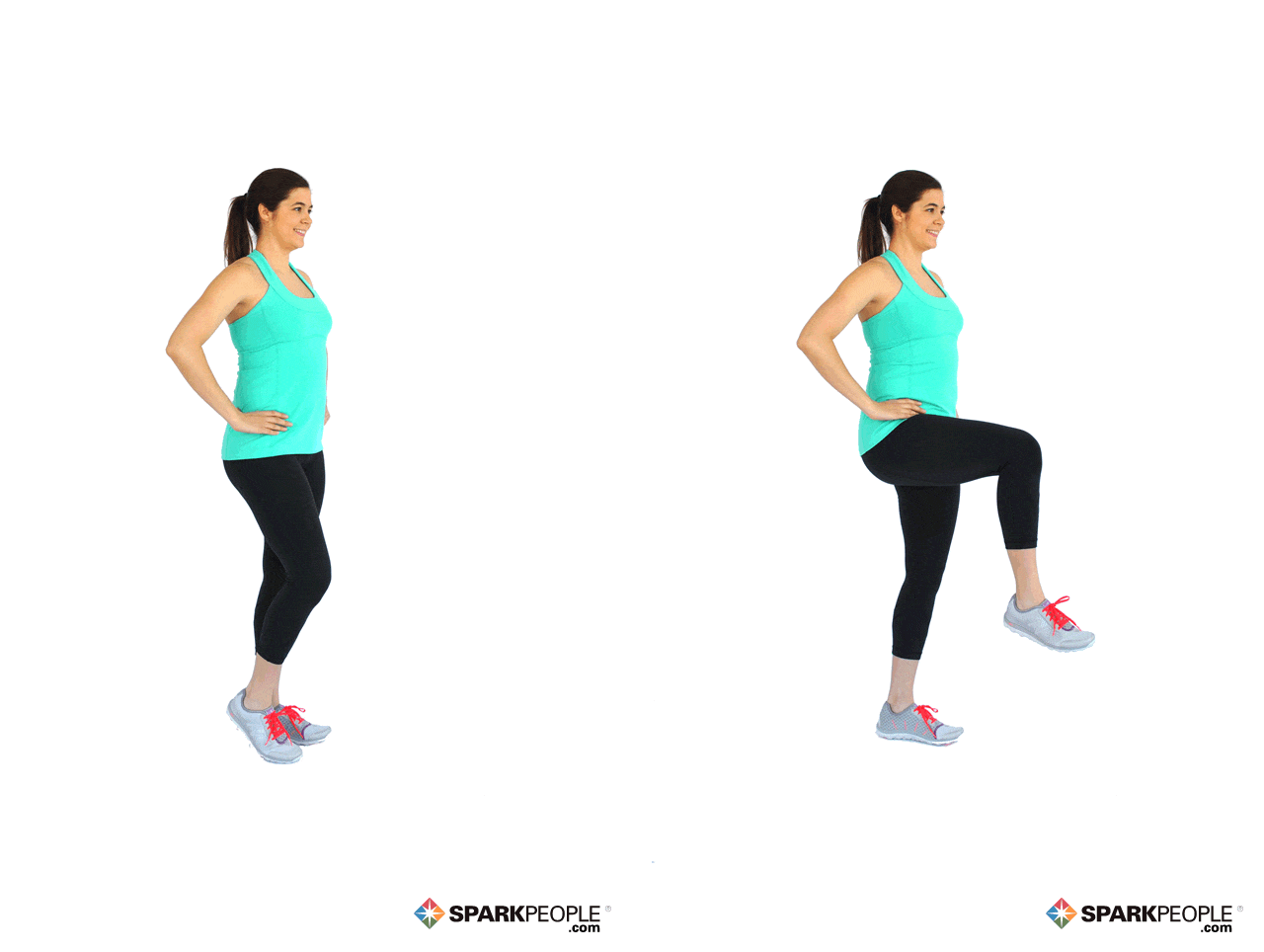
To perform this exercise start by standing upright and raising one knee to the height of your hip at a 90-degree angle. Squeeze your glutes to help you stabilize at the top. Hold that contraction for 5-10 seconds and lower your leg and repeat. This strength exercise targets your hip flexors, glutes, core, calves and the muscles of your feet.


Standing hip abduction.

To perform this exercise start by standing upright and shifting your weight to one leg. Slowly lift the opposite leg off the floor away from your body keeping the leg fully extended and the toes flexed. Make sure your toes are pointed ahead at all times to prevent your hip from externally rotating. The muscle primarily targets the hip abductor muscles located on the outside of the hip. This helps to promote strength and stability in the hip when walking or running.


Basic strength exercises for beginners with weak quads or hamstrings and glutes.

Lying glute bridges.

To perform this exercise start by lying flat on your back with your legs bent at 90 degrees and feet planted on the floor. Pull your pelvis into a neutral position by contracting your core and pulling your navel in towards your spine. From this position contract your glutes and lift your hips towards the ceiling. This exercise targets your erector spinae, transverse abdominis, glute medius and minimus (abductors), hamstrings and adductors.

Wall sits.

To perform this exercise start by standing upright with your feet shoulder-width apart and about 1 foot from the wall. Bring your back and shoulders against the wall and lower your body against the wall until your knees are at or near 90 degrees from your hips. Keeping your back, shoulders, arms and head against the wall hold this contraction for 10-15 seconds. Then release and repeat. This exercise targets your glutes, quadriceps, hamstrings and calves.

Strength exercises should improve function

Regardless of whether you are a beginner or experienced, strength training should always aim to improve your body’s function. When approached in this way, strength training can protect you against injury, heal muscular imbalances, improve your mobility, reduce your musculoskeletal aches and pains and greatly enhance your quality of life. The best part of all is it’s easy to get started. You can start off strength training from home without the need of any equipment. 

9 Most common workout mistakes & how you can avoid them

Workout mistakes may be hindering your progress

If you find yourself getting frustrated that you’re not seeing the results you desire from your training chances are there is something you’re doing wrong. Oftentimes people will jump into a new exercise routine without first assessing themselves to avoid any common workout mistakes. If you don’t know what you’re doing you can hinder your progress and even put yourself at risk for injury or set-backs.

9 Common workout mistakes to avoid

To figure out what you’re doing wrong check to see if any of these common workout mistakes apply to you:

  1. Inconsistency in your training. One of the most important factors in seeing results is maintaining consistency with your program. If you have a tendency to frequently start and stop a program or only periodically train you’re going to be hard-pressed to see progress. Without consistency, your body can’t adapt and master new skill-sets, which is what allows you to gain foot ground in your program. The more consistent you train per week the more volume you gain over time. This is what leads to progress. Ideally, you should aim to train at least 2-3x per week to gain the most benefits. However, it’s more important to train at a consistency you can maintain even if it’s only 1x per week. 

  1. Overtraining. Overtraining can lead to burn-out and injury. If you are seeing declines in your performance or if your muscle soreness recovery seems to linger chances are you are overtraining. To avoid overtraining schedule rest days in between your workouts and don’t do too much too quickly. When you put excessive demands on your body it could lead to muscle strain or injury.

  2. Improper form. If you’re doing an exercise with the improper form you risk targeting unintended muscles and putting your body in a compromised position. This can lead to injury. If you aren’t engaging the muscle correctly you’re not gaining the full benefit of the exercise. Always check yourself in the mirror or film yourself to ensure your form is correct.

  3. Not doing enough strength training. Strength training is important for improving motor skills, your body composition, your joint health, metabolism, muscular strength and endurance and more. By not following a consistent strength training program you are missing out on these many benefits to your health.

  1. Poor nutrition. It’s important to note that while exercise is key for making progress you are doing yourself a disservice if you aren’t also incorporating a well-balanced macro-friendly diet. No matter how hard you train, you can never outperform a bad diet. Calorie consumption is equally important here as it aids in having an optimal metabolism, which we break-down for you under our nutrition guide.

  2. Not progressing in your program. If you have been doing the same workout routine for weeks or months on end without adjusting your rep scheme, your level of resistance or exercise routine you have probably plateaued by now. Your body responds and adapts quickly to a consistent exercise program so it’s important that you make your exercises more demanding overtime. This forces your body to get stronger as it adapts to these new demands.

  3. Not incorporating a good stretching and mobility routine. Active and passive stretching is important for improving your ability to move each muscle through its full range of motion. Moving the muscle and joint through a full range of motion helps prevent injury and allow for maximum recruitment of muscle fibers. This allows you to train more efficiently.

  4. Not sleeping enough. Sleep is when your body recovers. When you’re not getting enough uninterrupted hours of rest per night it puts added stress on the body. Your muscles can’t build back up stronger if they haven’t first had the chance to recover. Lack of sleep can also contribute to joint pain and stiffness.

  5. Doing too much too soon. Always aim to master the basics in your program first. Start with building your foundation. Training calisthenics is important for understanding proper form and being able to manage your body weight in space. Bodyweight training teaches you coordination, balance, proprioception and self awareness.

Other key points to remember when training

If you’re avoiding all these common workout mistakes and still struggling to see results keep in mind results take time. Set realistic expectations for yourself. Give yourself at least 4-6 weeks following a consistent weekly program before you start evaluating any changes happening to your body. 

If you have hefty goals like to lose 40 lbs or being able to do an unassisted pull-up you should be thinking long-term. With long-term goals reevaluate yourself in 6 months. Real change does not happen overnight. Be patient with yourself and learn to trust the process. You should also keep in mind that success is not linear. Expect to face set-backs. This is a fact of life. The more you can enjoy the journey the more success you will find in the long run.

Hire a professional to help

If you are questioning whether you’re effectively avoiding these common workout mistakes you should seek help from a professional. Our certified trainers are equipped to design a program specifically to fit your needs. We are here to guide you through each workout to make sure you’re executing each exercise correctly. We also serve as your accountability partner. Having our support and expertise will help set you up for success and take the guesswork out of the equation for you. If you are interested in learning more about our services contact us today for a free phone consultation. 

Deadlifts for beginners: Benefits, Techniques, and Tips!

Deadlifts for beginners: Using proper form and technique

A very common exercise that’s enjoyed by many in the fitness world is the deadlift.
Unfortunately, if performed poorly, the heavy weight and sheer force necessary for
this exercise poses a great threat of injury.

Do you know how to protect yourself by having a proper deadlifting form? When
using this compound exercise, learning a few primary deadlift tips and tricks will
help keep you safer while lifting more.

Benefits of the deadlift

Have you ever wondered what makes deadlifts such an important exercise? 
This is due to the fact that it’s a compound workout and therefore almost every
muscle in the body is used during it. Throughout the lift your arms, forearms, and grip help keep the bar secure and in place. Moreover, your core and back keep your
body tight and stable while also securing your spine.

Did you know an exercise that utilizes many muscles all at once achieves a higher
degree of calorie burning and fat loss? This is because these kinds of workouts take
a lot more energy to execute.

Another (not so) fun fact is that back pain is the main cause of injury in Americans of all ages. Fortunately, deadlifts are perfect for improving the muscles of your posterior chain and back

Executing a deadlift

If we know form is imperative to deadlifting safely what does this look like? Let’s go over the different steps so you have a better idea. First, you should know you can use either a barball or kettlebell to perform this exercise. To get started:

  • Stand with your feet beneath the bar and shoulder-width apart.
  • Grab the bar with your preferred grip just further than shoulder-width apart.
  • Bend your legs forward until the bar reaches your shins.
  • Straighten the lower back while keeping your shoulders and chest up.
  • Power through with your legs and raise the bar off the ground.
  • Pause at the top by locking your hips and ankles
  • Return to the ground by moving your hips back and simultaneously bending your
    knees.

This is a very simple description but it is a perfect starting point for any beginner. You can see these steps demonstrated in this deadlift video tutorial. 

You should begin by only practicing your form. Improving technique is the easiest way for you to boost your skills and the amount you can deadlift. Once you are familiar with the deadlift form you should start applying more weight slowly. Another way to make this movement more challenging is to check out this deadlift progression video with 7 different deadlift variations.

Deadlift checklist

Below are some great cues you can use to remind yourself of the proper form and
improve your technique:

  • The barbell or kettlebell should be held with your palms facing towards your body and in a vertical, straight line when looking from the side.
  • The barbell or kettlebell should return to the floor and, after every rep, be over the center of your foot
  • Your feet should be fully planted on the floor at an angle of 15-20 degrees.
  • Grip is a personal choice, however, your thumbs should be curling around the bar to help with grip strength
  • You should never bend your elbows, always try to keep them straight and locked
    out
  • To eliminate rounding in the lower back, you should keep your chest up.
  • There should be a natural inward curve in your lower back and no unnecessary
    outward rounding.
  • Your shoulder blades should be above the bar and relaxed.
  • Your hips should remain above parallel at all times.
  • Before the lift, you should take a deep breath, keep it at the top, and exhale again at the bottom.
  •  It should be a seamless flowing motion to lift the bar off the ground. 

When I’m in the gym I usually go over this like a checklist. This will help keep your form on track and allow you to see where you can improve

Usual problems with the deadlift

Scraping of the knees

Excessive scraping to the shins is one of the key concerns that I typically see from beginners’ deadlifting with a barbell. The bar scraping the shins is a typical (and uncomfortable) concern that immediately turns many individuals away from the exercise. Luckily, something like a high and padded deadlift sock might be enough protection from the bar, however, if the problem persists there are a few simple ways you can easily fix this further. 

  • Pulling the bar backward and not upwards is the first and most common
    explanation for this problem. You should be moving the bar directly vertical from a side view. If you’re having issues with this during your workout, the reason is probably that you’re rocking back or raising your chest and shoulders too quickly. Remind yourself that only once the bar is raised off the ground should your shoulders and chest begin their movement upwards.
  • Beginning with your hips too low is a second frequent error in beginners. This is an issue because dropping your hips will force your knees to be pushed forward.
    If this is the case, your knees and shin will then be in the way of the bar, allowing it
    to scratch upwards on its course to the top.There’s a pretty quick solution to this, just pull your butt and chest up and remind yourself that your hips can never break below parallel. 

A back that’s rounded and arched

Having a rounded or arched back is another typical error I see beginners make.
Rounding the back will quickly lead to spinal disc herniation and bulges, as Dr.
Stuart McGill has reported. This is something that you desperately don’t want to

happen. 

Well, then how can you fix a rounded back? The secret to this is tension and a good set up from the start. The best way to have more spinal stability and to avoid an arched back is by engaging the lats more. Some people believe the proper way to accomplish this back tightness is to pinch the shoulders. This is not the case, since the distance that the bar would have to move would consequently increase.

Instead, before taking the bar off the ground, I normally recommend you take the
“slack” out of it. This will help to fully engage the back and lats from the start. Don’t
forget to also keep that chest up and over the bar!
 

Lack of grip strength

The third most common issue people have is a lack of grip strength. Because
deadlifts are a heavy compound exercise it can be difficult on your hands to lift the bar off the ground. The knurling of the bar can lead to nasty tears and cuts. If this is something you suffer from I suggest you invest in some lifting gloves or hand grips when completing a deadlift. This will help protect your hands from those cuts, tears and even infections. These work by adding an extra layer of protection between your skin and the bar. As a result, this improves your grip and wrist support by relieving the pressure exerted on your hands.

Deadlifts are one of the perfect exercises for building strength

For any beginner, deadlifts are the perfect exercise since it works just about every single major muscle group in the body that helps in building strength. There’s a reason it’s one of the main powerlifting exercises done by people all around the world!

Just remember to start slow and focus on that form, the heavy weight and big gains
can come after you master the basics!

This article was written by, Josh Lafond, the owner and operator of healthygymhabits. After receiving his PT certification in 2014 he became a personal trainer at his local gym. Since then Josh has been bettering his understanding of fitness to help others achieve their health goals online and in person.

Stretching exercises for lower back pain

Understanding the root causes of back pain

Before we jump into stretching exercises for lower back pain we first need to understand the root causes. Lower back pain is a common problem that plagues adults of all ages. An estimated 85 percent of all American adults will experience some form of back pain during their lifetime. Americans spend a staggering $50 billion each year to treat and prevent lower back pain, which shows people are desperate for solutions.

There are many underlying causes, but a sedentary lifestyle is at the top of the list. Other common causes include:

  • genetics
  • a fall or injury
  • being overweight
  • too much repetition in the same movement pattern
  • degenerative problems, which often occurs in aging
  • mental health as anxiety and depression can influence our perception of pain
  • job-related factors such as heavy lifting, pulling or pushing or sitting at a desk for long hours

Although we can’t control all of these risk factors, back pain is more common among people who are not physically fit. When you have weak back and abdominal muscles it can not properly support the spine. Making moderate physical activity a daily habit can have lasting effects on the integrity of your back.

Stretches & exercises to relieve lower back pain

Stretching is an important component of any exercise program. In many cases, back pain can be relieved through consistent basic stretches. These stretching exercises for lower back pain are for beginners and should be done every day for optimal results. 

Spend at least 1-2 minutes in each position. Repeat each movement 3 times before moving onto the next one. It’s best to do these stretches first thing in the morning to start your day and at least once during the afternoon if you’ve been sitting a lot. 

Here are 5 beginners back stretches for lower back pain that you should be doing:

HALF LOTUS TWIST
COBRA
STANDING BACK BEND
CHILD'S POSE
DOWNWARD-FACING DOG
There are also beginner exercises you can do to improve posture and strengthen your core and back. These exercises can be done at anytime of the day you prefer. You should start to see noticeable changes within just a few weeks.
 

Here are 5 beginners lower back exercises you should be doing:

BRIDGE
BIRD DOG
V-UP
PLANK
SUPERMAN

How posture can improve back pain

Most of us are guilty of having poor posture by slouching while sitting or standing. This causes the loads on your spine to disperse incorrectly, weakening the tissues in your lower back. Over time bad posture can lead to chronic back pain by causing damage to the muscles, joints and ligaments of the lower back.  Chronic back pain is hard to reverse. To avoid this you need to become more aware of your posture by checking your form while you’re sitting and standing. 

When you’re SITTING make sure your neck is not jetting forward, your shoulders are not rounded forward and that your feet are both planted firmly on the floor. While STANDING you’ll want to engage your core and keep your hips tucked under you to minimize the curve in your lower back. This will help to ensure your body is in alignment and you’re not putting unnecessary strain on your lower back.

Additional measures for relieving lower back pain

If these corrective exercises and stretches are not helping to relieve your lower back pain it is important to get examined by a professional to see what may be the root cause. A doctor can take x-rays on your back to see the health of your spine. You can also get a bone density test done to see if you are at risk for osteoporosis. A chiropractor can perform safe adjustments on you if they notice your back pain is caused by a misalignment of your hips for example. 

Finally, acupuncture which acts by stimulating the central nervous system may be a reliable treatment option. By triggering the release of chemicals into the muscles, spinal cord and brain acupuncture can alter the experience of pain promoting a sense of well-being.

Other treatment options include:

  • Investing in a firmer mattress.
  • Alternating the  application of heat and cold packs.
  • Checking that where you are sitting provides enough back support.
  • Getting a massage regularly to help ease up tension you may be  carrying in your back.
  • Turmeric and willow bark are natural herbs you can take for alleviating back pain as they both contain anti-inflammatory properties.

Back pain is a common pain point you shouldn’t have to live with it. By adjusting your lifestyle and implementing some of these stretching exercises for lower back pain and treatment options you can reduce and even eliminate back pain all together! 

If you are facing any difficulty in understanding or performing any of these exercises or stretches then reaching out to a personal trainer might be in your best interest so you can receive professional guidance. We have a team of trainers always ready to help!

At home workout routine: Why you should keep a routine during Covid-19 outbreak

Replace the GYM with a home workout routine

Working out in a gym is not possible right now due to the risks involved with the spread of the COVID-19 virus. Sharing gym equipment increases the likelihood of contracting and spreading the virus. However, there’s NO reason why you can’t keep your workout routine going indoors from the safety of your home. The more we can maintain our daily routine the more we can create a sense of normalcy during these trying times.

You can easily replace most of the machines and equipment you would normally use in the gym with light weight resistance bands and free weights from home. You can even get creative and incorporate water jugs, towels, and furniture if you don’t have any equipment. In our 10-minute home workout we show you how you can workout using just your own body weight.

With no equipment or any special workout attire necessary and so many options for virtual training you don’t have an excuse to miss a workout. You can choose to have a personalized workout from a virtual trainer, a streamed live workout or you can watch a preloaded workout video on YouTube. Many workout classes that were offered in person prior to the pandemic are making their classes available online as well!

Pick what works best for your needs.

Skipping workouts could set you back

Exercise is vital to your health and especially important to building immunity against this pandemic outbreak. According to leading physiologists from the University of Bath’s Department of Health, “exercise can help the immune system find and deal with pathogens, and in the long term, regular exercise slows down changes that happen to the immune system with ageing, therefore reducing the risk of infections.”

Psychological stress and mental health is also better managed through exercise, which has a positive effect on your mood. Serotonin levels are boosted and feel-good endorphins are released through regular exercise.

Skipping your workouts now could also set you back on the progress you made in the gym. It doesn’t take long for muscles to start to atrophy without use. This leads to the onset of other ailments like back and joint pain.

Consistency is important for any kind of progress, but also to maintain what you already attained.

Other healthy habits to make part of your fitness routine

There are many ways one can try adopting & making a switch towards healthy habits without sticking to any rigid diet plan. Some healthy habits that you can start with:

  • You can boost your immunity by eating a diet high in fruits and vegetables. The more leafy greens the better! Try to also eat some of your vegetables raw so you don’t lose any of the nutritional benefits. A nutritious diet coupled with exercise can help you better maintain a healthy weight.
  • You should also make sure you’re getting enough quality sleep as this can also put stress on the body.
  • Make sure you’re LIMITING your consumption of alcohol and processed foods.

Following these healthy lifestyle habits won’t just help boost your immunity against disease and infection, they will also help keep your body strong for a better quality of life.

These factors help reduce your biological age slowing the aging process.

Routine is good for the psyche

As much as our lives seem uprooted right now it’s important to maintain some sense of normalcy. We can do this by holding onto the routines in our lives that we can still control.

Exercise is one of them!

Keeping up with our exercise routine will help us form new healthy habits. This routine will also help us:

  • better cope with the changes we are experiencing.
  • create order in our lives, which also helps us mange stress, anxiety, depression and even insomnia.

Establishing a routine on a personal level can also help with forming routines on a professional and relationship level. This will make your work environment healthier and the added strain on families forced to spend an unprecedented amount of time together easier.

Home exercise: 10-Minute quick lockdown workout you can do at home

Staying fit while stuck at home

Times have changed during this time of social distancing, due to the COVID-19 crisis, including how we workout. But just because you can’t get to the gym doesn’t mean your workout routine needs to suffer. Now that we are all stuck at home ideally we have more free time on our hands, but that’s not always the case when you’re juggling a demanding work schedule, a house full of kids and also playing homemaker. We’re here to show you how you can get an effective and efficient workout at home in just 10 minutes.

YES! In Just-10-Minutes..

By doing a 10-minute workout a day you can walk away feeling energized, motivated and satisfied that you’re doing something good for your body and your health. These 10 minutes of exercise are great to do first thing in the morning to kick-start your day, mid-day when you’re feeling sluggish or just before bed when you have fewer interruptions.

Home exercise complete with quick 10 minute workout

We recently teamed up with Chasing News to share our 10 minute home workout with viewers on Fox5 and NY9 and now we are sharing it here with you. We brainstormed and came up with 8 of the most effective total-body exercises that are practical for everyone. Whether you are a beginner, a seasoned gym-goer, pregnant or postpartum these exercises are simple enough for you to do.

There’s no excuse not to do this 10 minute at-home workout plan because it doesn’t even require any gym equipment. All you’ll need is a chair and yourself.

Yup! It’s that simple.

At home workout plan without equipment

This workout is effective at promoting strength, coordination and mobility development. If you do these exercises daily you will get stronger over time and you can gradually increase the intensity by adding more reps, more sets or increasing your pace.

Why CHAIR DIPS is the best:

To perform Chair dips, all you need is a sturdy chair or bench or even a staircase. Make sure your arms are at your sides gripping the front of the chair, bench or stair, and your feet are firmly planted on the floor shoulder-width apart. Shift your torso forward off the chair keeping your hips directly underneath you and slowly lower your butt towards the floor as you bend at the elbow. As you lower make sure your hips stay directly underneath your shoulders. Inhale as you lower and exhale as you come back up extending the arms to your starting position.

Complete this exercise for 10-15 reps and then repeat this set 2x. You can work your way up to doing more repetitions or sets as you build strength.

Takeaways –

Chair dips engage your –

  • triceps (back of your upper arm),
  • pectoralis major (pecs or chest muscles),
  • trapezius (triangular muscle extending from the neck to the shoulder to the middle back), and
  • serratus anterior (the muscle on the surface of the upper eight or nine ribs).

Most people don’t realize the triceps are important muscles used in everyday movement that involves extending the elbow and forearm. You use them when lifting things like grocery bags or when reaching for items overhead. This muscle also plays an important role in stabilizing the shoulder joint.

Tone your abs with LYING LEG RAISE:

Lying double leg raise with butt lift exercise starts with lying on your back with your feet up towards the ceiling. You can place your hands under the small of your back for support. Lower your straight legs towards the floor and then raise back up to the starting position adding in a butt lift and hip rotation at the top.

Repeat this exercise for 10-15 reps or until you become fatigued and repeat for 2 more sets.

Takeaways-

This exercise is great for building core strength in your rectus abdominis muscle and the internal and external oblique muscles. Leg raises also improves the strength and flexibility of your hips and lower back.

KNEELING SIDE CRUNCH for a flat belly:

You start in a kneeling modified side plank with your top leg extended away from the body. Your bottom are should be straight and your top arm should be behind your head. Bring your top elbow and top knee in towards your torso to meet and then extend the leg back out straight opening up the contraction.

Repeat this exercise for at least 15 repetitions on each side and then do 2 more sets.

Takeaways-

Kneeling side crunch exercise uses just your body and it mainly targets your core specifically your obliques. Your shoulders and glutes are also assisting so again this is a compound movement. Your core is your entire support system. Core strength is important in everything you do so it’s important to start here in your workouts.

Improving LATERAL LUNGES:

To perform lateral lunges exercise, stand with feet together and hands clasped together at your chest. Take a large step out to the right, immediately lowering into a lunge, sinking hips back and bending right knee to track directly in line with right foot.  Keep left leg straight but not locked, with both feet pointing forward. Push off the right foot to return to starting position.

Repeat on both legs. Do 10-15 reps on each leg for 3 sets.

Takeaways-

This exercise targets your glutes and legs and it helps improve your mobility in the frontal plane of motion (moving side to side). The side lunge also helps you build strength and stability in each leg individually as well as improve your balance.

DEAD BUGS are good:

Lie on your back with your arms and legs extended up towards the ceiling. Bend your knees and hips to a 90-degreeangle. Tighten your abs and press your lower back into the floor as you bring your left arm overhead and right leg down towards the floor.

Exhale as you lower and inhale as you raise being careful not to let your lower back arch.

Takeaways-

Dead bugs target your abs, back, shoulders and hips. By activating the deep abdominal muscles, the transverse abdominals and pelvic floor, this exercise helps stabilize the lower spine to reduce the risk of back strain. Doing this exercise also improves your motor skills and coordination. Plus, it helps with a wide range of motions, such as lifting and bending in everyday activities.

Combating poor posture with SEATED WALL ANGELS:

This exercise can be done against the wall either sitting or standing. You can also do it while lying on your back on the floor. To perform this exercise bring your hands up by your ears. While keeping your wrists and elbows in contact with the wall or floor slowly elevate your arms overhead as far as you can and then return to the starting position.

Repeat this exercise for 10-15 reps.

Takeaways-

Seated wall angels help in correcting bad posture by strengthening your shoulder mobility and back muscles while also opening up your tight chest muscles. It helps treat upper-crossed syndrome common in people who sit at a desk or computer for long periods of time.

SIT TO STAND to improve mobility:

Stand with your feet shoulder-width apart and with your arms behind your head. Lower yourself slowly into a chair keeping your back upright. Rest your butt into the chair and push your weight into your heels to come back up to a stand. You can make this exercise harder by sitting on an exercise ball instead of a chair or placing a small object between your legs.

Perform this exercise 15-10 times for 3 sets.

Takeaways-

Sit to stand helps strengthen your legs, glutes, and core. It’s a functional movement that promotes balance to prevent backward falls and helps with posture. When practiced regularly this exercise helps improve scores on the Berg Balance Scale, a test that measures balance and fall risk in older adults.

Mastering the PRONE T-RAISE FLOOR PUSH-UPS:

To perform Prone t-raise floor push-ups start in a straight arm plank position. With your elbows touched into your sides lower your body slowly to the floor. Then extend your arms out to your sides. Elevate your arms and legs off the floor for a beat and then lower and press back up into the plank.

Repeat this exercise 10 times for 3 sets.

Takeaways-

This two-part exercise targets the erector spinae and latissimus dorsi muscles in your back as well as your oblique, transverse abdominis, rectus abdominis, glutes, hamstrings, pecs, triceps and rear delts.

How to enroll in our virtual training

If you feel this routine might be too basic for you, I would suggest scheduling a 10-minute call with us because we are here to help!

As certified in-home personal trainers in NYC with years of experience, we are now offering customized virtual workouts to our clients. Unlike online training where you’re given a program to follow, with virtual training you still get the same one on one attention you would get in person and a tailored program to fit your needs.

 And the best part is..

To make it more affordable, we can also train you and your FRIENDS or FAMILY together using the Zoom gallery and you can take advantage of our special savings. Contact us today to learn more and get started!


Ready to connect with us?