5 things to consider before hiring a personal trainer in NYC

Is hiring a personal trainer worth it?

NYC is a bit more of a health-conscious city which means you have lot of options available to you from gyms to classes to help you on your fitness journey. However, nothing compares to having a personalized fitness and nutrition coach to design a program to help you meet your goals. The one on one attention you receive with a personal trainer not only helps to hold you accountable it also ensures you’re executing the exercises correctly and that you’re making measurable sustainable progress.

However, trainers are not all created equal. Like with most services you get what you pay for. A top tier trainer comes at a premium because they must be certified by an accredited source such as American Council on Exercise, have years of experience and continuing education, a solid reputation, an approach that has been proven successful, specialties in different areas of fitness and the personality to keep you engaged. When you invest in the right trainer who meets this criteria and is compatible with your specific needs you get real sustainable results.

Whether you decide to invest in a trainer for a few months or for years to come you can make improvements in your health to last a lifetime.

How to find the right personal trainer in New York City

New York City has more personal fitness trainers per square mile than any other city in the country so it can be hard to choose the right one for you. To help you narrow your focus first decide if you feel more comfortable working with a male or female trainer or if you have no preference. We have a team of both male and female trainers skilled in different areas.

With so many different styles of trainers, it’s important to find one that specializes in your needs so you’ll want to do a search in your area based on what your goals are. We specialize in many areas of fitness including weight loss, strength training and pre and post-natal training.

You’ll also need to decide on what location is best for you. We have trainers based all over the city so that we can service clients in Manhattan, Brooklyn and Queens.
 
Availability is another crucial factor. You’ll want to find a personal trainer that can meet you on the days and times that are convenient for you.

How to track your progress

One of the best ways to measure the success of a personal training program aside from meeting personal standards is to have tangible ways to track progress.

One way, of course, is to use the scale, but as we know this number isn’t always reliable since muscle weighs as much as fat and some days we may be retaining more water than others.

A better more positive way to track progress is with pictures!

We recommend our clients take pictures before starting our program and then we do a progress update with pictures every few months. This way you can pay attention to the subtle often unnoticed changes that happen gradually over time when you adopt a diet and exercise plan.

You can also track through exercise by monitoring your improvement in form, strength, speed and overall performance.

Choosing a trainer you look up to

It’s important that you work with a personal trainer that embodies the skills and physical attributes that you aspire to. This way you can trust that their program works and that they practice what they preach. Your trainer shouldn’t give you any exercise program or diet guidelines that they aren’t willing to do themselves. When we are in the company of someone we aspire to be like we subconsciously push ourselves to work harder. We are also more inclined to make better lifestyle choices when we see our trainer leading by example.

Home training vs training in a gym

In NYC you have the option of working with a personal trainer out of a gym or at your home. The benefit of training at a gym is that the trainers are already vetted for you. However, since many apartment buildings in NYC are equipped with a gym having a trainer come to you may be more appealing. This way you have the added convenience of not having to travel anywhere. You also get to select a trainer of your choice. This does require a little extra leg work as you’ll need to do your own research as mentioned above to find the right fit, but chances are since you’re the one choosing you’ll be more satisfied in the end.

Beginner’s workout plan for a busy schedule!

Where to start with a workout plan

Working out doesn’t have to be complex, complicated nor time-consuming. You just have to establish a workout plan that you can stick to consistently even when you aren’t feeling motivated. A good way to carry out this easy workout plan for beginners  is to follow these simple tips:

  • Establish a good time of day to workout that fits with your schedule and when your energy level is at its highest – If you are like me and aren’t a morning person pick a time in the afternoon or evening after work. If your schedule gets more chaotic as the day progresses an earlier time in the day may be best for you. A lunch hour workout may be good if you like the idea of breaking up your work day with some self-care.
  • Figure out what your goals are so you can follow a fitness program that will help you target them – If your goal is to lose weight your workout will look different then if your goal is to put on muscle. Maybe your goal is simply to move more and that is okay too.
  • Find someone to hold you accountable – When you’re feeling like the couch is looking more appealing than the gym you need that person who is going to call you out and remind you about your fitness goals. This person could be a friend, your partner or even a co-worker. You can even have this person workout with you so you have a buddy to help push you to work harder.
  • Upgrade your workout attire – If it’s been awhile since you worked out chances are your gym clothes could use some updating. Make sure you’re not wearing the best clothes to the office and scrubs to the gym. When you look good in what you’re wearing to the gym your confidence gets a nice boost and you’re more motivated to workout harder.

Workout routine for beginners

You can establish and try a workout routine for a week with a few easy yet effective exercises that don’t require any machines or equipment. These exercises can be consistently incorporated into any workout routine at home.

For strength training try these exercises:

  • Planks are a great exercise to include in your workout routine at home because they target your total body including your core and you can do lots of variations.
  • Lunges are a good lower body exercise to do because it is a compound movement, which means multiple muscles are engaged at once. You can also mix it up when you get bored by trying different variations including curtsy lunges.
  • Squats are another great lower body compound movement with lots of variations.
  • Push-ups everyone is familiar with and this exercise is great for your upper body workout.

If your focus is on cardio try these calisthenics moves:

  • mountain climbers
  • step-ups
  • jumping jacks
  • jump squats

For either goal you should aim to complete at least 10-15 reps of each exercise and then recover for up to one minute before then repeating the circuit again. If you have the time, repeat the circuit 3x. If it’s your first time, see if you can complete the circuit once fully and gradually over time work yourself up to three sets.

A good way to combine these exercises into a workout routine for beginners is to choose 2-3 lower body exercises, 2-3 upper body exercises and 2-3 core exercises and perform them in a circuit. As mentioned above you can go for 10-15 reps or if you have a stopwatch you can go for time instead. If you’re going for time push yourself for 30-45 seconds followed by a 15-30 second rest or recovery period. Then repeat with the next exercise.

This way you get a solid total body workout in as little as 15-30 minutes.

Workout routine at home when you're short on time

If you have small children at home or if you work from home you may find it hard to designate a certain time to exercise. A good way to workout with a busy schedule is to incorporate exercise into your normal everyday activities. For example:

  • You can be doing squats while you’re putting the laundry or dishes away. Squat before each time you pick-up the clothes or dishes.
  • Practice lunging while you’re running the vacuum.
  • If you are on mommy or daddy duty you can do shoulder overhead raises with your child in your arms or squats and lunges while holding them. Older children love to partake in exercise with mommy and daddy. You can do a yoga routine while teaching them how to do it with you so it becomes a family activity.
  • When you’re sitting at your desk for long periods of times incorporate a few sit and stands from your desk chair. You can also do a plank or triceps dips on your desk chair while you’re reading your emails.

There are lots of creative ways like these to incorporate exercise in the home each day. 

How often should beginners workout

When you’re new to exercise any bit counts. Don’t put pressure on yourself right away to workout a certain amount of times each week. Start with what is manageable for you and your schedule. Also, listen to your body and don’t overdo it.

As you get into a regular routine it’s most optimal to workout a minimum of twice per week and three times per week is even better! Your sessions don’t have to be an hour long each time. A very effective workout can be done in as little as 30 minutes. The key is to limit the amount of rest you take in between exercises.

It is NOT advised that you do strenuous exercise everyday. Your body needs time to recover in between workouts. However, getting in the habit of moving everyday is recommended. This could mean going for a walk or taking the stairs more often. It means instead of sitting at your desk for 8 hours straight you take breaks periodically to get up and walk around and stretch.

Posture can be improved to alleviate chronic pain

Fix Your Posture To Alleviate Chronic Pain

Correcting bad posture habits

We all are guilty of slouching when we sit, walk and even stand which promote bad posture. However, most of us aren’t even aware we are doing this. Most of us lack self-awareness of how we move throughout our day. Poor posture has been linked to back pain as a main cause. Breaking bad posture habits requires us to check in with ourselves and observe what proper posture looks and feels like.

Having good posture always looks better and it also affects both our health and our state of mind. Let’s look at some proper postures:

Proper Standing Posture:

We can do this by observing ourselves in a mirror. Good posture means we pull our head back and our shoulders down and back. You should feel as if you’re sticking out your chest if you’re standing correctly.

Proper Sitting Posture:

We can also practice sitting all the way back in our chairs. By doing so we should be able to keep our feet flat centering our weight over our buttocks and pubic bone. This will ensure we’re in the proper alignment. If we’re in a car or sitting against a soft service using a lumbar support pillow under our lower back helps alleviate discomfort.

Proper Lifting Posture:

Paying attention to how we lift is also important. We should always practice lifting with our legs by squatting to get our bodies under the weight rather than hinging from the waist. We never want to pick-up something by rounding our backs. Our shoulders should always remain back and chest out.

We should also get out of the habit of carrying heavy loads on our backs as this creates a lot of added strain. The best method for transporting a load is by using a cross-body bag or a backpack to help distribute the weight more evenly.

High heels are another culprit for poor posture. They cause the entire weight of the body to shift forward towards the ball of the foot putting strain on the back and knees. We should opt for wedges and low heels under 2 inches instead.

Proper Sleeping Posture:

Sleep posture is an important factor to consider when improving bad posture habits. When we sleep on our side we should always put a pillow between our knees to stay in alignment. If you’re a back sleeper placing a pillow under the knees can help open up the joint spaces in the spine. We should try to avoid sleeping on our stomachs as this puts a strain on the neck and move towards a healthy sleeping position.

Effects on the body - How bad posture hurts your body

Bad posture doesn’t only affect your back. It can also:

  • lead to knee, hip, shoulder, pelvic and neck pain and arthritis
  • can hinder digestion and even cause headaches
  • disrupt your ability to concentrate and move efficiently
  • can interfere with your quality of sleep and even quality of life

Many people spend hundreds of dollars on chiropractors and massages to help reduce the persistent pain they feel from poor posture. However, this remedy is only a temporary fix. Until we take a proactive approach to correct our posture and practice good sitting, standing and lifting habits we will continue to suffer the repercussions of bad posture.

Identifying bad posture

Good posture can feel exaggerated or unnatural especially if you’re used to slouching. In order to identify whether your posture is good or bad, here are a few things you may want to try:

Correcting Standing Posture:

When you’re standing your body should be in alignment by keeping your head in a neutral position and your ears lined up with the middle of your shoulders. Both your upper and lower back should be upright. Many people with a weak core stand with their pelvis tilted forward. You should always keep your hips tucked under you minimizing the curve in your lower back. The illustration below from the Comprehensive Spine Institute best depicts what good and bad standing posture should look like.


Correcting Sitting Posture:

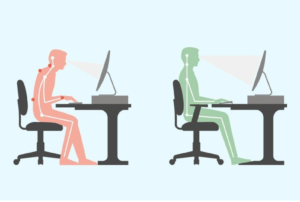
On average people spend 10 hours a day sitting, which is also taking a toll on our posture. The first thing you need to check is your computer, desk or work station. If your desk is not at the right eye level of the computer screen and your keyboard is not positioned the right distance from your chair you will slouch your shoulders jetting your neck forward, which is a sign of bad back posture. Check that your feet are resting flat on the floor and that your legs are not crossed. This ensures your weight is evenly distributed across both hips and feet. The illustration below is a good visual of the difference between good and bad sitting posture.

 
We can also use the wall test to help us identify bad posture. Start by standing with your head, shoulder blades and buttocks against the wall with your heels 2 to 4 inches from the wall. Bring your palms up by your ears so that your fingertips also touch the wall. Have someone place their palm behind your lower back against the wall. There should be just enough room for them to slide their hand between your lower back and wall. When there is too much space draw your belly button in towards your spine. If there is not enough space arch your back just enough for the hand to fit. In the event you don’t have someone to help you, practice using your own hand.
 
These simple tips can help you in identifying how to improve posture.

Exercises to improve posture

Now that you are aware of your bad posture there are some basic posture correction exercises you can do regularly to help correct it.

Back And Shoulder Exercises:

  1. The shoulder blade squeeze involves sitting upright in a chair with your hands resting on your thighs. Keeping your shoulders down slowly draw your shoulders back and squeeze your shoulder blades together. Hold here for a count of 5 and repeat several times. You can also try this exercise while lying flat on your stomach with your arms by your side and your thumbs pointed up towards the ceiling. All you have to do is practice drawing your shoulder blades together without lifting your head or feet off the ground.

  2. Wall angels are another exercise we do with our clients to help reverse bad posture. To do this stand with your back against the wall and your feet 2 to 4 inches from the wall. Bring your arms up by your ears so your elbows are bent and rest your palms, head, buttocks and shoulders against the wall. From here you can practice the shoulder squeeze exercise and then try straightening your elbows to raise your arms up over head forming the letter Y. Repeat this exercise 10 times for 2-3 sets.

  3. Using a resistance band you can also stand with your feet staggered with one foot in front. Place the band underneath your front foot and while holding the handles lift the resistance band upwards away from your body keeping your arms straight. Keep a slight bend in your elbows and hold here at shoulder height for a few seconds before repeating. Be sure to keep your shoulders down and back straight while doing this exercise. This is called the V-move.

Chest Exercises:

  1. To loosen your tight chest muscles, which often become restricted with bad posture try the doorway stretch. While standing in a doorway bend one elbow and lift your arm so that your elbow and shoulder are aligned. Place your hand at the edge of the doorway or on the corner of the wall and slowly lean into your raised arm so that your chest moves forward past the wall and hold for about 10 seconds. Repeat this several times on each side.

Hip Flexor Exercise:

  1. Tight hip flexors can also affect your posture. To stretch them start by kneeling on the floor with one foot planted and the opposite knee down. Place both hands on the right thigh and lean forward to feel a stretch in the hip flexors. You can also advance this stretch by bringing both palms on the inside of the front leg so that they are resting on the floor. The goal here is to get your shoulders in alignment with your front knee. Hold for 10 seconds and repeat several times on each side.

There are many yoga poses for correcting bad posture by stretching and training the back muscles to engage properly. Keeping your core strong and hips open also plays a part both of which yoga helps with.

Yoga + Stretching Does A Body Good

 A daily habit of stretching is not overrated. Most men and women suffer from hip pain due to tight hip flexors. Tight quads can often be mistaken for knee pain, and a lot of the back pain that plagues so many sedentary Americans is also attributed to tightness. I used to think I was prone to end up with a “bad back” as I get older because so many people in my family have back issues. I was even told by a doctor once that I am showing early signs of osteopenia. So I thought to myself, what can I do to prevent my back from failing me? Yoga became my solution. 

The first thing to go for many of us as we age is our posture and gradually we loose our range of motion. Yoga is a great way to correct this as it involves dynamic stretching; which uses movement and/or speed to gradually increase your range of motion. The key is not to rush. You want to steady yourself in each pose for about a minute to allow your muscles to relax allowing you to deepen the stretch. Adho Mukha Svanasana, better known as downward facing dog, is a great pose to start in for stretching your back and hamstrings and lengthening your spine by opening your shoulders, which over time will improve your posture. 

Tadasana, better known as mountain pose, is another pose to practice standing with correct alignment. Yoga.com describes the correct form for this pose, which starts by “standing with your feet about hip distance apart and parallel to each other, with your toes spread and pointing forward. Engage your calves and quads. Engage your core and slightly tuck your tailbone. Keep your shoulders wide and relaxed. Align your head so your chin is parallel to the floor, and the crown of your head is directly over the center of your pelvis. Raise your arms over your head, keeping them shoulder width apart. Be sure to keep your shoulders relaxed and down away from your ears. Hold for 1 minute.”

From here you can advance into Vrksasana, also known as tree pose. You start by shifting your weight onto one foot and elevating the opposite foot to place the sole of the foot on the calf or thigh of your standing leg. You will still need to have good posture to hold this pose. If your shoulders are slouched, as they are normally in everyday life, you would struggle keeping your balance because your body weight will be off center. 

Plank pose is another great position to practice holding because it will strengthen your core taking some of the stress off your spine. Often times, we slouch from having weak core muscles. The more we slouch the more restricted and tight our other muscles become.

Bhujangasana or cobra pose is a great segway from plank pose and it will work to gently “stretch the spine and open the chest reversing rounded shoulders and upper backs” (Yoga.com). 

You can also practice opening the chest and shoulder muscles by sinking into gomukhasana also known as cow face pose. Lengthening these muscles will improve your posture which will also release back pain. 

Anjaneyasana also known as crescent lunge is a great pose to help deepen your quad stretch. To do this pose you begin by kneeling on one knee. Gradually you shift your back leg further back to open up your hips and press deeper into your front knee so that your front knee is directly above your ankle.

From here you can go into virasana or hero pose, which is the practice of sitting in between your feet.

Dhanurasana also known as bow pose is great for stretching your quads and your back. Start by lying on your stomach and grabbing your feet or your ankles. Then, lift up raising your chest up towards the ceiling and trying to gently raise your thighs off the floor. Hold here for one minute.

The key here in doing each of these poses is to practice holding for as long as you can while breathing into the discomfort. This is a process that will take time, but by being diligent in your practice you will obtain amazing flexibility helping not only to alleviate joint and back pain, but also in injury prevention. 

Health conscious living

Being health conscious goes beyond just working out and eating a clean diet. The products we put on our skin and ingest through the air are also raising health concerns as many of them contain toxic ingredients. After I switched to buying mostly organic food (i.e. meat, eggs, and any produce where I consume the outer skin) I began looking more closely at the ingredients in my hair and skincare products. Before I knew it my entire household became mostly eco-friendly. All of my cleaning products, skin and hair care products are made with all natural ingredients and are paraben, phosphate and sulfate-free. There are many companies now offering clean products for the health conscious consumer. 

My personal favorite household brands are Method, Seventh Generation, Mrs. Meyers and The Honest Company. To prove that they are eco-friendly many of these companies provide a list of all the ingredients for each of their products, what these ingredients are and what they do on their website. Some like Method also use fun eco-friendly packaging, renewable energy and a biodiesel shipping program. Seventh Generation makes natural baby and feminine care products in addition to cleaning agents. Now many companies are joining the health craze and are going green. The GoodTrade has listed their top 12 picks so there’s plenty of options to choose from. 

When it comes to skincare I choose Natural Organic Coconut as my make-up remover and face moisturizer. I also apply Beauty By Earth all natural sunscreen on my face daily, which is free of parabens, phthalates, and nano-particles. My favorite body moisturizer C. Booth is cruelty-free, paraben and sulfate free and petroleum free. On my hair I use Deva Curl Supercream, which is paraben, lanolin, topical antibiotic and nickel free. I will be honest, I have not yet made the switch to organic make-up, but I do plan to in the near future.

Health conscious living has made me so much more aware of my habits and the amount of products I use and consume. I can’t buy anything now without first reading the label because it’s become such a habit now and I want to continue to educate myself. I think for so long we just trusted that the products on our shelves were safe for us to use since they are supposed to be FDA regulated and now we know that’s just not always the case. I realize it’s impossible to eliminate all toxins from our body, but I feel any bit we can do to be more green can enable us to better serve our health and our environment. 

Healthy habits that changed my life

Today I woke up congested with a head cold and for the last three nights I hadn’t gotten my usual 8 to 9 hours of sleep. Coincidence –I think not! I’ve gotten to understand my body very well and one thing I’ve always needed to feel and perform at my best is lots and lots of sleep. Up until this past week, I’ve made it a priority this year to get a full night’s rest consistently at all costs and as a result I have had my longest streak ever of not catching that pesky ol’ cold and flu that I’m normally so susceptible to. I dropped the ball this week by overloading my schedule with more clients, which cut down my sleep time and now sick is the price I pay. What people don’t realize is that sleep is most definitely not overrated. Each of those hours you are resting your body is actually using to repair itself. Every organ in your body has a repair/maintenance cycle during each hour of everyday. The liver, lungs, large intestine, stomach and spleen are all repairing themselves during the hours when we are supposed to be sleeping, which is why if your sleep cycle is disrupted you may wake up feeling bloated and achy.

Keeping a clear mental state has also become very important to me. I realize that if I’m feeling anxious, easily irritable and overwhelmed it inhibits my happiness. Meditation has become my calming agent. I try to meditate each morning for 20 minutes to set the day on a positive note. It allows me to quiet my mind and focus my attention on what I’m grateful for and positive affirmations. The more you fill your mind up with good thoughts the less you become effected by negative people and circumstances. Creating this space in my life has become a safe haven. It allows me to have a daily practice of self-care and self-love. It’s made me a more peaceful person and because of this I have so much more to give. And as the saying goes, “when you love life, it loves you right back.” 

I’ve found it so rewarding to have found my personal passion for fitness. Many people exercise to stay in shape, but when you find a physical outlet that you love it becomes therapeutic. Yoga for me has become that outlet. I enjoy lifting weights, but I love exploring what the body alone is capable of doing as can be seen in how I train my clients. It’s a true art form. The more disciplined, controlled and self-aware I am the more limitless I become. Meditation has really complimented my yoga practice because together they center on mind and body connection. This is a principal of exercise that I always strive to convey to my clients. The more you connect your mind with the physical form, the better you can execute.

Healthy habits don’t happen overnight. It’s something you have to nurture consistently, but the more you do the greater the impact you’ll see in your life.