Choosing the Best Prenatal Massage in Brooklyn: A Guide for Expectant Mothers

Prenatal Massage Brooklyn

Key Takeaways:

 
  • Personalized Prenatal Care: Every prenatal massage should be tailored to your unique needs during pregnancy.
  • Expert Therapists: Choose a service with skilled professionals trained in prenatal massage techniques.
  • Holistic Benefits: Prenatal massage offers physical relief, emotional support, and promotes overall well-being.
  • Safe Environment: Ensure the massage setting is comfortable and designed for expectant mothers.

Pregnancy is a transformative journey, often accompanied by physical discomforts and emotional stresses. 

From aching backs and sciatica to round ligament pain, expecting moms face numerous challenges throughout their pregnancy. 

Fortunately, prenatal massage emerges as a beacon of relief, offering a sanctuary of comfort and healing for expectant mothers.

In Brooklyn, a borough renowned for its wellness offerings, choosing the right prenatal massage service is crucial for ensuring both comfort and safety for you and your baby. 

A prenatal massage in Brooklyn offers far more than just relief from physical discomforts; it’s a nurturing experience that can soothe your senses and have a positive impact on your pregnancy journey, potentially aiding in the growth of your baby and contributing to a smoother delivery.

Understanding Prenatal Massage

choosing a prenatal massage service in Brooklyn

Prenatal massage is a specialized therapy designed to address the unique needs of expectant mothers. It’s like a special pamper session just for mamas-to-be, helping you say goodbye to stress and those uncomfortable pregnancy aches. 

It goes beyond mere relaxation, offering targeted relief for common pregnancy discomforts such as back pain, swollen ankles, and round ligament pain. More than just physical relief, prenatal massage can improve sleep quality, reduce stress and anxiety, and enhance body awareness.

The benefits of prenatal massage extend beyond immediate comfort. Regular sessions can potentially contribute to easier labor and delivery, help manage pregnancy-related depression, and even enhance your connection with your baby. It’s a holistic approach to prenatal care that supports both your physical and emotional well-being throughout your pregnancy journey.

What to Look for in a Prenatal Massage

When selecting a prenatal massage service in Brooklyn, there are several key factors to consider:

  1. Therapist Qualifications: Ensure your massage therapist is certified in prenatal massage techniques. This specialized training is crucial for understanding the unique needs of pregnant bodies. Don’t hesitate to ask about their specific training in pregnancy massage techniques and their knowledge of pregnancy-related contraindications.
  2. Specialized Equipment: Look for services that use pregnancy pillows or tables with special cutouts to accommodate your growing belly comfortably. Some places offer options like tables with a special pillow or net for your belly, while others provide side-lying positions with supportive pillows. Proper positioning is crucial for your comfort and safety.
  3. Hygiene and Safety: Cleanliness is paramount. Choose a service with strict hygiene protocols to protect you and your baby. In the current health climate, this aspect is more important than ever.
  4. Customization Options: Your needs may change as your pregnancy progresses. Opt for a service that tailors each session to your current stage and specific concerns. The ability to communicate openly with your therapist about pressure, comfort, and areas of focus is essential.

Types of Prenatal Massage Techniques

Types of Prenatal Massage Techniques

Different massage techniques can address various pregnancy-related discomforts. Most prenatal massages use a combination of these techniques, focusing on areas that tend to get really tight and sore during pregnancy:

  • Swedish Massage: Gentle strokes to improve circulation and reduce swelling. This is often the foundation of prenatal massage.
  • Deep Tissue Massage: Used cautiously to address specific areas of tension. Always communicate with your therapist about pressure preferences.
  • Reflexology: Focuses on pressure points in the feet to relieve pregnancy symptoms.
  • Shiatsu: A Japanese technique modified for pregnancy to balance energy flow.


Many prenatal massage sessions also incorporate gentle stretching, which can help improve flexibility and reduce pain. The key is finding a therapist who can blend these techniques to meet your specific needs.

Important Considerations

Before booking your prenatal massage, there are several important factors to keep in mind:

  • Timing: Most healthcare providers recommend waiting until the second trimester to start prenatal massage. This is because certain pressure points could affect your baby in the early stages of pregnancy.
  • Frequency: Bi-weekly or monthly sessions are common, but consult with your healthcare provider for personalized advice. Some women find increased benefits from weekly sessions, especially in the third trimester.
  • Safety Precautions: Certain conditions may contraindicate massage. Always consult your doctor before starting any new wellness regimen during pregnancy.
  • Convey Your Preferences: Don’t hesitate to speak up about your preferences. If you need stronger pressure to relax, let the therapist know when you book your appointment.


Remember, the goal is to create a relaxing and beneficial experience tailored to your needs. Open communication with both your healthcare provider and massage therapist is key to achieving this.

What Sets Our Prenatal Massage Apart

At Leading Edge Personal Trainers, we understand that every pregnancy is unique. Our approach to prenatal massage is tailored to your individual needs:

  • In-Home Service: Tired of the hassle of getting a massage? We’ve got you covered! Our licensed massage therapists come straight to your home in Brooklyn, so you can relax and skip the travel. This convenience is especially appreciated by expectant mothers dealing with fatigue or mobility issues.
  • Specialized Training: Our therapists are extensively trained in prenatal techniques, ensuring safe and effective treatments. They understand the physiological changes of pregnancy and how to adapt massage techniques accordingly.
  • Holistic Approach: We combine massage with gentle stretching and relaxation techniques for comprehensive care. When combined with our specialized stretching techniques, it can provide relaxation, reduce stress, and help minimize pain throughout your pregnancy period.
  • Flexible Session Length: Massages are typically 60 minutes, but we’re happy to extend them if you need more time to unwind. We understand that some days you might need a little extra care.
  • Continuity of Care: We offer the option to work with the same therapist throughout your pregnancy, allowing for a deeper understanding of your changing needs and preferences.


Real Results: Hear from Brooklyn Moms

The in-home prenatal massage from Leading Edge was exactly what I needed. It helped me manage my back pain and sleep better during my third trimester. The convenience of not having to travel was a game-changer!

Sarah, Brooklyn Heights

I felt so cared for during each session. The therapist really understood my changing needs throughout my pregnancy. What sets Leading Edge apart is their holistic approach – my therapist didn’t just provide massage, she offered stretching tips and nutritional advice that helped me throughout my pregnancy.

Emma, Williamsburg

The Holistic Benefits of Prenatal Massage

Prenatal Massage Benefits


Physical Benefits: Beyond Basic Relief


Prenatal massage offers more than just temporary comfort. It can aid in:

  • Reducing swelling in hands and feet
  • Alleviating sciatic nerve pain
  • Improving sleep quality
  • Preparing the body for labor
  • Easing muscle aches and joint pains
  • Improving circulation throughout your body


These physical benefits can significantly improve your day-to-day comfort, allowing you to enjoy your pregnancy journey more fully.


Emotional and Psychological Advantages

 
The power of touch extends to your emotional well-being:
 
  • Reduces stress and anxiety
  • Boosts mood and promotes relaxation
  • Helps in managing pregnancy-related depression
  • Enhances body awareness and connection with your baby
 
Many expectant mothers find that regular massage helps them feel more centered and positive throughout their pregnancy.


Long-Term Wellness for Motherhood

 
  • Regular prenatal massage can contribute to:
  • Improved posture and body mechanics
  • Enhanced ability to care for your newborn
  • Better postpartum recovery
  • Increased overall well-being as you transition into motherhood
 
By investing in prenatal massage, you’re not just caring for yourself during pregnancy, but also preparing for the demands of early motherhood.

How to Prepare for Your Prenatal Massage

Preparing for Your Prenatal Massage in Brooklyn

To get the most out of your session:

  • Wear Comfortable Clothing: Loose, easy-to-remove clothing is ideal.
  • Stay Hydrated: Drink plenty of water before and after your massage.
  • Communicate: Don’t hesitate to discuss any concerns or preferences with your therapist.
  • Create a Relaxing Atmosphere: If opting for an in-home service, prepare a quiet, comfortable space.
  • Timing: Consider scheduling your massage at a time when you typically feel most comfortable during the day.

After your massage, take some time to relax and notice how you feel. This awareness can help you communicate your needs more effectively in future sessions.

Conclusion

Choosing the right prenatal massage in Brooklyn is an investment in your well-being during pregnancy. By prioritizing qualified therapists, specialized techniques, and personalized care, you can ensure a safe and rejuvenating experience. 

At Leading Edge Personal Trainers, we’re committed to supporting your journey through pregnancy with expert prenatal massage services tailored just for you.

Our signature home massage stretch therapy is a unique blend of in-home massage and stretch therapy designed for long-term benefits. Our experienced therapists will listen to your body, using the right pressure and stretch to ease away any aches or tension. Need pregnancy exercise or nutrition tips? We offer those too!

Embrace this nurturing path to wellness. Book your prenatal massage session with us in Brooklyn today and take the first step towards a more comfortable, relaxed pregnancy. 

Let us be part of your support system as you prepare for the beautiful journey of motherhood.

Best massages in NYC for relaxation and rejuvenation

best massages in nyc

Discover the tranquility of NYC with a soothing massage experience

Finding tranquility in New York City might seem like a tall order, but once you escape the bustling city streets and are met by the special touch of a skilled therapist, relaxation awaits. Whether you’re seeking relief from the stresses of urban life or simply craving a moment of peace and calm in your day, the best massages in NYC provide the perfect place to unwind, detach from the world around you, and reconnect with yourself.

At Leading Edge, we recognize that the greatest sense of comfort is found in the familiarity of home. This is where we can feel most relaxed. That’s why we bring our massage experience directly to you, in the comfort of your own space. You can leave your shoes at the door, play your favorite tune and just be. Let us take care of the rest. 

Even better, we merge your preferred massage style with our distinguished assisted stretching methods for the ultimate healing power. 

Immerse yourself in the top massage and stretch therapy treatments offered at Leading Edge by booking your NYC massage today!

How to choose the best place for a NYC massage

NYC has no shortage of massage places to choose from so it’s important to consider your preferences to help you narrow your selection. Choosing the right place for your needs and expectations will enhance the quality of your experience to make it more memorable.

  1. Understand Your Needs: How far are you willing to travel or do you prefer in-home? Are you looking for spa services, which includes scrubs, facials and other body treatments or a more specialized massage? Is relaxation what you’re after or pain relief? Is ambiance important to you? Knowing your needs will help you in making your selection.
  2. Read Reviews and Testimonials: Client reviews and testimonials provide key insight into the quality standards and reputation, the ease of booking or canceling appointments, the business model and the general atmosphere of the establishment. These factors can greatly influence your experience.
  3. Check Credentials: Make sure the massage therapists are all licensed and experienced in the type of massage you are looking for to ensure they are reputable. 
  4. Consider Convenience: When it comes to ease you’ll want to consider location. How far will you need to travel and is it located by a major subway station convenient to where you live? Do you prefer if they can travel to you? The hours of operation and availability will also determine whether the establishment works with your needs. You should also consider how easy it is to book an appointment. Some establishments allow you to call and book whereas others may require you to send an email online to request a date and time.
  5. Research Types of Massage Offered: NYC is home to many different types of massages whether you’re looking for a more holistic or therapeutic approach. Make sure to research different massage locations to see the type of massage treatments they offer. At Leading Edge we offer some of the best massages in NYC with an array of massage options including: Swedish, Deep Tissue, Prenatal, Myofascial, Sports and Pressure Point Massage.

Our top 5 picks for the best massages in NYC

Massage and Stretch Therapy at Leading Edge

Leading Edge stands out among traditional methods for therapeutic massage through our integrative approach with stretch therapy for enhanced healing and faster recovery.

We prioritize convenience by offering an in-home model, eliminating the need for you to ever have to travel for a massage again. We travel to your location in Brooklyn, Queens, or Manhattan, ensuring a seamless experience tailored to you.

At home, you have the freedom to create your own ambiance, allowing you to feel deeply relaxed and comfortable during your massage and stretch therapy session to make your experience more enjoyable.

Our trained and licensed practitioners are here to serve you offering a variety of massage types to choose from and adjusting the intensity to suit your needs. Learn about our different massage options!

A woman getting facial and head massage.

This midtown Manhattan based spa is inspired by Japanese therapy. Their tailored facials are designed to target specific skin issues or concerns, leaving your skin feeling impeccably smooth. Make sure to experience one of their dry head massages before you go; they’re great for relieving headaches, soothing eye strain, and melting away stress.

Foot Massage at Lily Foot Spa Massage

This happening spa in lower Manhattan is known for their foot reflexology massage. Whether you’re looking to address pain and inflammation or you just want to feel the magic of a good foot massage this for you!

Lymphatic Drainage Massage at Magic Post Op NYC

This Brooklyn massage space is dedicated to addressing your personalized healing and post-operative requirements. Their lymphatic drainage massage assists in managing scar tissue formation, reducing pain, alleviating fluid retention, combating inflammation, enhancing blood circulation, and optimizing your overall results. Using their own personalized techniques each session includes 30 minutes of hands-on lymphatic drainage, body contouring/wood sculpting, gua sha, and other essential tools such as cavitation and cupping therapy. They also provide an in-home self care daily routine regimen of Lymphatic Drainage Massage tutorial to compliment your massages and ensure your healing stays on track.

Thai Massage at Thai Massage Village 

For a first class authentic Thai massage experience you can’t go wrong with this Manhattan spa. Each massage room creates a distinct Thai ambiance, transporting you to the serene settings of Thailand. Their massages are performed on plush foam mats on the floor, elevating comfort and contributing to the authentic Thai experience.

Other relaxing things to do in NYC

NYC may be bustling, yet it also offers many opportunities to kick up your feet and take the edge off a bit. Aside from the best massages in NYC here are 5 lesser known suggestions to help you unwind when in the Big Apple:

NYC Public Library

If you find pleasure in reading, then the NYC public library should definitely be on your list of places to visit with more than 10,000,000 books to choose from. If for nothing more it’s even worth a visit just to browse the shelves and check out the ornate architectural designs.

The Metropolitan Museum of Art (MET)

The MET comprises more than 2 million works of art spanning over 5000 years so there’s always more to see here. The MET’s iconic building itself is also a work of art featuring stunning architecture and beautiful galleries. You don’t want to miss it!

Highline in NYC

The Highline

If you’re looking for an urban green space, this repurposed elevated railroad track has been transformed into a beautiful scenic and lush green park. Spanning from the Meatpacking District to 34th street the High Line hosts a variety of art exhibits, live music performances and events so there’s something for everyone.

Central Park

Central Park is the most visited urban park in the United States offering a plethora of activities for visitors to enjoy. From the wildlife at the Central Park Zoo to the quaint horse and carriage rides, to the scenic bike paths and the iconic landmarks, there’s something for everyone to enjoy in this urban oasis. If you’re into running check out our article on Central Park running maps and routes.

Why choose NYC for your next massage destination

One of the great things about New York City is that you can have everything you need right at your fingertips without ever having to travel far. This accessibility combined with the allure NYC has to offer is a magnet for attracting top talent, which is why some of the best massage therapists in the world reside here. Nothing beats the exceptional quality and diverse techniques that the best massages in NYC have to offer.

If you’re ready for the ultimate relaxation experience, book a massage with Leading Edge and come out on the other side feeling anew again!

Relaxation massage: An ultimate stress buster experience

relaxation massage

How a relaxation massage can relieve stress

Stress may start in the brain, but it most often is felt in your body. Muscle tension in the body is often onset by stress. It’s the body’s defense against injury and pain. It might also present it self as headaches, fatigue and even if prolonged physical pain. A relaxation massage promotes a “feel good” bodily response by lowering the heart rate and the stress hormone cortisol and releasing the  hormones dopamine, serotonin endorphins and oxytocin that create feelings of happiness and calm. 

The result is that your body melts into this state of calm. Tension is no longer felt, your anxiety and depression levels drop and you’re left with a clearer frame of mind. You get to carry this calm state into the rest of your day so you feel less triggered and less overwhelmed, and you get to bask in the feeling of relaxation and enjoy a restful night’s sleep. All of these benefits contribute to living a healthy life in a bustling city like New York, where the majority of adults suffer from stress on a regular basis.

Where is stress most commonly felt in the body?

Stress can manifest in various ways throughout the body, and individuals may experience stress differently. However, physical stress is most often felt in these nine areas. A trained relaxation massage therapist will be able to pick up on where stress presents itself in your body even in places you might not have been aware of before. 

  1. Neck and Shoulders: Tension often accumulates in the muscles of the neck and shoulders. This can result in stiffness, discomfort, and sometimes headaches.

  2. Back: Stress may cause muscle tightness and discomfort in the upper, middle, or lower back. Poor posture and prolonged periods of sitting can contribute to stress-related back pain.

  3. Jaw: Clenching the jaw or grinding teeth, especially during times of stress, can lead to jaw pain, temporomandibular joint (TMJ) issues, and headaches.

  4. Head: Stress can contribute to tension headaches or migraines. Increased muscle tension in the neck and scalp regions may be associated with these types of headaches.

  5. Stomach and Digestive System: Stress can affect the digestive system, leading to symptoms such as indigestion, bloating, stomach cramps, and changes in bowel habits.

  6. Chest: Stress may cause the chest muscles to tighten, leading to discomfort or a feeling of heaviness. Stress can also contribute to shallow breathing, exacerbating chest discomfort.

  7. Hands and Fingers: Clenching fists or tensing the hands is a common physical response to stress. This can lead to muscle tension and discomfort in the hands and fingers.

  8. Hips and Pelvis: Chronic stress may contribute to muscle tension in the hips and pelvis. This tension can affect posture and contribute to lower back discomfort.

  9. Legs and Feet: Stress can lead to muscle tension and discomfort in the legs and feet. Some people may experience restlessness, cramping, or a “heavy” feeling in the legs.

It’s important to recognize that the body’s response to stress is complex, involving both physical and psychological components. Chronic stress can contribute to long-term health issues, so finding effective ways to manage stress is crucial. A relaxation massage is just one way.  

Types of relaxation massage offered at Leading Edge

Each of our massage techniques can be tailored to promote relaxation by adjusting the amount of pressure applied. However, typically a Swedish Massage is considered to be the most relaxing. It involves using light and gentle circular strokes, kneading and tapping on the skin and muscle for a more relaxing and calming experience.  This type of massage works to reduce tension, increase circulation and relax the body. It can also be used to reduce pain and improve flexibility. 

Other types of relaxation massage that we offer that are more popular for reducing stress in the body include:

Pressure Point Massage is an ancient healing art that uses various pressure points on the body to stimulate healing energy and promote relaxation. Pressure points are specific areas on the body that are known to be sensitive to touch, and when pressure is applied to these areas it can help to release tension. decrease pain and stimulate circulation. This type of body massage is commonly used to treat headaches, fatigue, insomnia, muscle pain and stress. 

Myofascial Massage is a type of massage therapy used to treat chronic pain, improve range of motion and reduce stress in the body. It is focused on the connective tissue known as fascia, which surrounds the muscles, bones and organs. Myofascial massage works to reduce tension in the fascia and improving circulation by stretching and manipulating the fascia. It can help to reduce pain and improve mobility in the affected area. 

Pre and Postnatal Massage is a type of therapeutic massage designed to help women before and after childbirth.  It is designed to promote relaxation, reduce stress, and help reduce pain during pregnancy and after birth. Pre and postnatal massage can also help with the physical and emotional changes associated with pregnancy and childbirth. 

If you don’t know which to choose you can consult with our licensed massage therapist to help you choose the best massage type to suit your body and your needs.

Choosing the right relaxation massage therapist

Choosing a massage therapist can be the deciding factor in achieving your desired outcome of ultimate full body relaxation. The kind that makes you want to drift off into the deepest sleep imaginable.  Here’s some important factors to consider in deciding on the massage therapist that is right for you:

    • Their work experience and credentials: When booking a relaxation massage you want to make sure your massage therapist is licensed to practice massage and is experienced and trained to treat your particular conditions.
    • Client reviews of the massage therapist and the company they work for: Reviews offer insight into the quality of treatment you will receive. You can look up a massage therapist by name or look up the company they work for and check that most of the reviews are favorable. Google is the best place to do your search because you know these reviews are verified and credible.
    • Location: You shouldn’t have to travel far to get an amazing full body relaxing massage. Make sure that you look for a massage therapist that is in your area. Better yet, find someone like Leading Edge who will come to you!

    • Availability: Booking an appointment should be easy! It’s best to call and talk to someone before you book your massage to ensure your needs and expectations will be met. If it’s difficult to get someone on the phone or if there’s long wait times to schedule it could be a sign that they are understaffed or poorly managed. Remember your time is valuable.

Other ways to manage stress

A relaxation massage is certainly a great way to take the edge off with stress and to get you feeling so much better in your body. However, having a healthy repertoire of ways to manage stress that are built into your daily habits is also key. 

Taking part in regular exercise, mindfulness activities, getting adequate sleep and proper nutrition are also all important. Having a strong support system of friends, family or mental health professionals matters too! 

The more consistent you are with managing your self-care practices the better prepared you will be for life’s curveballs and the more peace of mind you’ll have.

Different types of stress

It’s important to know that stress is not inherently bad. Stress is a natural response to life’s challenges or demands and there’s different types of stress.

Good stress is short-term and is a positive and constructive form of stress that motivates and energizes you. It can evoke feelings of excitement, anticipation, and engagement and can enhance performance, focus, and productivity.

Bad stress is the kind that wears on you and can lead to adverse effects on your physical and mental health if left unchecked.

It’s important to always assess where your stress levels are and manage accordingly. 

Why book a massage for relaxation with Leading Edge

We know living in the hustle and bustle of NYC although enchanting eventually takes its toll on your mind and body. You can be left feeling mentally and physically depleted in this city that never sleeps unless you take stake in your health and in your own inner peace. We are here to provide you that comfort and that safe haven that you need and crave. 

For the 60 or 90 minutes that you book with us you get to close your eyes and shut off your mind and melt into an oasis leaving all your stress behind. You’ll walk away feeling lighter than air and wondering why you didn’t book with us sooner. We look forward to seeing you very soon!

Benefits of prenatal massage and stretch therapy during pregnancy

benefits of prenatal massage

Common aches and pains during pregnancy

Your body undergoes a lot of physical changes during pregnancy as it makes room for a growing womb. Common symptoms include back aches, sciatica, pelvic pain and round ligament pain. These pain-points become more apparent in the latter stages of the third trimester as your body begins to start preparing for birth. These pains can be really bothersome for some women and even chronic. Thankfully, the benefits of prenatal massage and stretch therapy include managing these discomforts to make your pregnancy much more enjoyable. 

Benefits of stretch and prenatal massage therapy during pregnancy

Prenatal massage and stretch therapy has many benefits to your physiological and emotional health as the body undergoes physical, emotional and hormonal changes. Here are 7 ways prenatal massage and stretch therapy can help manage the symptoms of these changes in pregnancy and even help with delivery :

  1.  Reduces stress and anxiety: Pregnancy can be a stressful time for many women, but regular massage and stretching can help to reduce stress and anxiety levels. Prenatal massage has been shown to decrease cortisol (stress hormone) levels and increase levels of serotonin and dopamine, which are mood-enhancing hormones.
  2. Improves circulation: Massage and stretching can help to improve blood and lymphatic circulation, which can help to reduce swelling and decrease the risk of developing varicose veins.
  3. Reduces muscle tension: As the body changes and grows during pregnancy, many women experience muscle tension and pain. Regular massage and stretching can help to relieve these symptoms by loosening tight muscles and improving flexibility.
  4. Reduces back pain: Many women experience back pain during pregnancy, which can be caused by the extra weight and strain on the body. Massage and stretching can help to alleviate this pain by releasing tension in the muscles, improving posture, and increasing circulation.massage improves sleep during pregnancy
  5. Improves sleep: Getting a good night’s sleep can be difficult during pregnancy, but massage and stretching can help to improve sleep quality by reducing stress and tension in the body.
  6. Improves delivery outcomes: Prenatal massage has been shown to reduce the risk of complications during labor and delivery, including the need for pain medication and interventions such as forceps or vacuum extraction.
  7. Promotes bonding with your baby: Massage and stretching can be a great way to bond with your baby while still in utero. Gentle massage and stretching can soothe your baby and help to promote a sense of relaxation and calm.

Finding a good prenatal massage therapist

When choosing a prenatal massage therapist you want to ensure the practitioner has extensive experience performing massages on pregnant clients. You also want to make sure this person is reputable and licensed to practice. Finally, you want to be sure this person makes you feel comfortable and relaxed. 

Here at Leading Edge we work a ton with pregnant clients. In fact, a majority of our clients are women. If you’re based in NYC we can assist you with all of your fitness and nutrition needs during pregnancy and beyond. If comfort is what you’re after we have our signature in-home massage and stretch therapy service. We know the last thing you want to be doing when you’re pregnant is having to travel to more appointments, which is why we make it convenient for you by offering our services right from the privacy and comfort of your home. 

Looking to schedule an appointment with our licensed in-home massage therapist or to learn more? Contact us today! 

The difference between a prenatal massage and a regular massage

A prenatal massage is geared specifically towards your needs during pregnancy. It’s common to experience aches and pains at some stage of pregnancy and a massage and stretch can help target these pain-points. These areas include the back, hips, feet, neck, shoulders and joints. Massage and stretching can also be a great way to manage added stress, anxiety, depression and fatigue during pregnancy by promoting relaxation through trigger points. 

Unlike traditional massages, prenatal massages don’t involve deep pressure or certain trigger points that may cause contractions, unless you’re trying to stimulate labor. An added benefit of prenatal massage is that it involves unique positioning to keep you comfortable at all times and to ensure you’re feeling calm, relaxed and pain-free.

How often should you get a prenatal massage

You can begin receiving prenatal massages at any stage in their pregnancy. Monthly appointments can help aid your body in supporting the changes that are occurring. Once you’re at 36 weeks weekly appointments can be helpful in preparing your body for birth and even promoting labor if you’re near or past your due date. At 37 weeks you are considered full-term in your pregnancy so it is safe for your baby to come at any time after that week. Massage can help you induce labor naturally.

It’s important to remember that there’s no right or wrong here. Listen to your body and schedule a massage and stretch session as often as you see fit.

Postpartum exercise: Must know dos and don’ts

Knowing when your postpartum body is ready for exercise

The general rule of thumb for postpartum exercise is to wait until your 6 week postnatal doctor’s visit before resuming an exercise program to ensure your body has had adequate time to heal. This is usually when your doctor will clear you to resume exercise.  If you’ve had a c-section you may require more healing time. However, it is advised to begin walking and performing your kegal exercises very soon after pregnancy to promote recovery.

It’s also important to check in with yourself and see when you feel ready. There are a lot of physical and emotional changes that come after pregnancy. It’s absolutely normal to not feel yourself as you learn to care for this tiny human. You may experience mood swings, depression, fatigue and a general feeling of overwhelm. Take this process slow and don’t overdo it too soon. Always listen to your body and what feels right for you. If you feel any pain or uncomfortable pulling particularly in your abs don’t push through. Dial back the intensity of your workouts until your body has recovered fully.

Rebuilding your core post-pregnancy

Your core after pregnancy is going to be both an area of increased weakness and an area that requires a lot of attention. Most women will experience at least a mild case of diastasis recti as a result of pregnancy due to the increased demand put on the abdominal muscles during pregnancy and in labor. In some cases, this muscle separation in the abdominals can be so severe that surgery is required to correct it. However, most times this can be resolved with the proper training. It’s a good idea if you’re currently pregnant to do prenatal exercises to begin strengthening your transverse abdominis before delivery. This can help decrease your risk of developing severe diastasis recti. 

Here are three core exercises that are great for postpartum exercise to help with strengthening and rebuilding your core.

  • Pelvic tilt: For this exercise, you want to lie on your back with your feet planted and arms at your sides. Focus on inhaling as you tilt your pelvis forward forming an arch in your lower back and exhaling while contracting the core and pulling the pelvis in towards the floor. Repeat this sequence for 10-15 reps. This exercise is great for working on regaining proper pelvic alignment and strength and stability in your transverse abdominis.

pelvic tilt for strong abs postpartum

  • Side plank extension: For this exercise, you want to start on your side resting your bottom arm on your forearm. From here stack your feet and extend the legs. Then, drive the hips up towards the ceiling keeping your hips stacked on top of each other. Repeat this exercise for 10-15 reps on each side. This exercise is great for strengthening and stabilizing your transverse abominis and your oblique. 

side plank for strong core postpartum

  • Dead bug: To perform this exercise first lie on your back with your legs elevated above your hips and your arms above your shoulders. Then slowly lower the opposite arm and leg towards the floor while exhaling and contracting your core. Inhale and relax the core as you bring the arm and leg back up to the starting position. Repeat this exercise for 10 reps on each side. This exercise is great for strengthening and stabilizing your core as well as your spine and back muscles. 

dead bug for strong core postpartum

When to start postpartum exercise after normal delivery

Where to start with postpartum exercise will in large part depend on how active you were prior to and during pregnancy. If you never did strength training before or if it’s been several months you should start by using very light weights or doing body weight strength training only. If you are accustomed to weight training you should start by regressing down at least in the amount of weight you are using and start slow to see how your body feels.

Tips for safe strength training after pregnancy:

  • Form is most important here. Never compromise your form in order to lift heavier.
  • Don’t overdo it. Less is more. Only do what your body feels comfortable with and rest if you feel any pain or discomfort in your core. Be particularly mindful of this if you had a c-section.

Safe postpartum exercises to target total body

Here are four functional postpartum exercises you should be doing to work on building total body strength and conditioning.

  • Push-ups: To modify this exercise you can start by doing wall push-ups and gradually work up to doing them from a lower incline until you can do them from the floor. To perform this exercise make sure your hands are positioned shoulder width apart and feet are hip width apart. Starting from a straight arm plank slowly lower your chest towards the wall or surface you’re on while bending the elbows back at 45 degrees. Make sure to keep a long neck and shoulders down and back. Try to perform 5-8 reps to start out. This exercise is great for targeting your chest, triceps, shoulders, core and serratus anterior muscles.

elevated pushups

  • Squat into overhead press: To modify this exercise you can start with body weight air squats or box squats. Gradually as you get stronger you can start doing weighted squats and then add in the overhead press. Start by standing with your feet hip width apart and practice squatting over a chair to ensure correct form. As you add in the weight make sure you’re keeping your chest open, shoulders down and back and core tight. You should press the weights overhead directly in alignment with your ears. Make sure to fully extend your elbows at the top of the press. You should aim for at least 8-1o reps with this exercise. This exercise is great for hitting hamstrings, glutes, quads, core and shoulders. 

squat into overhead press

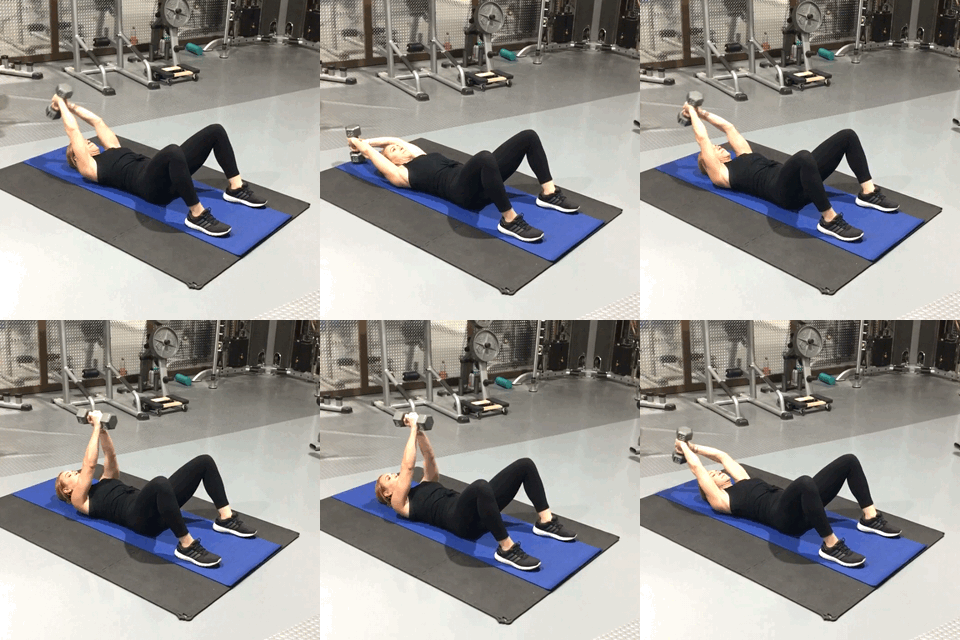
  • Pull-overs: To modify this exercise start by using a light weight while lying on your back on the floor. Start with your feet planted and arms holding the weight above your chest. Slowly bring the weight overhead to tap the floor while flaring your elbows and keeping only a slight bend in the arm. As you bring the weight overhead pull your pelvis back by contracting your core and pressing your back into the floor. As you progress you can do this exercise from an elevated surface such as the bench to gain a bigger depth and stretch at the bottom of this motion. Aim to perform 10-15 reps of this exercise. This exercise is great for targeting the upper back including your lats, chest, triceps, serratus anterior and core muscles. 

dumbbell pull-overs

  • Romanian deadlift with a row: This exercise can be modified by standing with your feet turned out slightly and using lighter weights. As you get stronger you can slowly increase the amount of weight you’re using and the number of reps and sets you’re doing. Start by standing with your feet about hip width apart and arm hanging down in front of the body. Then, slowly hinge forward with your chest by sitting back into your hips until your back is at a 45 degree angle. While keeping a flat back row the arms back towards your hips driving your elbows past your back. Repeat this exercise for 10-15 reps. This exercise targets your glutes, hamstrings, core, back and biceps. 

romanian deadlift with a row

Showing yourself grace post-pregnancy

Getting your body back to where it was pre-pregnancy is going to be a process that takes time. Be patient with yourself and learn to love and appreciate your body along the way. Your body just went through a ton of changes and created a human life, which it deserves recognition for. The female body is truly a miracle worker!  The best thing you can do for yourself is help your body recover and get back to its strongest self by being consistent in your training, eating a well-balanced macro-friendly diet and listening to your body’s needs.

If you need help getting started we have trained prenatal and postpartum professionals who are here to help. We work a ton with moms and often times we work with our moms through multiple pregnancies. We understand the delicate balance between wanting to get back to your pre-pregnancy body and showing yourself some grace through this transition period. The important thing to remember with postpartum exercise is that there’s nothing your body can’t do with the right training and proper guidance.

At home workout routine: Why you should keep a routine during Covid-19 outbreak

Replace the GYM with a home workout routine

Working out in a gym is not possible right now due to the risks involved with the spread of the COVID-19 virus. Sharing gym equipment increases the likelihood of contracting and spreading the virus. However, there’s NO reason why you can’t keep your workout routine going indoors from the safety of your home. The more we can maintain our daily routine the more we can create a sense of normalcy during these trying times.

You can easily replace most of the machines and equipment you would normally use in the gym with light weight resistance bands and free weights from home. You can even get creative and incorporate water jugs, towels, and furniture if you don’t have any equipment. In our 10-minute home workout we show you how you can workout using just your own body weight.

With no equipment or any special workout attire necessary and so many options for virtual training you don’t have an excuse to miss a workout. You can choose to have a personalized workout from a virtual trainer, a streamed live workout or you can watch a preloaded workout video on YouTube. Many workout classes that were offered in person prior to the pandemic are making their classes available online as well!

Pick what works best for your needs.

Skipping workouts could set you back

Exercise is vital to your health and especially important to building immunity against this pandemic outbreak. According to leading physiologists from the University of Bath’s Department of Health, “exercise can help the immune system find and deal with pathogens, and in the long term, regular exercise slows down changes that happen to the immune system with ageing, therefore reducing the risk of infections.”

Psychological stress and mental health is also better managed through exercise, which has a positive effect on your mood. Serotonin levels are boosted and feel-good endorphins are released through regular exercise.

Skipping your workouts now could also set you back on the progress you made in the gym. It doesn’t take long for muscles to start to atrophy without use. This leads to the onset of other ailments like back and joint pain.

Consistency is important for any kind of progress, but also to maintain what you already attained.

Other healthy habits to make part of your fitness routine

There are many ways one can try adopting & making a switch towards healthy habits without sticking to any rigid diet plan. Some healthy habits that you can start with:

  • You can boost your immunity by eating a diet high in fruits and vegetables. The more leafy greens the better! Try to also eat some of your vegetables raw so you don’t lose any of the nutritional benefits. A nutritious diet coupled with exercise can help you better maintain a healthy weight.
  • You should also make sure you’re getting enough quality sleep as this can also put stress on the body.
  • Make sure you’re LIMITING your consumption of alcohol and processed foods.

Following these healthy lifestyle habits won’t just help boost your immunity against disease and infection, they will also help keep your body strong for a better quality of life.

These factors help reduce your biological age slowing the aging process.

Routine is good for the psyche

As much as our lives seem uprooted right now it’s important to maintain some sense of normalcy. We can do this by holding onto the routines in our lives that we can still control.

Exercise is one of them!

Keeping up with our exercise routine will help us form new healthy habits. This routine will also help us:

  • better cope with the changes we are experiencing.
  • create order in our lives, which also helps us mange stress, anxiety, depression and even insomnia.

Establishing a routine on a personal level can also help with forming routines on a professional and relationship level. This will make your work environment healthier and the added strain on families forced to spend an unprecedented amount of time together easier.

Home exercise: 10-Minute quick lockdown workout you can do at home

Staying fit while stuck at home

Times have changed during this time of social distancing, due to the COVID-19 crisis, including how we workout. But just because you can’t get to the gym doesn’t mean your workout routine needs to suffer. Now that we are all stuck at home ideally we have more free time on our hands, but that’s not always the case when you’re juggling a demanding work schedule, a house full of kids and also playing homemaker. We’re here to show you how you can get an effective and efficient workout at home in just 10 minutes.

YES! In Just-10-Minutes..

By doing a 10-minute workout a day you can walk away feeling energized, motivated and satisfied that you’re doing something good for your body and your health. These 10 minutes of exercise are great to do first thing in the morning to kick-start your day, mid-day when you’re feeling sluggish or just before bed when you have fewer interruptions.

Home exercise complete with quick 10 minute workout

We recently teamed up with Chasing News to share our 10 minute home workout with viewers on Fox5 and NY9 and now we are sharing it here with you. We brainstormed and came up with 8 of the most effective total-body exercises that are practical for everyone. Whether you are a beginner, a seasoned gym-goer, pregnant or postpartum these exercises are simple enough for you to do.

There’s no excuse not to do this 10 minute at-home workout plan because it doesn’t even require any gym equipment. All you’ll need is a chair and yourself.

Yup! It’s that simple.

At home workout plan without equipment

This workout is effective at promoting strength, coordination and mobility development. If you do these exercises daily you will get stronger over time and you can gradually increase the intensity by adding more reps, more sets or increasing your pace.

Why CHAIR DIPS is the best:

To perform Chair dips, all you need is a sturdy chair or bench or even a staircase. Make sure your arms are at your sides gripping the front of the chair, bench or stair, and your feet are firmly planted on the floor shoulder-width apart. Shift your torso forward off the chair keeping your hips directly underneath you and slowly lower your butt towards the floor as you bend at the elbow. As you lower make sure your hips stay directly underneath your shoulders. Inhale as you lower and exhale as you come back up extending the arms to your starting position.

Complete this exercise for 10-15 reps and then repeat this set 2x. You can work your way up to doing more repetitions or sets as you build strength.

Takeaways –

Chair dips engage your –

  • triceps (back of your upper arm),
  • pectoralis major (pecs or chest muscles),
  • trapezius (triangular muscle extending from the neck to the shoulder to the middle back), and
  • serratus anterior (the muscle on the surface of the upper eight or nine ribs).

Most people don’t realize the triceps are important muscles used in everyday movement that involves extending the elbow and forearm. You use them when lifting things like grocery bags or when reaching for items overhead. This muscle also plays an important role in stabilizing the shoulder joint.

Tone your abs with LYING LEG RAISE:

Lying double leg raise with butt lift exercise starts with lying on your back with your feet up towards the ceiling. You can place your hands under the small of your back for support. Lower your straight legs towards the floor and then raise back up to the starting position adding in a butt lift and hip rotation at the top.

Repeat this exercise for 10-15 reps or until you become fatigued and repeat for 2 more sets.

Takeaways-

This exercise is great for building core strength in your rectus abdominis muscle and the internal and external oblique muscles. Leg raises also improves the strength and flexibility of your hips and lower back.

KNEELING SIDE CRUNCH for a flat belly:

You start in a kneeling modified side plank with your top leg extended away from the body. Your bottom are should be straight and your top arm should be behind your head. Bring your top elbow and top knee in towards your torso to meet and then extend the leg back out straight opening up the contraction.

Repeat this exercise for at least 15 repetitions on each side and then do 2 more sets.

Takeaways-

Kneeling side crunch exercise uses just your body and it mainly targets your core specifically your obliques. Your shoulders and glutes are also assisting so again this is a compound movement. Your core is your entire support system. Core strength is important in everything you do so it’s important to start here in your workouts.

Improving LATERAL LUNGES:

To perform lateral lunges exercise, stand with feet together and hands clasped together at your chest. Take a large step out to the right, immediately lowering into a lunge, sinking hips back and bending right knee to track directly in line with right foot.  Keep left leg straight but not locked, with both feet pointing forward. Push off the right foot to return to starting position.

Repeat on both legs. Do 10-15 reps on each leg for 3 sets.

Takeaways-

This exercise targets your glutes and legs and it helps improve your mobility in the frontal plane of motion (moving side to side). The side lunge also helps you build strength and stability in each leg individually as well as improve your balance.

DEAD BUGS are good:

Lie on your back with your arms and legs extended up towards the ceiling. Bend your knees and hips to a 90-degreeangle. Tighten your abs and press your lower back into the floor as you bring your left arm overhead and right leg down towards the floor.

Exhale as you lower and inhale as you raise being careful not to let your lower back arch.

Takeaways-

Dead bugs target your abs, back, shoulders and hips. By activating the deep abdominal muscles, the transverse abdominals and pelvic floor, this exercise helps stabilize the lower spine to reduce the risk of back strain. Doing this exercise also improves your motor skills and coordination. Plus, it helps with a wide range of motions, such as lifting and bending in everyday activities.

Combating poor posture with SEATED WALL ANGELS:

This exercise can be done against the wall either sitting or standing. You can also do it while lying on your back on the floor. To perform this exercise bring your hands up by your ears. While keeping your wrists and elbows in contact with the wall or floor slowly elevate your arms overhead as far as you can and then return to the starting position.

Repeat this exercise for 10-15 reps.

Takeaways-

Seated wall angels help in correcting bad posture by strengthening your shoulder mobility and back muscles while also opening up your tight chest muscles. It helps treat upper-crossed syndrome common in people who sit at a desk or computer for long periods of time.

SIT TO STAND to improve mobility:

Stand with your feet shoulder-width apart and with your arms behind your head. Lower yourself slowly into a chair keeping your back upright. Rest your butt into the chair and push your weight into your heels to come back up to a stand. You can make this exercise harder by sitting on an exercise ball instead of a chair or placing a small object between your legs.

Perform this exercise 15-10 times for 3 sets.

Takeaways-

Sit to stand helps strengthen your legs, glutes, and core. It’s a functional movement that promotes balance to prevent backward falls and helps with posture. When practiced regularly this exercise helps improve scores on the Berg Balance Scale, a test that measures balance and fall risk in older adults.

Mastering the PRONE T-RAISE FLOOR PUSH-UPS:

To perform Prone t-raise floor push-ups start in a straight arm plank position. With your elbows touched into your sides lower your body slowly to the floor. Then extend your arms out to your sides. Elevate your arms and legs off the floor for a beat and then lower and press back up into the plank.

Repeat this exercise 10 times for 3 sets.

Takeaways-

This two-part exercise targets the erector spinae and latissimus dorsi muscles in your back as well as your oblique, transverse abdominis, rectus abdominis, glutes, hamstrings, pecs, triceps and rear delts.

How to enroll in our virtual training

If you feel this routine might be too basic for you, I would suggest scheduling a 10-minute call with us because we are here to help!

As certified in-home personal trainers in NYC with years of experience, we are now offering customized virtual workouts to our clients. Unlike online training where you’re given a program to follow, with virtual training you still get the same one on one attention you would get in person and a tailored program to fit your needs.

 And the best part is..

To make it more affordable, we can also train you and your FRIENDS or FAMILY together using the Zoom gallery and you can take advantage of our special savings. Contact us today to learn more and get started!


Ready to connect with us?

5 things to consider before hiring a personal trainer in NYC

Is hiring a personal trainer worth it?

NYC is a bit more of a health-conscious city which means you have lot of options available to you from gyms to classes to help you on your fitness journey. However, nothing compares to having a personalized fitness and nutrition coach to design a program to help you meet your goals. The one on one attention you receive with a personal trainer not only helps to hold you accountable it also ensures you’re executing the exercises correctly and that you’re making measurable sustainable progress.

However, trainers are not all created equal. Like with most services you get what you pay for. A top tier trainer comes at a premium because they must be certified by an accredited source such as American Council on Exercise, have years of experience and continuing education, a solid reputation, an approach that has been proven successful, specialties in different areas of fitness and the personality to keep you engaged. When you invest in the right trainer who meets this criteria and is compatible with your specific needs you get real sustainable results.

Whether you decide to invest in a trainer for a few months or for years to come you can make improvements in your health to last a lifetime.

How to find the right personal trainer in New York City

New York City has more personal fitness trainers per square mile than any other city in the country so it can be hard to choose the right one for you. To help you narrow your focus first decide if you feel more comfortable working with a male or female trainer or if you have no preference. We have a team of both male and female trainers skilled in different areas.

With so many different styles of trainers, it’s important to find one that specializes in your needs so you’ll want to do a search in your area based on what your goals are. We specialize in many areas of fitness including weight loss, strength training and pre and post-natal training.

You’ll also need to decide on what location is best for you. We have trainers based all over the city so that we can service clients in Manhattan, Brooklyn and Queens.
 
Availability is another crucial factor. You’ll want to find a personal trainer that can meet you on the days and times that are convenient for you.

How to track your progress

One of the best ways to measure the success of a personal training program aside from meeting personal standards is to have tangible ways to track progress.

One way, of course, is to use the scale, but as we know this number isn’t always reliable since muscle weighs as much as fat and some days we may be retaining more water than others.

A better more positive way to track progress is with pictures!

We recommend our clients take pictures before starting our program and then we do a progress update with pictures every few months. This way you can pay attention to the subtle often unnoticed changes that happen gradually over time when you adopt a diet and exercise plan.

You can also track through exercise by monitoring your improvement in form, strength, speed and overall performance.

Choosing a trainer you look up to

It’s important that you work with a personal trainer that embodies the skills and physical attributes that you aspire to. This way you can trust that their program works and that they practice what they preach. Your trainer shouldn’t give you any exercise program or diet guidelines that they aren’t willing to do themselves. When we are in the company of someone we aspire to be like we subconsciously push ourselves to work harder. We are also more inclined to make better lifestyle choices when we see our trainer leading by example.

Home training vs training in a gym

In NYC you have the option of working with a personal trainer out of a gym or at your home. The benefit of training at a gym is that the trainers are already vetted for you. However, since many apartment buildings in NYC are equipped with a gym having a trainer come to you may be more appealing. This way you have the added convenience of not having to travel anywhere. You also get to select a trainer of your choice. This does require a little extra leg work as you’ll need to do your own research as mentioned above to find the right fit, but chances are since you’re the one choosing you’ll be more satisfied in the end.

Pregnancy and exercise: Sweating for two

Benefits of Exercise During Pregnancy

Exercise does not put you at risk for a miscarriage instead it promotes the development of a healthy fetus and better prepares you for childbirth and postpartum recovery. When you exercise regularly through your pregnancy you are more likely to have a leaner baby, gain within the recommended 25-35 pounds, have more energy, better sleep and be in a better mood.

If you are starting a new exercise program while pregnant it’s wise to start gradual and listen to your body. Resistance work using either body weight or weight bearing exercises is beneficial for keeping the body strong throughout your pregnancy. Squats are an important lower body exercise to do consistently during pregnancy to help strengthen your glutes to reduce lower back and pelvic pain and also to help with labour. Arm building exercises such as overhead shoulder press, bicep curls, back rows, chest press, lat pulls are all important for keeping your upper body strong. After delivery the upper body will be responsible for lifting and carrying your baby so it needs to be in good shape. Certain ab exercises such as bird dog, and side plank are important to continue doing throughout your pregnancy to keep your transverse abdominis muscles strong. These muscles are used to support your lower back and core muscles.

Avoiding Diastasis Recti

Without a strong transverse you are susceptible for developing diastasis recti, which is a separation in your rectus abdominis. This means that your rectus abdominis (ab muscles) are no longer able to support your back and organs. Should you develop this separation along your linea alba (the mid-line of your stomach) you can treat it with some simple exercises that involve belly breathing. You lie flat on your back with your feet planted and practice inhaling through your diaphragm while expanding your stomach and then on the inhale pulling your navel in towards your spine as if you’re wrapping your abs like a corset. The key is to not move your hips or back while doing this. If you repeat this exercise several times a day gradually this separation in the abs will close.

Another important aspect of exercise during pregnancy is keeping a strong pelvic floor. Most women are familiar with kegel exercises, but they aren’t exactly sure how to do them correctly. The easiest way to know how to use these muscles is to practice stopping the flow of urination without engaging your abs or buttocks. You can practice doing this contraction through varies exercises such as bird dog and split tabletop poses. The way to do this to breathe in through your diaphragm expanding your lower rib cage for 3-5 seconds and then contracting your pelvic floor muscles and transverse abs by pulling your belly button in towards your spine as you exhale. During the contraction and exhale is when you want to elevate your leg and arm into bird dog or open your legs in the split tabletop. Then lower back to the floor or close the legs as you take your next inhale relaxing the pelvic floor and transverse abdominals. Once you’ve mastered how to engage your pelvic floor you should repeat these exercises daily during and after pregnancy. 

Exercises to Avoid During Pregnancy

There are a few positions you should try to avoid during exercise when pregnant especially as you enter into the later part of your second and third trimesters when your baby does the most growing. Once your stomach becomes pronounced you should try to avoid bent over exercises or any exercise from the plank position that can cause your stomach to go into a cone shape. This cone shape puts increased pressure on your rectus abdominal muscles putting you more at risk for developing diastasis recti, which I spoke about earlier. You also want to avoid lying in the supine position particularly in the second and third trimesters as this can lower your blood pressure and reduce blood flow to the placenta. Lying on your stomach during exercise is also not recommended once your baby bump arrives as this will also feel very uncomfortable.

Your pace and strength in your workouts will likely decrease during pregnancy which is normal. A lot of your body’s strength and energy goes to supporting the development of a healthy fetus so don’t be surprised if you find that the weights that you used to use comfortably before pregnancy are now more challenging. The important thing is to do what you can and just stay active. You will also experience more shortness of breathe during pregnancy so pace yourself during your workouts. This may mean you’ll have to take more breaks. As long as you are staying active consistently during your pregnancy once the baby comes your strength level will return to where it was prior to becoming pregnant.

Exercising during pregnancy can also help you recover quicker postpartum. Your body always responds quicker to what it is used to. Although it is generally not recommended that you resume exercise until at least 6 weeks after delivering and with a doctor’s clearance, you know your body better than anyone. You may need a little more or less time. Take what you need. The most important thing is to listen to how you feel. The process of getting back to your old self will be gradual, but you will get there. Start slow and be careful of doing any strenuous core work right away. It will take several months for your body to fully heal.

Benefits of Exercise Before Pregnancy

For any woman thinking of getting pregnant within the next year I recommend you start on an exercise program first. Not only can exercise improve your fertility, it’s important to have a strong able body that can handle the increased demands of pregnancy. Think of this prep work as building your foundation for having a fit and healthy pregnancy. The more exercise you do before you become pregnant, the more active you’ll be able to be during and after pregnancy because your body will already be used to it. 

Loving Your Body Post-Pregnancy

Many of the women I train are prenatal and postpartum clients. I am happy to report that all have them through a carefully designed exercise program, consistent gradual effort and patience have managed to get back to their pre-pregnancy weight and look stronger and feel better than ever! The important thing is to understand that pregnancy does change your body, but to not give up on yourself. Love your body for its ability to bring the miracle of life into this world and then start to be proactive about your health. Through exercise you will see noticeable improvement in your body’s physical state, in your mood, energy level and confidence. Ultimately, exercise is the best thing you could ever do for yourself because it will improve your quality of life so you will be able to be a better parent to your child.