What is ego lifting and why you need to stop it immediately

ego lifting

What is ego lifting and the dangers it poses

What is ego lifting? We’ve all witnessed that person in the gym either attempting to lift more than they can handle or pushing themselves to edge out one too many reps. The result? Terrible form and technique, which can be cringe-worthy to watch because we all know bad execution of an exercise can lead to injury. The confidence boost in trying to impress yourself or others is not worth the potential risk. Injuries can result from compensation occurring in other parts of the musculoskeletal system being over-utilized, the strain put on the muscles, joints, and connective tissue being targeted, and the wear and tear on the joints, tendons, and ligaments over time. Ego lifting not only increases your risk of getting hurt, it actually derails your progress and limits your potential of actually getting stronger. 

The key principles to safe and effective lifting

There are several rules that have to be practiced to make your workouts safe, effective, and progressive. Following these principles will help you see the most growth in your training while perfecting how you move and use your body. 

  1. Control: You must be able to own the movement by controlling the entire lift. At no point is it recommended that you drop the weight or rely on momentum to try to compensate for your inability to control the weight you’re moving, which is typical to see in ego lifting. 
  2. Technique: You should be cueing the correct muscles to engage during the exercise to avoid compensation and stress on your bones and joints. This means you need to be aware of body positioning. Your joints should be stacked, your alignment should be correct and you should have a good mind and muscle connection.
  3. Range of Motion: You should be working on hitting your optimal end range of motion to ensure maximal recruitment of the muscles you are targeting and to place minimal stress on the joints and bones. If you’re unable to move with good mobility you may need to regress the load you’re using or the exercise itself.
  4. Avoid Pain: Pain is different from muscle soreness. You should never train through pain. Make sure to listen to your body. Pain is usually a sign that your form is off, you’re using too much resistance, or your recovery is lacking and you need to prioritize foam rolling, stretching, and rest days. (Read more: Stretching exercises for lower back pain)
  5. Posture: You need to always be practicing good posture when you lift to avoid injury. Think about keeping a neutral spine, shoulders, and hips parallel to the floor, chest tall and pelvis tucked. 

Why patience and consistency matters in training

Achieving results doesn’t come from sporadic gym visits and pushing yourself to failure commonly seen in ego lifting. It requires dedication, consistency, and patience for gradual, steady, and consistent progress that accumulates into significant results over time. 

If you learn to embrace patience and consistency in your training as well as maintaining the integrity of each exercise, you’ll achieve your fitness goals and far exceed your expectations of what is possible. Stay the course and don’t rush the process. 

Approaching exercise with an understanding of proper form, body awareness, and mechanics trumps the pursuit of heavier weights or excessive repetitions, as it ensures safer and more effective workouts, reducing the risk of injury and maximizing long-term fitness gains. 

At Leading Edge we lead with form and function

If ever you are in question about the safety and effectiveness of an exercise program or need some oversight to ensure you’re doing an exercise correctly our team at Leading Edge is here to guide you. We prioritize safety first and promoting good posture so you can maintain not only the integrity of the exercise but also the overall health and longevity of your body. Unlike with ego lifting when you maintain control and proper form through a movement you’re sending a signal to your central nervous system that you are capable fostering a foundation for safer and more effective strength-building. This translates into improved quality of movement in real life allowing your body to support you when you need it the most.

When we start with a new client we evaluate your posture and your gait. Then we pay close attention to your form, alignment, mobility, stability, and strength as you move through a series of different functional movement patterns. This analysis reveals areas of weakness, strength, tightness, restriction, and compensations for muscle imbalances. This comprehensive assessment serves as the groundwork for developing your program, allowing us to prioritize optimizing your movement without limitations or discomfort. It’s only from this place that we can construct a robust physique.  

Interested in scheduling an assessment and first workout with us to take your training to the next level? Call or email us to book your free phone consultation with us so we can learn more about your exercise and injury history and map out a plan to get you moving and feeling your best!

How to progress gradually in your training

Once you have established a solid understanding of fundamental movement mechanics and achieving optimal form, it is time to progress. The goal should be to incrementally increase the resistance or intensity of your workouts to provide a challenging stimulus without compromising form. Here are 4 methods you can use to accomplish this:

  1. Increase resistance: You can do this by gradually increasing the load by 5-10 pounds every week or as you are capable.
  2. Adjust the tempo: You can also progress by adjusting the tempo of an exercise either by slowing it down or speeding it up.
  3. Increase your reps or sets: Adding more reps or sets to an exercise without adjusting the load is an effective way to train progressive overload.
  4. Reduce your recovery time: You can reduce your rest time in between each exercise or set to place an increased demand on the muscles you’re training. 

Using these methods will help prevent ego lifting so you can achieve the results you’re after without the risk of overexertion or possible injury, which only leads to setbacks and frustration. 

Feel free to schedule a free consultation call with the best personal trainers from New York for more information about workout plans tailored to your requirements or to discover how you can achieve the best results from exercising, regardless of your time constraints.

Benefits of calisthenics for beginners

calisthenics for beginners

What is calisthenics and why is it so popular

Calisthenics is a form of resistance training that involves utilizing only one’s body-weight to perform exercises. It has become increasingly popular in recent years, as more people are seeing the value in building strength, improving their cardiovascular function, and overall fitness level. Calisthenics is an easy exercise choice for building strength, endurance, flexibility, and coordination because it accomplishes all these things without the need for expensive and heavy equipment. This means you can train calisthenics from anywhere making it easy to do consistently. In this article, we will explore the many other benefits of calisthenics for beginners and why it is a good exercise option for anyone looking to improve their fitness. 

Benefits of calisthenics for beginners

Here are 7 benefits that make calisthenics appealing for anyone just starting out with resistance training:

  1. No need for equipment and gym membership. One of the most significant advantages of calisthenics is that it does not require any equipment or a gym membership. This makes it an easy exercise option for anyone who is on a budget or cannot make it to a gym. All you need is a small open space to exercise in, and you are good to go.
  2. Build strength and endurance. The dynamic compound movement of calisthenics requires a lot of energy and strength to be performed correctly. As you continue to perform these exercises, your body’s strength and endurance will increase. You will, over time, be able to perform more reps, increase the difficulty of the exercises, and build more strength.
  3. Improved flexibility and mobility. Many calisthenics exercises focus on movements that improve flexibility and mobility. This can help reduce the risk of injury and improve your quality of movement making it an excellent exercise option for older adults or people with mobility issues.calisthenics improves flexibility
  4. It’s safe. For beginners calisthenics is generally safer with a lower risk of injury because you’re using just your body weight for resistance and not externally loading your body.
  5. Improve posture. Calisthenics exercises work on strengthening the core muscles, which helps to improve posture. Good posture enables your body to move and perform better, and it can also prevent back pain.
  6. Easy to modify. This type of training is easy to modify to fit your skill level. You can start with basic exercises and gradually increase the difficulty as your strength improves. Additionally, you can focus on specific areas of the body that need improvement. This makes it an excellent exercise option for anyone of any fitness level.
  7. Improved mental health Calisthenics has been known to reduce depression, anxiety and stress levels. This makes it a great tool for elevating your mood and clearing your mind to make you feel good about yourself. 

Calisthenics for beginners exercises

Here are 5 calisthenics exercises to start your program with:

  1. Body weight squats: Stand with feet shoulder-width apart, toes pointing forward. Lower your body until your thighs are parallel to the ground, keeping your knees behind your toes. Push through your heels to stand back up. via GIPHY
  2. Push-ups: Start in a plank position with your hands shoulder-width apart. Lower your body towards the ground, keeping your elbows close to your body. Push through your hands to lift your body back up. via GIPHY 
  3. Lunges: Stand with your feet hip-width apart. Step forward with one foot, lowering your back knee until it nearly touches the ground. Push through your front foot to return to standing and alternate sides.via GIPHY 
  4. Planks: Lower your body into a starting push-up position. Think about pushing away from the floor to keep your elbows locked and shoulders down and back. Hold steady for as long as you can while engaging your core, glutes and quads.via GIPHY
  5. Leg raises: Lay down on your back with knees bent in table top position. Position your palms at your sides or under your butt for added lower back support. Lower your legs towards the floor keeping your core tight and pelvis tilted back and then raise your legs back up into table top position. 

via GIPHY

Remember to move at a pace that is comfortable for you, focusing on proper form and keeping your movements controlled. As you progress, you can increase the number of repetitions and add more challenging variations of each exercise.


How to get started doing calisthenics

Calisthenics for beginners is a great place to start if you’ve never done strength training before. By using your body weight for resistance you’re able to improve how you move and build a better understanding of mind and muscle connection and proprioception. This is all very helpful in improving your day to day quality of life. 

However it is important that you understand what good form looks and feels like and that’s where having a certified personal trainer with you becomes hugely beneficial. A personal trainer can help correct your form and challenge you to push yourself so that you gain the most from each workout. This all helps ensure you’re exercising in a way that is safe and effective. 

personal trainer to improve form

When we work with new clients here at Leading Edge we always lead with form and function to help train your body how to move optimally while also correcting any muscular imbalances and building better technique. If you would like to learn more about how to get started you can schedule a free phone consultation with us so we can assess your fitness needs and goals and share with you our different program options. 

Strength training for runners: A step-by-step guide

Why strength training is important for runners

Strength training for runners is key if you want to become a better runner. Many runners think that doing speed work, hill repeats, long tempo runs and interval work is the ticket to running faster. However, if you’re neglecting strength training you’re missing out on a critical component of what makes a good runner.

Strength training helps prevent injuries by strengthening muscles that are underutilized in running and by building strong bones, joints and connective tissues. Building strength is particularly beneficial for building upper body strength, which is needed to propel your legs in running and improve running form. Strength training also helps increase power output, which will help with your explosiveness and knee drive needed for speed and performance. Contrary to popular belief, strength training for runners doesn’t cause you to gain muscle in a way that will slow you down. Instead, it actually helps with balance, speed and endurance as it improves your efficiency.

Strength training exercises for runners

It’s important for runners to train total body when strength training. It’s also recommended that you use weights for added resistance. Choose a weight that is challenging with moderate intensity, but that you can can still maintain good form with. A good rep range to shoot for is 8-15 reps of each exercise. below is a break-down of exercises you can do to target upper body, lower body and core.


Core exercises for improved running performance

Having a strong core is critical for running performance as it promotes balance and stability. You can train your core with these exercises that don’t require any weight.

  • Planks: To perform this core exercise start with your arms placed under your shoulders and your feet on the floor hip width apart in a plank position. This is the same as the starting position for a push-up. Think about screwing your palms into the floor so that your elbows face behind you and pull the top of your pelvis back by tightening your core. You can either hold steady from this position or challenge yourself further by driving your knees into your chest one leg at a time while maintaining a  neutral spine. This core exercise targets your entire core including the transverse abdominis, rectus abdominis, internal and external oblique muscles. It also activates your entire body including shoulders, quads, chest, biceps, triceps and back.

via GIPHY

  • Hollow Body Rocker: To perform this exercise start lying on your back. Extend your arms and legs fully away from your torso. Elevate arms and legs so that your arms are slightly above your head and your feet are elevated at a 45 degree angle from the floor. Focus on keeping your back flat by squeezing your glutes and your core to keep the top of your pelvis back. You can either hold steady here or challenge yourself more by slowly rocking your torso back and forth while maintaining this position. Hollow body rocker targets your entire core including the transverse abdominis, rectus abdominis, obliques as well as your quads, hip flexors, inner thighs and erector spinae muscles.

via GIPHY

  • Windshield Wipers: Start by lying on your back with your arms out to the sides and your legs extended above your hips. Pull the top of your pelvis back by tightening your core and slowly lower your legs towards the floor from the side to side. As you lower your legs to the left side of your body the right hip will leave the floor and then you will return to the starting position before repeating on the other side. Focus on keeping your core and glutes tight throughout this entire movement. Windshield wipers are excellent for targeting the oblique muscles and your erector spinae. 

via GIPHY


Lower body exercises for better running form and technique

It’s also important to strength train your legs to improve power and muscle endurance for running. Running only involves moving in a forward motion so unless you incorporate unilateral exercise into your training as well as multi-plane movements you’ll be putting yourself at an increased risk of developing muscle imbalances. This often can lead to injury. The following compound exercises are best to do because they enable you to train multiple muscle groups at once. You can also incorporate unilateral variations of these exercises like single leg deadlifts or single leg squats. Lateral lunges allow you to move in the frontal plane and curtsy lunges allow you to move in the transverse plane.
 
  • Squats: For this exercise start standing with your feet slightly wider than hip width apart. Hold a weight at your chest with your elbows tucked. Lower your hips towards the floor by driving your knees apart and shifting your weight back into your heels. In order to maintain a neutral spine keep your chest tall and your eye line out in front. Push off through the ball of your feet to come back to the starting position. This compound exercise targets your entire lower body including your glutes, quads, calves, hamstrings and hip flexors. When you add in a weight as demonstrated with this goblet squat variation it becomes a full body exercise. Now you’re also targeting your entire core, arms and grip strength. 

via GIPHY

  • Single Leg Deadlifts: To begin this exercise stand with your feet hip width apart. You’re going to hinge by pushing your hips out behind you like you’re trying to close a door with your butt. As you do this your chest will come forward. Only hinge back until you’ve hit the end range in your hamstring stretch. Your hips should never come higher than your chest here. Make sure to keep a neutral spine by keeping your core tight and shoulders down and back. Once you’ve mastered this form you can try elevating one leg for the hinge and eventually adding in a weight. In this leg exercise the primary muscles involved are the hamstrings. Secondary muscles include the erector spinae, glutes, calves, obliques and transverse abdominis. 

via GIPHY

  • Around The World Lunges: To begin stand with your feet together. Step forward with your left leg far enough so that you’re able to bend both knees down to a right angle. Keep your chest tall here and your weight distributed equally over both feet. Then, push off the front leg to come back to the starting position. Now step out the side with your left leg bending your left knee while keeping your right leg straight. Make sure in this lateral lunge that your left knee is tracking over your left ankle as you lunge. Push off the left leg to come back to the starting position and then step back with the left leg into a backwards lunge. Here you’re bending both knees to a right angle and then pushing off the left leg to come back to the starting position. Repeat this sequence on the other leg. Around the world lunges target the glutes, hamstrings, quadriceps and adductor muscles. You’re also using your back, core and calf muscles to help stabilize. 

via GIPHY


Upper body strength exercises for runners

Upper body strength is vital for good running technique because your arms are what propel your legs. Having a strong upper body allows you to maintain good form with your arms, which improves speed and efficiency. Here are compound exercises you can do to target each major muscle group of your body.

  • Renegade Rows: This floor exercise is great for targeting full body. Begin in a plank position with your hands placed under your shoulders and your feet hip width apart. With a weight under one hand slowly pull the weight to your hip while maintaining a neutral spine. Then return to your starting position. As you move the weight focus on trying to keep your hips square with the floor to use more of your core. This is a full body exercise that targets the entire core including the obliques, transverse abdominis and rectus abdominis. It also works the back, shoulders and triceps. It’s a great exercise for improving not just strength, but also balance and stability.

via GIPHY

  • Chest Press: This is a great exercise for training your chest, shoulders and triceps. Start by lying on your back on a bench and grab two weights. Bring your arms above your shoulders and slowly lower the weights towards your chest keeping your elbows 45 degrees from your body. Inhale as you lower the weights and exhale to press the weights back to the starting position. As you lower the weight your elbows should stay lower than your shoulders. This upper body exercise is great for targeting the chest, anterior deltoids and triceps.

via GIPHY

  • Overhead Shoulder Press: This shoulder exercise is great for working your shoulders, upper back and triceps. Start standing with your weights at your shoulders and slowly extend your arms overhead locking out your elbows at the top of the press. Then lower your arms back to the starting position. As you press it’s important to keep your core tight so you don’t compensate by using your lower back. Exhale as you press the weight and inhale as you lower back to the starting position. This is a great upper body exercise for strengthening your shoulders, triceps, trapezius and pecs. 

via GIPHY

  • Pullovers: This exercise is great for targeting the chest, triceps, back and the front of your shoulders. To start lie on your back on a bench or on the floor. Grab a weight and bring it above your chest. While keeping your core tight to keep your back on the floor slowly bring the weight overhead. As you lower the weight overhead focus on also keeping your elbows flared to feel the work in your lats. Then slowly exhale to bring the weight back up above your chest to the starting position. The main muscle targeted with this exercise  are your pecs and lats. In addition you’re also targeting your triceps, anterior deltoids and teres major muscles. 

via GIPHY

Creating a training plan for runners

Strength training for runners is key, but it’s important that you don’t overlap it with your runs to avoid over fatigue. Studies have found you should  allow for at least an 8 hour recovery window after your runs before you do your strength workouts. This will help prevent injury and increase the effectiveness of both your runs and strength training workouts. A good example of this would be to perform your training runs in the morning and than to wait and do your strength training in the evening. If you are only running 3-4 days per week than you could also look at doing your strength workouts on your off days. Ideally you should aim for at least 2 strength workouts per week.

If you’re doing strength training 2x per week you can program your workouts into push and pull splits or train total body both days. With a push and pull split you train chest, triceps, shoulders and quads one day and then train back, biceps, hamstrings and glutes for the other day. If you’re doing strength training more than 2x per week you can program your workouts into push, pull and legs or train total body all three days. If you’re doing a push, pull and leg split you will train upper body push muscles which include your chest, triceps and shoulders one day. Then, you will train upper body pull muscles, which includes your back and biceps another day. For leg day you will train quads, hamstrings, glutes and calves.

If you’re a beginner aim at doing 2-3 sets of 10-15 reps for each exercise and for the static isometric exercises perform 2-3 sets of 30 seconds holding. As you become more advanced you can add weights to increase the resistance and extend your static holds to 1 minute. 

Here is a good sample strength training program for runners

Monday: Strength train: Total Body Push/Core (morning)

Tuesday: Tempo run

Wednesday: Easy run (morning); Strength train Total Body Pull/Core (evening)

Thursday: Rest day

Friday: Track intervals 

Saturday: Rest day

Sunday: Long run

Strength training makes you a better runner

If you’re looking at becoming a better runner by improving your speed, technique or stamina then strength training has its benefits. As you get stronger you’ll see improvements in your running performance and you’ll become less injury prone. Start with a basic program using just your body weight for resistance and gradually you’ll be able to increase the intensity by adding weights for resistance. You can eventually work up to trying some of these more advanced functional strength training exercises. If you are consistent you’ll notice improvements in your running within weeks. 

Strength training for women over 50: Benefits and how to get started

Strength training for women over 50 can help you age well

Strength training if anything becomes even more critical as we age in order to maintain quality of living. Many women in their 50s are nearing menopause or are in peri-menopause and so estrogen hormone production suffers. This puts them at an increased risk for osteoporosis, heart disease, diabetes, loss of muscle mass and hormonal imbalances. What many people don’t realize is that strength training for women over 50 can actually help boost estrogen production and regulate hormone levels. Women spend 40% of their life post-menopausal so you can see how reversing  the effects of menopause through strength training can have a tremendous impact on overall well-being.

Strength training is also important for women over 50 because as we age, our muscles tend to lose mass and strength, which can lead to a decrease in mobility and balance. This also results in bone density loss and so the risk of falling or injury increases. Strength training is preventative by helping maintain and even increase muscle mass, strength, coordination and functioning. Having more muscle mass also helps improve metabolism and weight management.

Strength training for women over 50 and the effects on mental health

These changes in hormone levels for women over 50 can also take a toll on one’s mental health causing mood swings, anxiety and symptoms of depression. Strength training helps improve mental health by releasing endorphins, which are chemical signals in the brain that increase feelings of wellbeing. Weight training also helps build self-confidence, build self-esteem and improve body image. 

Research has found that weight training can also help lower levels of cortisol, the hormone that is released when we are feeling stressed. It can even help improve cognitive function. Studies have found that strength training can help improve memory, reduce the risk of dementia and Alzheimer‘s, and increase focus and concentration. 

Best muscle strength exercises for women over 50

For best results women over 50 should be lifting 2-3x per week consistently to see progress. It’s also important to be lifting heavy to work on improving strength, muscle and bone density retention. You should ideally be working with a weight that’s challenging at 4-6 reps. Statistically speaking, women are much more likely to lift weights that are far less than their capabilities limiting their potential gains. It’s important not to be afraid to lift heavy.

Here are 5 strength training exercises you should incorporate into your routine for total body strength. You want to make sure you’re doing a combination of compound and unilateral lifts.

  1. Squats

via GIPHY

Squats are an important compound functional exercise for training lower body including the quadriceps, hamstrings, calves, glutes and other abductor muscles. It’s a movement pattern that we use everyday. When you add a load to this exercise such as with a goblet squat you’re able to incorporate upper body as well by engaging the core, traps and upper back muscles.

     2. Deadlifts

via GIPHY

Deadlifts are an important compound exercise for developing muscle strength in the posterior chain. They target the hamstrings, glutes, back, hips, core and trapezius. Hinging is an important movement pattern that we need to be able to do effectively in everyday life.

     3. Lunges

via GIPHY

Lunges are an important exercise not only for strength, but for improving balance, stability and coordination. This is also a functional exercise that prepares you for movement in everyday life such as walking up stairs. This is a great exercise for training not just legs, but upper body and core too. The primary muscles working are the quadriceps, glutes, hamstrings, calves, transverse abdominis, oblique, erector spinae and adductors. Lunges are considered a unilateral exercise because the lead leg is working more. Training with unilateral exercises allows you to achieve symmetry throughout your body. By training both sides of the body equally, unilateral exercises help prevent muscle imbalances, which often lead to injuries.

      4. Push-ups

via GIPHY

Push-ups are a very effective body weight functional movement for training total body when executed well. The primary muscles utilized are your triceps, pectoral muscles, shoulders and core. However, you can also effectively engage your glutes, quadriceps and upper back muscles.

       5. Pull-ups

via GIPHY

Pull-ups are another important body weight exercise for training upper body and core. For most women this exercise will be quite difficult so you can easily modify it by doing banded negative pull-ups. This exercise primarily uses your lats and biceps, while also recruiting your deltoids, rhomboids and core. There are few other exercises that allow you to train so many different muscle groups at once. This exercise trains you to pull your shoulder blades down and back into proper position to help improve posture. 

Women over 50 can live better

Overall, strength training is a great way to help women over 50 maintain physical health, as well as mental wellbeing. The benefits show that aging doesn’t have to be a period of our lives that we dread. Instead we can actually train our bodies to get better with age with the proper training. This applies to us  even as we age into our 60s, 70s, 80s and beyond! Our age does not have to define us.

If you are interested in learning more about where to start on your fitness journey our team is happy to help! Our program is personalized to fit your unique goals and needs. Contact us to schedule a free phone consultation. 

Do you need supplements to build muscle and increase strength?

The debate over supplement use to build muscle

The debate over whether or not you need supplements to build muscle and increase strength is one that has been raging for years in the fitness and bodybuilding world. On one side, you have those who believe that you can achieve your desired results simply by eating a balanced diet, exercising regularly, and getting enough rest. On the other side, you have those who believe supplements are necessary to maximize your gains and reach your full potential. So, what’s the real answer?

What matters most for building muscle

The truth is that supplements can certainly help you build muscle and increase strength, but they are far from essential. Eating a balanced diet and following a sensible exercise program are the two most important factors when it comes to building muscle and increasing strength. If you’re not getting the results you want, it’s likely because you’re not following a good program or eating enough of the right foods.

When you’re training to build muscle it’s important that you’re following a program that is designed to help you get stronger week to week by incorporating progressive overload training. This is a type of training that involves gradually increasing the intensity or difficulty of your workouts over time to maximize results.

Your diet is also important because you need to make sure you’re getting sufficient calories and protein for the most optimal results from your training. We can help by designing a customized meal plan for you to ensure you’re hitting your goals and are still able to enjoy flexibility in your diet! 

Supplements that can be beneficial for building muscle

That being said, there are some supplements that can help you reach your goals faster. Creatine, for example, can boost your performance in the gym by increasing your energy levels and allowing you to push harder during your workouts. Your body stores creatine as phosphocreatine primarily in your muscles where it’s used for energy. This is a natural compound that the body produces and that is also found in foods like red meat, poultry and fish. However, the levels found in our body naturally and in foods are much lower. This is why taking creatine as a supplement can optimize your performance and help you build muscle quicker.

Pre-workout supplements can also be taken shortly before your workouts to help you increase your performance by boosting energy, cognition, stamina and power. The three main ingredients in most pre-workout are: caffeine, beta-alanine, and citrulline. Beta-alanine is a naturally occurring beta amino acid and citrulline is an amino acid found in watermelon. The body uses amino acids for vital body functions like building proteins, hormones and neurotransmitters.

protein powder

Protein powder can also help you get more protein and even vital micronutrients into your diet, which is essential for muscle growth and repair. If you’re trying to build lean muscle, whey protein isolate is a better choice than whey protein concentrate because it contains more protein and less fat and carbs. This makes it a more efficient energy source. Plant proteins are also good as long as they contain at least 20-30 grams of protein per serving. On days you workout it’s best to take your protein powder after your workout to help your body replenish what you burned during your workout and to help with post-workout muscle recovery. If you’re trying to build muscle it’s recommended that you take protein powder everyday to ensure you’re able to maintain at least 100 grams of protein per day or .7 of your body weight in grams. 

Fish oil is a supplement that is also found in fatty fish such as salmon, mackerel and trout as well as shellfish. It’s high in omega-3 fats EPA and DHA. These fatty acids can benefit bodybuilders and weight lifters by reducing muscle soreness and severe delayed onset muscle soreness. Fish oil is most beneficial with long-term use. You should aim to take 2-3 grams per day.

Myths about supplements

If the supplement says it’s natural, it must be safe. 

“Natural” is a coined term that says little about the safety or effectiveness of a supplement. Before you start taking a supplement it’s important to read and understand the label, do your own research and be weary of extreme claims like “completely safe.” Also always check with your doctor first.

In most cases, multi-vitamin supplements don’t pose any health risks unless it interferes with any medication you’re taking. It’s important to note that federal regulations for dietary supplements are less strict than prescription drugs so these should be consumed with extra caution. 

Supplements are a great alternative for weight loss

Many weight loss supplements contain ingredients that are contaminated, ineffective, dangerous or actually illegal. Most help you lose weight by suppressing your appetite so severely that your calorie consumption is reduced to unhealthy levels. Not only can this leave you feeling ill, it can cause poor body functioning, severe energy loss and dizziness. This is not a healthy or sustainable tactic for weight loss. 

Supplements promote longevity of health

There is simply no substitute for a well-balanced diet and exercise routine. Research has shown that people who eat more vegetables and fruits in their diet have a lower risk of diseases. There are some exceptions here. Vitamin D supplement has been shown to be beneficial for people who live in colder climates especially during the darker months.  The Centers for Disease Control and Prevention (CDC) also advises females of child-bearing age to take folic acid supplements. To help ensure a healthy pregnancy women who are pregnant should also look at taking a daily prenatal vitamin. In general, though, for adults without health conditions who eat a balanced diet, the vast majority of supplements are nonessential. 

Final thoughts about supplement use

At the end of the day, supplements are not a necessity for building muscle and increasing strength. You can achieve your goals with just a good diet and exercise program. However, if you’re looking to maximize your progress and get to your goals faster, then supplements can certainly be beneficial. But it should be noted that taking supplements alone is not enough for muscle growth. It’s important that you’re also following an effective and consistent exercise program and eating the right foods. We can walk you through this process by designing a plan that is just right for you! To learn more schedule a free phone consultation with us! 


Frequently asked questions (FAQS) about supplements

Should I have a supplement break month?

A month break isn’t necessary, but a week long break can be beneficial depending on what you’re taking. If you’re taking something like caffeine, sometimes a week long break is beneficial so your body becomes re-sensitized to it. Otherwise you would likely need to continue increasing your dose for the same effects.  An example of a supplement that you shouldn’t take time off from taking is creatine. This is because it takes time to build up in your system for optimal benefits and if you stop taking it you have to start that process over. Listen to your body and if you feel like something is off you should seek advice from a medical professional.


Should I stack supplements for muscle building?

The only two supplements proven to positively impact muscle growth, are creatine and protein powder. Both of these supplements are safe to take together for most people.


Is there any side effects of creatine after you stop taking it?

The only side effect of stopping creatine is that you lose whatever benefits you gained. You’ll likely lose the strength, endurance and cognitive boost to your workouts that you were gaining by taking it.

Functional strength training exercises to improve your daily life

What is functional strength training

Functional strength training is a form of resistance training that focuses on developing strength in ways that enhance the performance of movements used in daily activities. As a result you gain more functionality of your body so you can carry out the physiological demands of everyday life. Performing functional strength training exercises is one of the best ways to improve your quality of life.

Benefits of functional strength training exercises

Functional strength training exercises not only help you build stronger muscles, bones and joints, they also greatly enhance your quality of life by improving how you move everyday. When you move better you feel better in your body because you’re able to:

  • reduce your risk of fall or injury
  • have fewer aches and pains
  • build confidence for performing movements on your own that are essential to everyday life such as squatting and hinging
  • build a stronger sense of spacial awareness
  • try new physical activities that require more skills
  • gain a greater sense of autonomy for independent living situations

When our bodies are able to do what they are designed to do we also experience a better sense of appreciation for life, which can improve our emotional and psychological health. Movement after all is medicine for changing a person’s physical, emotional and mental state.

What are functional strength training exercises

Functional strength training exercises use large groups of muscles working together to perform a particular movement pattern used in everyday life. Such movements would include:

  • squatting to sit-down or pick up a heavy object
  • carrying an item across a room
  • reaching for something overhead
  • rotating cross-body to see something behind you
  • balancing to prevent slipping or falling

You can also use functional training to improve your performance needed for any particular sport such as being able to swing a bat, dribble a ball or transfer your weight from one foot to the next for skiing or skating. 

In short, functional exercises are any movement patterns that are useful in helping you master a skillset needed for tasks of everyday life, hobbies and sports you enjoy and for helping you live a more pain-free life.

Beginner exercises for functional strength

If you’re just starting out with functional strength exercises you can start off by using your own body weight for resistance and you can modify where needed. It’s important to pick exercises that target both the upper and lower body and core as well as that train your body to move well in all 3 planes of motion. Don’t forget to also train unilaterally to correct any muscular imbalances that are present. Here are some examples of exercises you can do and how to modify them if needed.

Squats are great for training all the muscles of your lower body. If you find them too hard you can start with box squats or wall sits.

via GIPHY

Push-ups train the upper body and core. If you need to modify this exercise you can try doing them incline on an elevated service like a bench or from the wall. 

via GIPHY

Deadlifts are important for mastering how to hinge properly. This functional exercise targets your hamstrings and glutes. If you struggle with your form you can use the wall for assistance.

via GIPHY

Side lunges are great for training your legs unilaterally or using predominately one half of your body at a time. This is also a great functional strength training exercise for improving your body’s ability to move in the frontal plane. If you need to modify this exercise you can use the wall to hold onto for assistance

via GIPHY

More advanced functional exercises

If you’re more proficient in your training or you’ve been doing functional training for awhile you may want to consider challenging yourself to more technical exercises that not only challenge your strength, but also your coordination and mobility.

Turkish get-ups is a great total body functional exercise that targets major muscle groups including your glutes, traps, hamstrings, triceps, lats and calves. This exercise is great for coordination, stability, and it helps promote a stable spine. It also takes you through all three planes of motion–sagittal, transverse and frontal.

via GIPHY

Prisoner get-ups is not only a great functional strength exercise for the hamstrings and glutes, it also targets your hip flexors and core. Also as an added benefit, this exercise improves your stabilizer muscles. 

via GIPHY

Inch worm is another effective total body exercise. It’s great for building strength throughout your shoulders, chest and core as well as increasing flexibility throughout your hamstrings. 

via GIPHY

Long-term results of functional training

There are hundreds of functional strength training exercises to choose from. The underlying benefit of them all is that they help improve how you move both inside and outside of the gym. As a result by incorporating more functional strength training exercises in your workout over time you’ll experience a better quality of life. 

Here at Leading Edge we lead with function first in our training program. If you need a personal trainer to help you incorporate more functional strength training exercises in your workout contact us today to set-up a free phone consultation so we can help get you moving better!

Strength training for obese beginners – here’s why it’s so effective!

Is strength training for obese beginners different?

Strength training for obese beginners should be no different from anyone else just starting out. It’s always a good idea to start with low-impact strength training using only your body weight for resistance. This helps protect your joints and puts you less at risk for injury. The benefit of doing strength training far outweighs doing just cardio. Not only are you burning calories, you’re also taxing your muscles and joints to promote strength and new muscle growth. The other benefit is the more you weigh, the more work you’re putting on your body doing body weight strength training. As a result, you burn more calories leading to more weight loss when you couple this with a calorie deficit macro-friendly diet. 

How to gauge appropriate exercise intensity and frequency

A good way to measure how hard you should be training is judging by your RPE (rate of perceived exertion). This looks at your workout intensity based on a scale of 1-10 with 1 being no intensity and 10 being maximum intensity. When you’re just starting out you should aim for an intensity level of a 5 or 6 and as your body adapts you should shoot for a 7 or 8 for intensity. Anything less or more than this would not be sufficient. 

You can also judge intensity by how many reps of any given exercise you can do. You should comfortably be able to perform at least 5 reps before rest. If you can’t you can go with a modified version until you’re able to work your way up to at least 5 reps. As you get stronger, you should be able to comfortably work up to 10-15 reps of any exercise before resting. 

Exercise frequency should be based on what you can maintain consistently. Ideally, you should aim for 2-3 times per week for at least 20-30 minutes of active exercise at a time. 

Obesity beginner workout program

There are different types of low-impact non-weight bearing exercises you can do to start your fitness journey. Walking, swimming, cycling, and walking the stairs are all great for you!

These are exercises you can seek out in your everyday life by for example opting to take the stairs instead of the elevator and cycling or walking instead of driving to get to your destination.

In order to get more strength training in your routine, it’s also a good idea to do low-impact body weight exercises such as planks, hinges, wall sits, wall push-ups and superman hold in a prone position. These are all compound movements, which are also functional making them much more beneficial to your health. Compound movements involve the engagement of multiple muscles and joints so you gain more from the movement. Functional means it’s applicable to how you move in everyday life. The more your body is adapted to move well the less at risk you are for injury. 

With any new exercise program, form is most important. You want to make sure you’re only choosing exercises you can perform correctly. Modify your routine as needed to ensure your mastering form first. 

Four weight loss exercises you can modify as an obese beginner

    1. Strength training for obese beginners should focus on compound exercises that are easy to modify. The plank is a great exercise because it involves your entire body. It’s a great way to build strength and get your heart rate up. To modify the plank you can either drop to your knees from the floor or elevate into an incline plank on the wall. Start off by seeing how long you can hold this position with good form and then start timing yourself until you can work up to a minute.


    1. Squats are a great exercise for working your lower extremities. It also requires stability and mobility. You can modify it by doing squats over a chair or bench where you lower into a seated position and then push yourself back up to a standing position. You can also modify with a wall sit. Focus on depth here and good form. As you get stronger gradually increase the reps you can do.

      squat exercise


    1. A lying glute bridge hold is great for strengthening your posterior chain as well as your back. It’s also great for helping to promote good hip and back extension. To modify this exercise you practice holding for a second or two before lowering back to the floor. As you get stronger you can hold for longer at the top and perform more repetitions.


  1. Push-ups are a great compound exercise for hitting the upper body and core. You can easily modify this exercise by starting from your knees or you can perform them elevated from the wall. As you progress, you can aim to do full push-ups from the floor and even other variations of push-ups.

Diet is also a factor for overweight beginners

While strength training is a great place to start for obesity, it’s not always enough for fat loss. Your calorie consumption and protein intake are also equally important not only for fat loss, but for improving your lean body mass. No matter how hard you train you can never outperform your diet. A healthy caloric deficit, which should look different for everyone, coupled with a macro-friendly diet and exercise is the key for the treatment of metabolic disorders, reduction in the risk factors of cardiovascular disease and fat storage in the body. It’s also beneficial for improving your overall body composition, which helps enable you to maintain long-term results.

Do you need help with your fitness goal? Get in touch with our specialized fitness trainers to start your journey for recovery now or book your free 1-1 consultation with us.

Best ways to lose belly fat

Why it's impossible to target belly fat

Contrary to popular belief, there are unfortunately no specific exercises you can do to target stubborn belly fat. You can do crunches all day and have very little to show for it. This is because where we lose fat is genetically redetermined so trying to focus solely on your stomach will only leave you frustrated. Focusing instead on losing weight overall will however help you in your pursuit. However, this is no simple process. 

5 Ways diet and nutrition play a role in belly fat

Diet and nutrition is the most important first step to take for stomach fat loss. You can never compete with an unhealthy diet no matter how much exercise you do. Here are 5 tips you should start doing:

  1. Curb your intake of alcohol and sweetened beverages.  Calories from alcohol add up fast, which can quickly put you into a caloric surplus. Increased regular alcohol consumption has also been linked to increased belly fat likely due to an increase in visceral fat. Sugary beverages act the same way in that they spike your blood sugar and insulin levels resulting in more belly fat storage.
  2. Avoid foods that contain trans fats, which have been linked to inflammation, heart disease, insulin resistance, and abdominal fat gain. Trans fats are found in processed foods such as pre-packaged foods, margarine and spreads, fast foods, and fried foods. To help avoid trans fats start eating more whole foods and pay attention to food labels. Trans fats can also be labeled as partially hydrogenated fats.
  3. Eat a high protein diet. This doesn’t mean you have to cut out carbs, it just means approximately 30% of your calories should be coming from protein. Protein is important for weight management because it raises your metabolic rate, which allows you to burn fat more efficiently. Protein also keeps you full longer to keep you from overeating and helps you retain muscle mass during weight loss to improve your overall body composition.
  4. Cut back on carbs, especially refined sugars. Replacing simple carbs with unprocessed complex carbs such as whole grains can be enough to trigger belly fat loss. Refined carbs are void of most fiber, minerals, and vitamins so they are considered “empty calories,” These foods include: white flour, white bread, white rice, pastries, sodas, snacks, pasta, sweets, breakfast cereals and added sugars. Due to their high glycemic index, simple carbs lead to rapid spikes in blood sugar and insulin levels after meals. High levels of insulin over time result in fat storage, specifically around the abdomen. 
  5. Eat more soluble fiber, which is slow to digest, keeping you full longer to prevent you from overeating. Good sources of soluble fiber include flax seeds, Brussel sprouts, avocados, blackberries, and legumes. Soluble fiber also helps with weight loss by blocking fats that would otherwise be digested and absorbed.

Other beneficial ways to target stubborn belly fat

Belly fat isn’t only caused by what you eat. Your lifestyle also plays a role. Here are other ways you can lose your belly fat:

  1. Lower your stress levels. Chronic stress causes a spike in the hormone, cortisol. There has been shown to be a strong link between uncontrollable stress and bell fat. You can learn to manage your stress levels through exercise, meditation, and sleep.
  2. Exercise, specifically resistance training. Strength training promotes muscle growth, which increases your energy expenditure. You end up burning more calories throughout the day. Resistance training also helps reduce visceral fat, which tends to store around the mid-section.
  3. Stay active. It’s important that you don’t remain too sedentary. Aside from exercise, you should spend less time sitting and more time moving. Spend more time outdoors. Get more steps in.
  4. Get more sleep. Believe it or not the amount and quality of your sleep has an effect on your weight. Aim for at least 7 hours of restful sleep per night.
  5. Drink more water. Dehydration causes your body to retain more water causing bloat. It can also lead to poor digestion and constipation.

Lose belly fat and live healthier too

Although you can’t magically melt belly fat away, with the right diet and lifestyle changes you can achieve your desired results. Give yourself time and recognize how these changes not only help you get rid of stubborn belly fat but also help you feel better too! When you live a healthier lifestyle you’ll look and feel better on the inside and out!

Postpartum exercise: Must know dos and don’ts

Knowing when your postpartum body is ready for exercise

The general rule of thumb for postpartum exercise is to wait until your 6 week postnatal doctor’s visit before resuming an exercise program to ensure your body has had adequate time to heal. This is usually when your doctor will clear you to resume exercise.  If you’ve had a c-section you may require more healing time. However, it is advised to begin walking and performing your kegal exercises very soon after pregnancy to promote recovery.

It’s also important to check in with yourself and see when you feel ready. There are a lot of physical and emotional changes that come after pregnancy. It’s absolutely normal to not feel yourself as you learn to care for this tiny human. You may experience mood swings, depression, fatigue and a general feeling of overwhelm. Take this process slow and don’t overdo it too soon. Always listen to your body and what feels right for you. If you feel any pain or uncomfortable pulling particularly in your abs don’t push through. Dial back the intensity of your workouts until your body has recovered fully.

Rebuilding your core post-pregnancy

Your core after pregnancy is going to be both an area of increased weakness and an area that requires a lot of attention. Most women will experience at least a mild case of diastasis recti as a result of pregnancy due to the increased demand put on the abdominal muscles during pregnancy and in labor. In some cases, this muscle separation in the abdominals can be so severe that surgery is required to correct it. However, most times this can be resolved with the proper training. It’s a good idea if you’re currently pregnant to do prenatal exercises to begin strengthening your transverse abdominis before delivery. This can help decrease your risk of developing severe diastasis recti. 

Here are three core exercises that are great for postpartum exercise to help with strengthening and rebuilding your core.

  • Pelvic tilt: For this exercise, you want to lie on your back with your feet planted and arms at your sides. Focus on inhaling as you tilt your pelvis forward forming an arch in your lower back and exhaling while contracting the core and pulling the pelvis in towards the floor. Repeat this sequence for 10-15 reps. This exercise is great for working on regaining proper pelvic alignment and strength and stability in your transverse abdominis.

pelvic tilt for strong abs postpartum

  • Side plank extension: For this exercise, you want to start on your side resting your bottom arm on your forearm. From here stack your feet and extend the legs. Then, drive the hips up towards the ceiling keeping your hips stacked on top of each other. Repeat this exercise for 10-15 reps on each side. This exercise is great for strengthening and stabilizing your transverse abominis and your oblique. 

side plank for strong core postpartum

  • Dead bug: To perform this exercise first lie on your back with your legs elevated above your hips and your arms above your shoulders. Then slowly lower the opposite arm and leg towards the floor while exhaling and contracting your core. Inhale and relax the core as you bring the arm and leg back up to the starting position. Repeat this exercise for 10 reps on each side. This exercise is great for strengthening and stabilizing your core as well as your spine and back muscles. 

dead bug for strong core postpartum

When to start postpartum exercise after normal delivery

Where to start with postpartum exercise will in large part depend on how active you were prior to and during pregnancy. If you never did strength training before or if it’s been several months you should start by using very light weights or doing body weight strength training only. If you are accustomed to weight training you should start by regressing down at least in the amount of weight you are using and start slow to see how your body feels.

Tips for safe strength training after pregnancy:

  • Form is most important here. Never compromise your form in order to lift heavier.
  • Don’t overdo it. Less is more. Only do what your body feels comfortable with and rest if you feel any pain or discomfort in your core. Be particularly mindful of this if you had a c-section.

Safe postpartum exercises to target total body

Here are four functional postpartum exercises you should be doing to work on building total body strength and conditioning.

  • Push-ups: To modify this exercise you can start by doing wall push-ups and gradually work up to doing them from a lower incline until you can do them from the floor. To perform this exercise make sure your hands are positioned shoulder width apart and feet are hip width apart. Starting from a straight arm plank slowly lower your chest towards the wall or surface you’re on while bending the elbows back at 45 degrees. Make sure to keep a long neck and shoulders down and back. Try to perform 5-8 reps to start out. This exercise is great for targeting your chest, triceps, shoulders, core and serratus anterior muscles.

elevated pushups

  • Squat into overhead press: To modify this exercise you can start with body weight air squats or box squats. Gradually as you get stronger you can start doing weighted squats and then add in the overhead press. Start by standing with your feet hip width apart and practice squatting over a chair to ensure correct form. As you add in the weight make sure you’re keeping your chest open, shoulders down and back and core tight. You should press the weights overhead directly in alignment with your ears. Make sure to fully extend your elbows at the top of the press. You should aim for at least 8-1o reps with this exercise. This exercise is great for hitting hamstrings, glutes, quads, core and shoulders. 

squat into overhead press

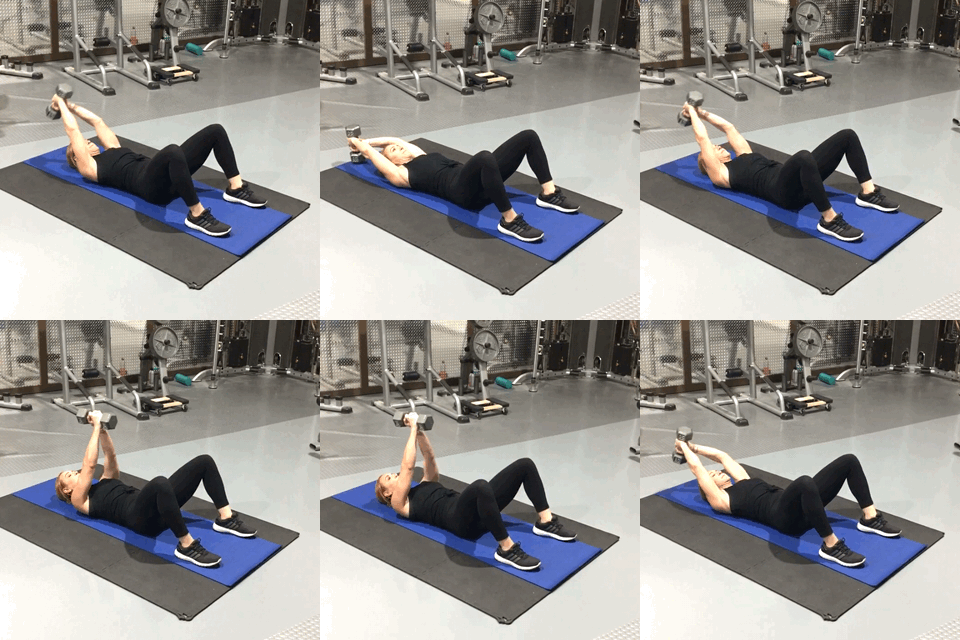
  • Pull-overs: To modify this exercise start by using a light weight while lying on your back on the floor. Start with your feet planted and arms holding the weight above your chest. Slowly bring the weight overhead to tap the floor while flaring your elbows and keeping only a slight bend in the arm. As you bring the weight overhead pull your pelvis back by contracting your core and pressing your back into the floor. As you progress you can do this exercise from an elevated surface such as the bench to gain a bigger depth and stretch at the bottom of this motion. Aim to perform 10-15 reps of this exercise. This exercise is great for targeting the upper back including your lats, chest, triceps, serratus anterior and core muscles. 

dumbbell pull-overs

  • Romanian deadlift with a row: This exercise can be modified by standing with your feet turned out slightly and using lighter weights. As you get stronger you can slowly increase the amount of weight you’re using and the number of reps and sets you’re doing. Start by standing with your feet about hip width apart and arm hanging down in front of the body. Then, slowly hinge forward with your chest by sitting back into your hips until your back is at a 45 degree angle. While keeping a flat back row the arms back towards your hips driving your elbows past your back. Repeat this exercise for 10-15 reps. This exercise targets your glutes, hamstrings, core, back and biceps. 

romanian deadlift with a row

Showing yourself grace post-pregnancy

Getting your body back to where it was pre-pregnancy is going to be a process that takes time. Be patient with yourself and learn to love and appreciate your body along the way. Your body just went through a ton of changes and created a human life, which it deserves recognition for. The female body is truly a miracle worker!  The best thing you can do for yourself is help your body recover and get back to its strongest self by being consistent in your training, eating a well-balanced macro-friendly diet and listening to your body’s needs.

If you need help getting started we have trained prenatal and postpartum professionals who are here to help. We work a ton with moms and often times we work with our moms through multiple pregnancies. We understand the delicate balance between wanting to get back to your pre-pregnancy body and showing yourself some grace through this transition period. The important thing to remember with postpartum exercise is that there’s nothing your body can’t do with the right training and proper guidance.

6 Strength exercises for beginners to improve how their body functions

Where to start with strength training

If you’ve never done strength training before it can be confusing to know where to begin. It’s always better to value form before function so start with basic strength exercises for beginners. For most people this means starting off with some body weight movements to understand form, muscle engagement and how to activate your core properly. This means that the use of weights or other forms of added resistance will come later in your training. If you get ahead of yourself you risk injury or compensation. 

How to choose the right strength training exercises

When you think about strength training you want to make sure you’re picking exercises that are functional, meaning movements you perform in everyday life outside of the gym. You also want to think about choosing exercises that will help you improve your posture and how you move. This is important so that you can shield yourself against injury and improve the overall functioning of your body

To know which exercises are right for you it’s recommended that you perform a postural assessment.

You can do this by either having someone take a picture of you standing facing the camera, in profile and with your back to the camera or you can assess yourself in the mirror. You want to be looking for any alignment issues or compensation that is happening in your body. If you drew a line down the center of your body both sides of your body should mirror each other both from side to side and front to back. In using this midline you also want to be looking to see if your joints are stacked on top of each other. If your shoulders round forward or your pelvis tilts forward you will see that your joints are not stacked on top of each other following this midline. Any deviations in how you stand will need to be addressed in your strength training routine. 

Basic strength exercises for beginners

Once you’ve performed your self-assessment we can begin selecting the right exercises for you based on your needs.

Basic strength exercises for beginners with weak back and core muscles.

If your shoulders round forward and you slouch you should be doing strength exercises to train your back and core muscles. To do this perform 3 sets of 10-15 reps of each of the following exercises:

Lying prone scapular retractions doing superman pull-downs.

To perform this exercise focus on contracting your abdominal muscles to stabilize your spin and then depress and retract your scapulae (shoulder blades) by pulling your shoulders back and down. Maintain this squeeze between your shoulder blades as you drive your elbows back towards your sides. Then repeat and remember to keep your feet elevated. This exercise targets your transverse abdominal muscles, glutes, upper trapezius, middle trapezius, levator scapulae, rhomboid minor, serratus anterior (muscles that move the scapulae), and erector spinae muscles.


Bird dog.

To perform this exercise start by kneeling on all fours and slowly extending the opposite arm and leg away from your body. Be sure to keep the core tight and shoulders down and back. You also want to fully extend through the arm and leg that are elevated so that the arm and leg are straight. Hold for 10 seconds and then repeat on the other side. This exercise targets the erector spinae, rectus abdominis, glutes, anterior deltoid, upper trapezius, middle trapezius, levator scapulae, rhomboid minor, serratus anterior (muscles that move the scapulae).


Basic strength exercises for beginners with weak hips and glutes.

Standing hip flexion.

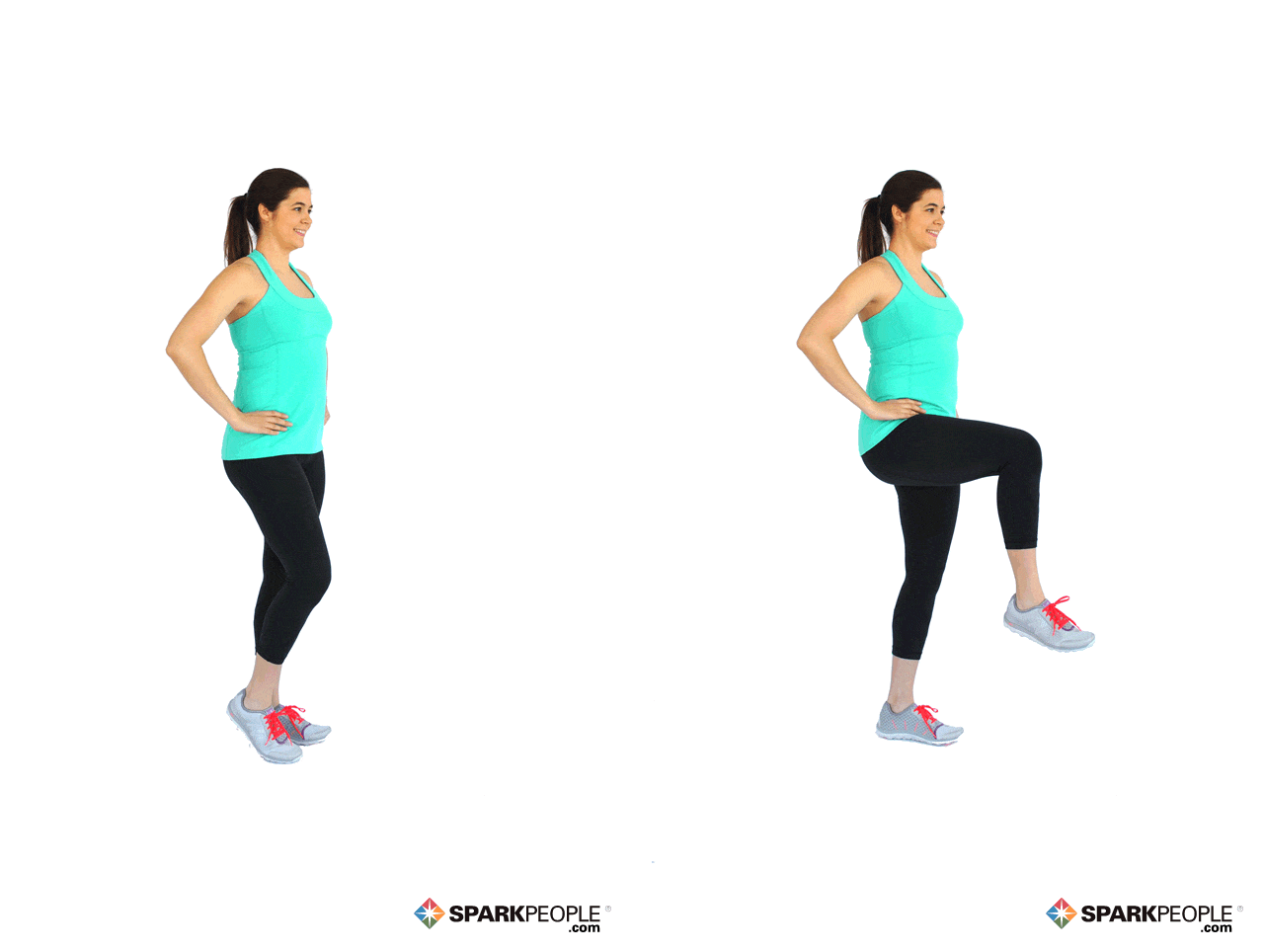
To perform this exercise start by standing upright and raising one knee to the height of your hip at a 90-degree angle. Squeeze your glutes to help you stabilize at the top. Hold that contraction for 5-10 seconds and lower your leg and repeat. This strength exercise targets your hip flexors, glutes, core, calves and the muscles of your feet.


Standing hip abduction.

To perform this exercise start by standing upright and shifting your weight to one leg. Slowly lift the opposite leg off the floor away from your body keeping the leg fully extended and the toes flexed. Make sure your toes are pointed ahead at all times to prevent your hip from externally rotating. The muscle primarily targets the hip abductor muscles located on the outside of the hip. This helps to promote strength and stability in the hip when walking or running.


Basic strength exercises for beginners with weak quads or hamstrings and glutes.

Lying glute bridges.

To perform this exercise start by lying flat on your back with your legs bent at 90 degrees and feet planted on the floor. Pull your pelvis into a neutral position by contracting your core and pulling your navel in towards your spine. From this position contract your glutes and lift your hips towards the ceiling. This exercise targets your erector spinae, transverse abdominis, glute medius and minimus (abductors), hamstrings and adductors.

Wall sits.

To perform this exercise start by standing upright with your feet shoulder-width apart and about 1 foot from the wall. Bring your back and shoulders against the wall and lower your body against the wall until your knees are at or near 90 degrees from your hips. Keeping your back, shoulders, arms and head against the wall hold this contraction for 10-15 seconds. Then release and repeat. This exercise targets your glutes, quadriceps, hamstrings and calves.

Strength exercises should improve function

Regardless of whether you are a beginner or experienced, strength training should always aim to improve your body’s function. When approached in this way, strength training can protect you against injury, heal muscular imbalances, improve your mobility, reduce your musculoskeletal aches and pains and greatly enhance your quality of life. The best part of all is it’s easy to get started. You can start off strength training from home without the need of any equipment.Â