Turning fat into muscle: Truth about the myth

How to change your body composition

You lose weight by being in a caloric deficit. This means you’re burning more calories than you’re taking in. However, most people don’t realize that when you lose weight you don’t just lose fat, you also lose muscle. Just like you can’t spot reduce where you lose weight, you can’t control what percentage of your weight loss is fat loss. In order to preserve the muscle on your body you need to be sure that while you’re in a caloric deficit you’re also: 

It’s important to note however that the muscle definition that you see once you lose fat is often the muscle you already had on your body, it just becomes more visible once your body becomes leaner. It’s hard to build new muscle while in a caloric deficit because a caloric surplus is generally needed to perform the workouts necessary and progressively overload. You expend a lot of calories during your strength training workouts. This is why it’s hard to simultaneously lose fat and gain muscle. There are a few exceptions to this.

For example, if you’re new to weight lifting and have very little muscle on your body currently this will be easier to accomplish because weight lifting becomes a new stimuli. It shouldn’t be a disappointment to you if this exception doesn’t apply to you. You can still get the physique you want by losing fat and maintaining the muscle you currently have on your body. This is accomplished by following a proper diet and exercise program.

Does fat turn into muscle

You can shrink fat cells, but you can not turn fat into muscle. Muscle is “active tissue that burns calories around the clock even as you sleep.” Fat however is just the storage of excess energy. Some body fat is needed to stay healthy but when you have too much it will start to collect around your waist, hips and butt. 

You can help fuel your muscles by taking in a high protein diet as I mentioned above and you can help reduce your fat by putting yourself in a healthy caloric deficit, which should be about 20% below your maintenance. If you cut your calories too much too fast you risk slowing your metabolism and losing too much muscle.

How aging affects body composition

It is a myth that muscle turns to fat with age, but rather studies have shown that fat mass increases and muscle mass decreases with age. This increase in fat is more likely to collect around the mid-section, which puts you at risk for things like cardiovascular disease and diabetes. Part of the reason for this is because naturally our metabolism slows down with age. This is why we can’t get away with eating the same unhealthy foods we did when we were younger without paying the price for it in our body fat.

Having a solid strength training program in place helps to counter this effect of aging because it helps slow down the process of muscle atrophy and speeds up your metabolism so you’re burning more calories at rest. 

Diet to lose fat and maintain muscle

There is no such thing as a fat to muscle diet. Having a high protein diet that is rich in lean protein sources such as chicken, beef, fish, beans, eggs, yogurt, turkey and lentils is helpful in building or maintaining muscle because protein is necessary for the repair, growth and maintenance of muscles. However, you don’t want to have so much protein that it puts you into a caloric surplus, which will cause the extra calories to convert to fat. To better understand how many calories you should be taking in each day read our blog post on macro-tracking.  To lose fat you need to make sure you are in a healthy caloric deficit so you don’t lose weight too fast and risk losing too much muscle too. 

Beginner’s workout plan for a busy schedule!

Where to start with a workout plan

Working out doesn’t have to be complex, complicated nor time-consuming. You just have to establish a workout plan that you can stick to consistently even when you aren’t feeling motivated. A good way to carry out this easy workout plan for beginners  is to follow these simple tips:

  • Establish a good time of day to workout that fits with your schedule and when your energy level is at its highest – If you are like me and aren’t a morning person pick a time in the afternoon or evening after work. If your schedule gets more chaotic as the day progresses an earlier time in the day may be best for you. A lunch hour workout may be good if you like the idea of breaking up your work day with some self-care.
  • Figure out what your goals are so you can follow a fitness program that will help you target them – If your goal is to lose weight your workout will look different then if your goal is to put on muscle. Maybe your goal is simply to move more and that is okay too.
  • Find someone to hold you accountable – When you’re feeling like the couch is looking more appealing than the gym you need that person who is going to call you out and remind you about your fitness goals. This person could be a friend, your partner or even a co-worker. You can even have this person workout with you so you have a buddy to help push you to work harder.
  • Upgrade your workout attire – If it’s been awhile since you worked out chances are your gym clothes could use some updating. Make sure you’re not wearing the best clothes to the office and scrubs to the gym. When you look good in what you’re wearing to the gym your confidence gets a nice boost and you’re more motivated to workout harder.

Workout routine for beginners

You can establish and try a workout routine for a week with a few easy yet effective exercises that don’t require any machines or equipment. These exercises can be consistently incorporated into any workout routine at home.

For strength training try these exercises:

  • Planks are a great exercise to include in your workout routine at home because they target your total body including your core and you can do lots of variations.
  • Lunges are a good lower body exercise to do because it is a compound movement, which means multiple muscles are engaged at once. You can also mix it up when you get bored by trying different variations including curtsy lunges.
  • Squats are another great lower body compound movement with lots of variations.
  • Push-ups everyone is familiar with and this exercise is great for your upper body workout.

If your focus is on cardio try these calisthenics moves:

  • mountain climbers
  • step-ups
  • jumping jacks
  • jump squats

For either goal you should aim to complete at least 10-15 reps of each exercise and then recover for up to one minute before then repeating the circuit again. If you have the time, repeat the circuit 3x. If it’s your first time, see if you can complete the circuit once fully and gradually over time work yourself up to three sets.

A good way to combine these exercises into a workout routine for beginners is to choose 2-3 lower body exercises, 2-3 upper body exercises and 2-3 core exercises and perform them in a circuit. As mentioned above you can go for 10-15 reps or if you have a stopwatch you can go for time instead. If you’re going for time push yourself for 30-45 seconds followed by a 15-30 second rest or recovery period. Then repeat with the next exercise.

This way you get a solid total body workout in as little as 15-30 minutes.

Workout routine at home when you're short on time

If you have small children at home or if you work from home you may find it hard to designate a certain time to exercise. A good way to workout with a busy schedule is to incorporate exercise into your normal everyday activities. For example:

  • You can be doing squats while you’re putting the laundry or dishes away. Squat before each time you pick-up the clothes or dishes.
  • Practice lunging while you’re running the vacuum.
  • If you are on mommy or daddy duty you can do shoulder overhead raises with your child in your arms or squats and lunges while holding them. Older children love to partake in exercise with mommy and daddy. You can do a yoga routine while teaching them how to do it with you so it becomes a family activity.
  • When you’re sitting at your desk for long periods of times incorporate a few sit and stands from your desk chair. You can also do a plank or triceps dips on your desk chair while you’re reading your emails.

There are lots of creative ways like these to incorporate exercise in the home each day. 

How often should beginners workout

When you’re new to exercise any bit counts. Don’t put pressure on yourself right away to workout a certain amount of times each week. Start with what is manageable for you and your schedule. Also, listen to your body and don’t overdo it.

As you get into a regular routine it’s most optimal to workout a minimum of twice per week and three times per week is even better! Your sessions don’t have to be an hour long each time. A very effective workout can be done in as little as 30 minutes. The key is to limit the amount of rest you take in between exercises.

It is NOT advised that you do strenuous exercise everyday. Your body needs time to recover in between workouts. However, getting in the habit of moving everyday is recommended. This could mean going for a walk or taking the stairs more often. It means instead of sitting at your desk for 8 hours straight you take breaks periodically to get up and walk around and stretch.

Posture can be improved to alleviate chronic pain

Fix Your Posture To Alleviate Chronic Pain

Correcting bad posture habits

We all are guilty of slouching when we sit, walk and even stand which promote bad posture. However, most of us aren’t even aware we are doing this. Most of us lack self-awareness of how we move throughout our day. Poor posture has been linked to back pain as a main cause. Breaking bad posture habits requires us to check in with ourselves and observe what proper posture looks and feels like.

Having good posture always looks better and it also affects both our health and our state of mind. Let’s look at some proper postures:

Proper Standing Posture:

We can do this by observing ourselves in a mirror. Good posture means we pull our head back and our shoulders down and back. You should feel as if you’re sticking out your chest if you’re standing correctly.

Proper Sitting Posture:

We can also practice sitting all the way back in our chairs. By doing so we should be able to keep our feet flat centering our weight over our buttocks and pubic bone. This will ensure we’re in the proper alignment. If we’re in a car or sitting against a soft service using a lumbar support pillow under our lower back helps alleviate discomfort.

Proper Lifting Posture:

Paying attention to how we lift is also important. We should always practice lifting with our legs by squatting to get our bodies under the weight rather than hinging from the waist. We never want to pick-up something by rounding our backs. Our shoulders should always remain back and chest out.

We should also get out of the habit of carrying heavy loads on our backs as this creates a lot of added strain. The best method for transporting a load is by using a cross-body bag or a backpack to help distribute the weight more evenly.

High heels are another culprit for poor posture. They cause the entire weight of the body to shift forward towards the ball of the foot putting strain on the back and knees. We should opt for wedges and low heels under 2 inches instead.

Proper Sleeping Posture:

Sleep posture is an important factor to consider when improving bad posture habits. When we sleep on our side we should always put a pillow between our knees to stay in alignment. If you’re a back sleeper placing a pillow under the knees can help open up the joint spaces in the spine. We should try to avoid sleeping on our stomachs as this puts a strain on the neck and move towards a healthy sleeping position.

Effects on the body - How bad posture hurts your body

Bad posture doesn’t only affect your back. It can also:

  • lead to knee, hip, shoulder, pelvic and neck pain and arthritis
  • can hinder digestion and even cause headaches
  • disrupt your ability to concentrate and move efficiently
  • can interfere with your quality of sleep and even quality of life

Many people spend hundreds of dollars on chiropractors and massages to help reduce the persistent pain they feel from poor posture. However, this remedy is only a temporary fix. Until we take a proactive approach to correct our posture and practice good sitting, standing and lifting habits we will continue to suffer the repercussions of bad posture.

Identifying bad posture

Good posture can feel exaggerated or unnatural especially if you’re used to slouching. In order to identify whether your posture is good or bad, here are a few things you may want to try:

Correcting Standing Posture:

When you’re standing your body should be in alignment by keeping your head in a neutral position and your ears lined up with the middle of your shoulders. Both your upper and lower back should be upright. Many people with a weak core stand with their pelvis tilted forward. You should always keep your hips tucked under you minimizing the curve in your lower back. The illustration below from the Comprehensive Spine Institute best depicts what good and bad standing posture should look like.


Correcting Sitting Posture:

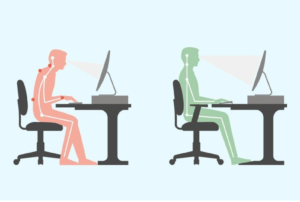
On average people spend 10 hours a day sitting, which is also taking a toll on our posture. The first thing you need to check is your computer, desk or work station. If your desk is not at the right eye level of the computer screen and your keyboard is not positioned the right distance from your chair you will slouch your shoulders jetting your neck forward, which is a sign of bad back posture. Check that your feet are resting flat on the floor and that your legs are not crossed. This ensures your weight is evenly distributed across both hips and feet. The illustration below is a good visual of the difference between good and bad sitting posture.

 
We can also use the wall test to help us identify bad posture. Start by standing with your head, shoulder blades and buttocks against the wall with your heels 2 to 4 inches from the wall. Bring your palms up by your ears so that your fingertips also touch the wall. Have someone place their palm behind your lower back against the wall. There should be just enough room for them to slide their hand between your lower back and wall. When there is too much space draw your belly button in towards your spine. If there is not enough space arch your back just enough for the hand to fit. In the event you don’t have someone to help you, practice using your own hand.
 
These simple tips can help you in identifying how to improve posture.

Exercises to improve posture

Now that you are aware of your bad posture there are some basic posture correction exercises you can do regularly to help correct it.

Back And Shoulder Exercises:

  1. The shoulder blade squeeze involves sitting upright in a chair with your hands resting on your thighs. Keeping your shoulders down slowly draw your shoulders back and squeeze your shoulder blades together. Hold here for a count of 5 and repeat several times. You can also try this exercise while lying flat on your stomach with your arms by your side and your thumbs pointed up towards the ceiling. All you have to do is practice drawing your shoulder blades together without lifting your head or feet off the ground.

  2. Wall angels are another exercise we do with our clients to help reverse bad posture. To do this stand with your back against the wall and your feet 2 to 4 inches from the wall. Bring your arms up by your ears so your elbows are bent and rest your palms, head, buttocks and shoulders against the wall. From here you can practice the shoulder squeeze exercise and then try straightening your elbows to raise your arms up over head forming the letter Y. Repeat this exercise 10 times for 2-3 sets.

  3. Using a resistance band you can also stand with your feet staggered with one foot in front. Place the band underneath your front foot and while holding the handles lift the resistance band upwards away from your body keeping your arms straight. Keep a slight bend in your elbows and hold here at shoulder height for a few seconds before repeating. Be sure to keep your shoulders down and back straight while doing this exercise. This is called the V-move.

Chest Exercises:

  1. To loosen your tight chest muscles, which often become restricted with bad posture try the doorway stretch. While standing in a doorway bend one elbow and lift your arm so that your elbow and shoulder are aligned. Place your hand at the edge of the doorway or on the corner of the wall and slowly lean into your raised arm so that your chest moves forward past the wall and hold for about 10 seconds. Repeat this several times on each side.

Hip Flexor Exercise:

  1. Tight hip flexors can also affect your posture. To stretch them start by kneeling on the floor with one foot planted and the opposite knee down. Place both hands on the right thigh and lean forward to feel a stretch in the hip flexors. You can also advance this stretch by bringing both palms on the inside of the front leg so that they are resting on the floor. The goal here is to get your shoulders in alignment with your front knee. Hold for 10 seconds and repeat several times on each side.

There are many yoga poses for correcting bad posture by stretching and training the back muscles to engage properly. Keeping your core strong and hips open also plays a part both of which yoga helps with.

Calisthenics is effective and convenient

Why calisthenics is so popular

Calisthenics, better known as body weight training, continues to be a highly favored form of exercise. This is because you can do it from anywhere at anytime without the need for equipment. It’s also very effective because your body itself is a great form of resistance. Have you ever tried holding a plank or a wall sit for a minute? It’s not easy even without any added weights. Calisthenics is just the right amount of challenge for someone just starting out with an exercise program. It’s also an effective form of exercise to supplement with your weight-lifting days. Boredom is also never an issue because there is a lot you can do with your own body weight.

Start with body weight training first

You never want to jump into lifting heavy weights right away when you’re starting an exercise program because you could injure yourself. We first introduce calisthenics when working with new clients so we can identify their strengths and weaknesses. If you can’t do a proper squat without weights, you definitely don’t want to use dumbbells. This will only become more detrimental to your form.

Calisthenics will help improve your posture, strength and overall body composition making it effective for building muscle and losing weight. This will prepare you for more advanced levels of training later on.

Most effective calisthenics exercises

There are many effective body weight exercises to target total body. These include push-ups, planks, superman, sit-ups, squats, lunges, dips, and pull-ups. You can also check-out loads of variations to these exercises. Here is a list of 50 body weight (calisthenics) exercises broken down into 5 different sections. This way you can recognize, which muscles are being targeted in each exercise. Some of my favorite more advanced moves not included here are v-ups, standing split squats and single leg burpees.

Never under estimate what you can accomplish from doing body weight training

Body weight training is harder than it looks so don’t underestimate what it can do for you! It is a great place to start for beginners and also an effective way to measure your progress. Calisthenics teaches you to become aware of your form at all times. It gives you a great overall total body workout so that you can walk away feeling you’ve accomplished a lot!

Spot Training for Fat Loss: Why it’s a myth

Spot Training For Fat Loss Isn’t A Thing

What is spot training

Spot training seems to be on everyone’s mind lately. As nice as the idea of spot reducing your fat stores in certain parts of your body sounds, it is not how the body works. If it were that easy, we should all have six-pack abs by now.

Our bodies are predisposed to store fat in certain areas. The only way to target fat loss in certain areas is to target the whole body. When you lower your overall body fat percentage you’ll lean out your total body including those problem areas. This is why spot training is a myth. As we know lowering your body fat requires proper diet and exercise.

Reduce muscle imbalances with spot training

Spot training can work if you are looking at correcting muscle imbalances or improving strength in certain parts of your body. For example, runners are able to build up strong quad and hamstring muscles in their legs by running consistently. However, by not training arms their upper body tends to be weaker, which can hinder their running form. By focusing on training upper body they can ensure their upper body has the strength to propel their legs forward.

This type of spot training is helpful if you are training for something specific that requires it. The optimal body composition is one that is in balance because we are designed to use our whole bodies. When you have muscular imbalances it can lead to health issues such as poor posture, joint pain, and muscle compensation. These muscle imbalances can be caused by over-training certain parts of the body as mentioned above. We can also unknowingly cause these imbalances through poor posture, remaining in a sedentary seated position for an extended period of time or wearing shoes with an elevated heel.

Perfection doesn't exist

The way most people view spot training is with the idea that there are problem areas on your body. The reality is all of our bodies have imperfections. We all have stretch marks, flab somewhere, cellulite, you name it. Rather than zeroing in on these areas we want to change we should broaden our focus to building overall body strength and improving our health. When we put our health first, our bodies will respond. It takes time and consistency, which is why it’s important to form new healthy habits and adopt an effective fitness routine.

Leave your comments below if you need any further clarity on spot fat reduction or how you can achieve your fitness goals.

Weight training guide for women

A lot of women that I train or that I know are afraid to use weights that are challenging for them because they assume it will make them look bulky so they keep using the same light weights week after week in their workouts. Women are not genetically built with enough testosterone in their body for this to happen. 

The key to building strength and a toned build is to challenge your muscles so they grow otherwise you will never see much of a change. To gain muscle you need to build muscle strength. If you can do 15+ reps of any given exercise easily before reaching muscle failure, then it’s more effective for you to increase your weight. Doing lots of reps with less weights improves muscle endurance. Ideally, for muscle hypertrophy you should be using weights that you can only comfortably do 8-10 reps at a time before resting.

It’s also important to maintain good form through each of these reps. If you notice your body having to compensate using other parts of your body to complete the rep then you should rest or immediately drop down to the next size weight.

Consistently is also necessary. You should aim to do strength training at minimum 3x a week to see the best results and you want to make sure you are working your entire body. Some people prefer to isolate certain parts of the body during workouts or the other option is to work total body during each workout. Either way, you need to find a routine and stick with it to make progress.

Here is my frame and right now I am using between 15-25 pound weights for my upper body workouts and between 20-35 pound weights for my lower body workouts. As these weights become easier I will gradually keep increasing the weight I use. Checkout my latest exercise routines  to train upper and lower body that I use and also use with my clients to help jumpstart your next workout.

Having more muscle on your body is advantageous for a few reasons. First, it makes you look leaner. Second, it speeds up your metabolism, which helps you burn fat more efficiently because it takes more energy to sustain muscle on the body. When you are more toned you actually burn more calories even after you are done working out.

So, ladies, stop doing 50 reps with the 3-5 pound weights. It’s much more effective and a better use of your time to do fewer reps with more weight. You will gain more muscle over time giving you the lean strong physique you desire.

Health conscious living

Being health conscious goes beyond just working out and eating a clean diet. The products we put on our skin and ingest through the air are also raising health concerns as many of them contain toxic ingredients. After I switched to buying mostly organic food (i.e. meat, eggs, and any produce where I consume the outer skin) I began looking more closely at the ingredients in my hair and skincare products. Before I knew it my entire household became mostly eco-friendly. All of my cleaning products, skin and hair care products are made with all natural ingredients and are paraben, phosphate and sulfate-free. There are many companies now offering clean products for the health conscious consumer. 

My personal favorite household brands are Method, Seventh Generation, Mrs. Meyers and The Honest Company. To prove that they are eco-friendly many of these companies provide a list of all the ingredients for each of their products, what these ingredients are and what they do on their website. Some like Method also use fun eco-friendly packaging, renewable energy and a biodiesel shipping program. Seventh Generation makes natural baby and feminine care products in addition to cleaning agents. Now many companies are joining the health craze and are going green. The GoodTrade has listed their top 12 picks so there’s plenty of options to choose from. 

When it comes to skincare I choose Natural Organic Coconut as my make-up remover and face moisturizer. I also apply Beauty By Earth all natural sunscreen on my face daily, which is free of parabens, phthalates, and nano-particles. My favorite body moisturizer C. Booth is cruelty-free, paraben and sulfate free and petroleum free. On my hair I use Deva Curl Supercream, which is paraben, lanolin, topical antibiotic and nickel free. I will be honest, I have not yet made the switch to organic make-up, but I do plan to in the near future.

Health conscious living has made me so much more aware of my habits and the amount of products I use and consume. I can’t buy anything now without first reading the label because it’s become such a habit now and I want to continue to educate myself. I think for so long we just trusted that the products on our shelves were safe for us to use since they are supposed to be FDA regulated and now we know that’s just not always the case. I realize it’s impossible to eliminate all toxins from our body, but I feel any bit we can do to be more green can enable us to better serve our health and our environment. 

Healthy habits that changed my life

Today I woke up congested with a head cold and for the last three nights I hadn’t gotten my usual 8 to 9 hours of sleep. Coincidence –I think not! I’ve gotten to understand my body very well and one thing I’ve always needed to feel and perform at my best is lots and lots of sleep. Up until this past week, I’ve made it a priority this year to get a full night’s rest consistently at all costs and as a result I have had my longest streak ever of not catching that pesky ol’ cold and flu that I’m normally so susceptible to. I dropped the ball this week by overloading my schedule with more clients, which cut down my sleep time and now sick is the price I pay. What people don’t realize is that sleep is most definitely not overrated. Each of those hours you are resting your body is actually using to repair itself. Every organ in your body has a repair/maintenance cycle during each hour of everyday. The liver, lungs, large intestine, stomach and spleen are all repairing themselves during the hours when we are supposed to be sleeping, which is why if your sleep cycle is disrupted you may wake up feeling bloated and achy.

Keeping a clear mental state has also become very important to me. I realize that if I’m feeling anxious, easily irritable and overwhelmed it inhibits my happiness. Meditation has become my calming agent. I try to meditate each morning for 20 minutes to set the day on a positive note. It allows me to quiet my mind and focus my attention on what I’m grateful for and positive affirmations. The more you fill your mind up with good thoughts the less you become effected by negative people and circumstances. Creating this space in my life has become a safe haven. It allows me to have a daily practice of self-care and self-love. It’s made me a more peaceful person and because of this I have so much more to give. And as the saying goes, “when you love life, it loves you right back.” 

I’ve found it so rewarding to have found my personal passion for fitness. Many people exercise to stay in shape, but when you find a physical outlet that you love it becomes therapeutic. Yoga for me has become that outlet. I enjoy lifting weights, but I love exploring what the body alone is capable of doing as can be seen in how I train my clients. It’s a true art form. The more disciplined, controlled and self-aware I am the more limitless I become. Meditation has really complimented my yoga practice because together they center on mind and body connection. This is a principal of exercise that I always strive to convey to my clients. The more you connect your mind with the physical form, the better you can execute.

Healthy habits don’t happen overnight. It’s something you have to nurture consistently, but the more you do the greater the impact you’ll see in your life.