6 Strength exercises for beginners to improve how their body functions

Where to start with strength training

If you’ve never done strength training before it can be confusing to know where to begin. It’s always better to value form before function so start with basic strength exercises for beginners. For most people this means starting off with some body weight movements to understand form, muscle engagement and how to activate your core properly. This means that the use of weights or other forms of added resistance will come later in your training. If you get ahead of yourself you risk injury or compensation. 

How to choose the right strength training exercises

When you think about strength training you want to make sure you’re picking exercises that are functional, meaning movements you perform in everyday life outside of the gym. You also want to think about choosing exercises that will help you improve your posture and how you move. This is important so that you can shield yourself against injury and improve the overall functioning of your body

To know which exercises are right for you it’s recommended that you perform a postural assessment.

You can do this by either having someone take a picture of you standing facing the camera, in profile and with your back to the camera or you can assess yourself in the mirror. You want to be looking for any alignment issues or compensation that is happening in your body. If you drew a line down the center of your body both sides of your body should mirror each other both from side to side and front to back. In using this midline you also want to be looking to see if your joints are stacked on top of each other. If your shoulders round forward or your pelvis tilts forward you will see that your joints are not stacked on top of each other following this midline. Any deviations in how you stand will need to be addressed in your strength training routine. 

Basic strength exercises for beginners

Once you’ve performed your self-assessment we can begin selecting the right exercises for you based on your needs.

Basic strength exercises for beginners with weak back and core muscles.

If your shoulders round forward and you slouch you should be doing strength exercises to train your back and core muscles. To do this perform 3 sets of 10-15 reps of each of the following exercises:

Lying prone scapular retractions doing superman pull-downs.

To perform this exercise focus on contracting your abdominal muscles to stabilize your spin and then depress and retract your scapulae (shoulder blades) by pulling your shoulders back and down. Maintain this squeeze between your shoulder blades as you drive your elbows back towards your sides. Then repeat and remember to keep your feet elevated. This exercise targets your transverse abdominal muscles, glutes, upper trapezius, middle trapezius, levator scapulae, rhomboid minor, serratus anterior (muscles that move the scapulae), and erector spinae muscles.


Bird dog.

To perform this exercise start by kneeling on all fours and slowly extending the opposite arm and leg away from your body. Be sure to keep the core tight and shoulders down and back. You also want to fully extend through the arm and leg that are elevated so that the arm and leg are straight. Hold for 10 seconds and then repeat on the other side. This exercise targets the erector spinae, rectus abdominis, glutes, anterior deltoid, upper trapezius, middle trapezius, levator scapulae, rhomboid minor, serratus anterior (muscles that move the scapulae).


Basic strength exercises for beginners with weak hips and glutes.

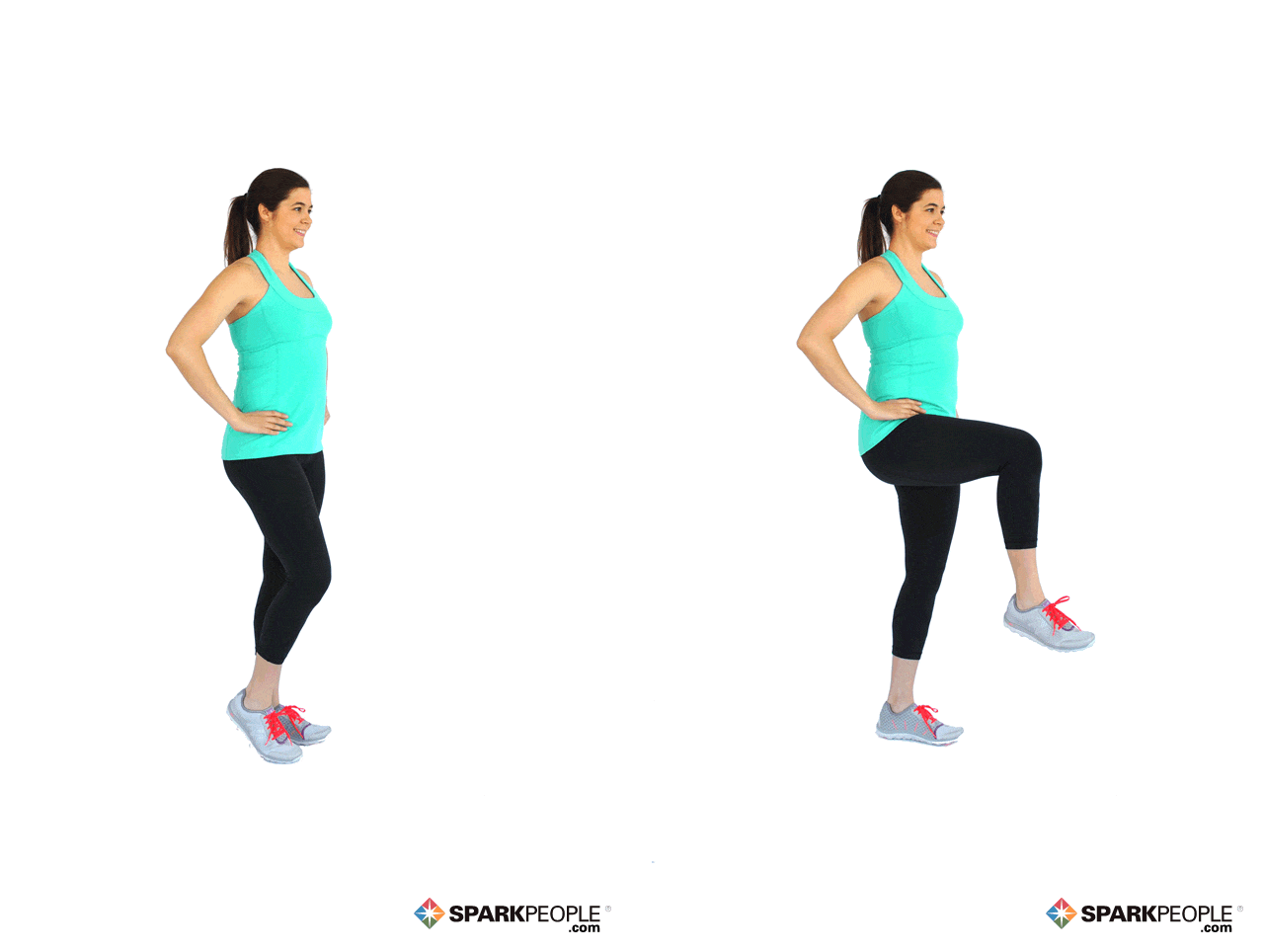
Standing hip flexion.

To perform this exercise start by standing upright and raising one knee to the height of your hip at a 90-degree angle. Squeeze your glutes to help you stabilize at the top. Hold that contraction for 5-10 seconds and lower your leg and repeat. This strength exercise targets your hip flexors, glutes, core, calves and the muscles of your feet.
 

Standing hip abduction.

To perform this exercise start by standing upright and shifting your weight to one leg. Slowly lift the opposite leg off the floor away from your body keeping the leg fully extended and the toes flexed. Make sure your toes are pointed ahead at all times to prevent your hip from externally rotating. The muscle primarily targets the hip abductor muscles located on the outside of the hip. This helps to promote strength and stability in the hip when walking or running.


Basic strength exercises for beginners with weak quads or hamstrings and glutes.

Lying glute bridges.

To perform this exercise start by lying flat on your back with your legs bent at 90 degrees and feet planted on the floor. Pull your pelvis into a neutral position by contracting your core and pulling your navel in towards your spine. From this position contract your glutes and lift your hips towards the ceiling. This exercise targets your erector spinae, transverse abdominis, glute medius and minimus (abductors), hamstrings and adductors.

Wall sits.

To perform this exercise start by standing upright with your feet shoulder-width apart and about 1 foot from the wall. Bring your back and shoulders against the wall and lower your body against the wall until your knees are at or near 90 degrees from your hips. Keeping your back, shoulders, arms and head against the wall hold this contraction for 10-15 seconds. Then release and repeat. This exercise targets your glutes, quadriceps, hamstrings and calves.

Strength exercises should improve function

Regardless of whether you are a beginner or experienced, strength training should always aim to improve your body’s function. When approached in this way, strength training can protect you against injury, heal muscular imbalances, improve your mobility, reduce your musculoskeletal aches and pains and greatly enhance your quality of life. The best part of all is it’s easy to get started. You can start off strength training from home without the need of any equipment. 

Deadlifts for beginners: Benefits, Techniques, and Tips!

Deadlifts for beginners: Using proper form and technique

A very common exercise that’s enjoyed by many in the fitness world is the deadlift.
Unfortunately, if performed poorly, the heavy weight and sheer force necessary for
this exercise poses a great threat of injury.

Do you know how to protect yourself by having a proper deadlifting form? When
using this compound exercise, learning a few primary deadlift tips and tricks will
help keep you safer while lifting more.

Benefits of the deadlift

Have you ever wondered what makes deadlifts such an important exercise? 
This is due to the fact that it’s a compound workout and therefore almost every
muscle in the body is used during it. Throughout the lift your arms, forearms, and grip help keep the bar secure and in place. Moreover, your core and back keep your
body tight and stable while also securing your spine.

Did you know an exercise that utilizes many muscles all at once achieves a higher
degree of calorie burning and fat loss? This is because these kinds of workouts take
a lot more energy to execute.

Another (not so) fun fact is that back pain is the main cause of injury in Americans of all ages. Fortunately, deadlifts are perfect for improving the muscles of your posterior chain and back

Executing a deadlift

If we know form is imperative to deadlifting safely what does this look like? Let’s go over the different steps so you have a better idea. First, you should know you can use either a barball or kettlebell to perform this exercise. To get started:

  • Stand with your feet beneath the bar and shoulder-width apart.
  • Grab the bar with your preferred grip just further than shoulder-width apart.
  • Bend your legs forward until the bar reaches your shins.
  • Straighten the lower back while keeping your shoulders and chest up.
  • Power through with your legs and raise the bar off the ground.
  • Pause at the top by locking your hips and ankles
  • Return to the ground by moving your hips back and simultaneously bending your
    knees.

This is a very simple description but it is a perfect starting point for any beginner. You can see these steps demonstrated in this deadlift video tutorial. 

You should begin by only practicing your form. Improving technique is the easiest way for you to boost your skills and the amount you can deadlift. Once you are familiar with the deadlift form you should start applying more weight slowly. Another way to make this movement more challenging is to check out this deadlift progression video with 7 different deadlift variations.

Deadlift checklist

Below are some great cues you can use to remind yourself of the proper form and
improve your technique:

  • The barbell or kettlebell should be held with your palms facing towards your body and in a vertical, straight line when looking from the side.
  • The barbell or kettlebell should return to the floor and, after every rep, be over the center of your foot
  • Your feet should be fully planted on the floor at an angle of 15-20 degrees.
  • Grip is a personal choice, however, your thumbs should be curling around the bar to help with grip strength
  • You should never bend your elbows, always try to keep them straight and locked
    out
  • To eliminate rounding in the lower back, you should keep your chest up.
  • There should be a natural inward curve in your lower back and no unnecessary
    outward rounding.
  • Your shoulder blades should be above the bar and relaxed.
  • Your hips should remain above parallel at all times.
  • Before the lift, you should take a deep breath, keep it at the top, and exhale again at the bottom.
  •  It should be a seamless flowing motion to lift the bar off the ground. 

When I’m in the gym I usually go over this like a checklist. This will help keep your form on track and allow you to see where you can improve

Usual problems with the deadlift

Scraping of the knees

Excessive scraping to the shins is one of the key concerns that I typically see from beginners’ deadlifting with a barbell. The bar scraping the shins is a typical (and uncomfortable) concern that immediately turns many individuals away from the exercise. Luckily, something like a high and padded deadlift sock might be enough protection from the bar, however, if the problem persists there are a few simple ways you can easily fix this further. 

  • Pulling the bar backward and not upwards is the first and most common
    explanation for this problem. You should be moving the bar directly vertical from a side view. If you’re having issues with this during your workout, the reason is probably that you’re rocking back or raising your chest and shoulders too quickly. Remind yourself that only once the bar is raised off the ground should your shoulders and chest begin their movement upwards.
  • Beginning with your hips too low is a second frequent error in beginners. This is an issue because dropping your hips will force your knees to be pushed forward.
    If this is the case, your knees and shin will then be in the way of the bar, allowing it
    to scratch upwards on its course to the top.There’s a pretty quick solution to this, just pull your butt and chest up and remind yourself that your hips can never break below parallel. 

A back that’s rounded and arched

Having a rounded or arched back is another typical error I see beginners make.
Rounding the back will quickly lead to spinal disc herniation and bulges, as Dr.
Stuart McGill has reported. This is something that you desperately don’t want to

happen. 

Well, then how can you fix a rounded back? The secret to this is tension and a good set up from the start. The best way to have more spinal stability and to avoid an arched back is by engaging the lats more. Some people believe the proper way to accomplish this back tightness is to pinch the shoulders. This is not the case, since the distance that the bar would have to move would consequently increase.

Instead, before taking the bar off the ground, I normally recommend you take the
“slack” out of it. This will help to fully engage the back and lats from the start. Don’t
forget to also keep that chest up and over the bar!
 

Lack of grip strength

The third most common issue people have is a lack of grip strength. Because
deadlifts are a heavy compound exercise it can be difficult on your hands to lift the bar off the ground. The knurling of the bar can lead to nasty tears and cuts. If this is something you suffer from I suggest you invest in some lifting gloves or hand grips when completing a deadlift. This will help protect your hands from those cuts, tears and even infections. These work by adding an extra layer of protection between your skin and the bar. As a result, this improves your grip and wrist support by relieving the pressure exerted on your hands.

Deadlifts are one of the perfect exercises for building strength

For any beginner, deadlifts are the perfect exercise since it works just about every single major muscle group in the body that helps in building strength. There’s a reason it’s one of the main powerlifting exercises done by people all around the world!

Just remember to start slow and focus on that form, the heavy weight and big gains
can come after you master the basics!

This article was written by, Josh Lafond, the owner and operator of healthygymhabits. After receiving his PT certification in 2014 he became a personal trainer at his local gym. Since then Josh has been bettering his understanding of fitness to help others achieve their health goals online and in person.

Beginner’s workout plan for a busy schedule!

Where to start with a workout plan

Working out doesn’t have to be complex, complicated nor time-consuming. You just have to establish a workout plan that you can stick to consistently even when you aren’t feeling motivated. A good way to carry out this easy workout plan for beginners  is to follow these simple tips:

  • Establish a good time of day to workout that fits with your schedule and when your energy level is at its highest – If you are like me and aren’t a morning person pick a time in the afternoon or evening after work. If your schedule gets more chaotic as the day progresses an earlier time in the day may be best for you. A lunch hour workout may be good if you like the idea of breaking up your work day with some self-care.
  • Figure out what your goals are so you can follow a fitness program that will help you target them – If your goal is to lose weight your workout will look different then if your goal is to put on muscle. Maybe your goal is simply to move more and that is okay too.
  • Find someone to hold you accountable – When you’re feeling like the couch is looking more appealing than the gym you need that person who is going to call you out and remind you about your fitness goals. This person could be a friend, your partner or even a co-worker. You can even have this person workout with you so you have a buddy to help push you to work harder.
  • Upgrade your workout attire – If it’s been awhile since you worked out chances are your gym clothes could use some updating. Make sure you’re not wearing the best clothes to the office and scrubs to the gym. When you look good in what you’re wearing to the gym your confidence gets a nice boost and you’re more motivated to workout harder.

Workout routine for beginners

You can establish and try a workout routine for a week with a few easy yet effective exercises that don’t require any machines or equipment. These exercises can be consistently incorporated into any workout routine at home.

For strength training try these exercises:

  • Planks are a great exercise to include in your workout routine at home because they target your total body including your core and you can do lots of variations.
  • Lunges are a good lower body exercise to do because it is a compound movement, which means multiple muscles are engaged at once. You can also mix it up when you get bored by trying different variations including curtsy lunges.
  • Squats are another great lower body compound movement with lots of variations.
  • Push-ups everyone is familiar with and this exercise is great for your upper body workout.

If your focus is on cardio try these calisthenics moves:

  • mountain climbers
  • step-ups
  • jumping jacks
  • jump squats

For either goal you should aim to complete at least 10-15 reps of each exercise and then recover for up to one minute before then repeating the circuit again. If you have the time, repeat the circuit 3x. If it’s your first time, see if you can complete the circuit once fully and gradually over time work yourself up to three sets.

A good way to combine these exercises into a workout routine for beginners is to choose 2-3 lower body exercises, 2-3 upper body exercises and 2-3 core exercises and perform them in a circuit. As mentioned above you can go for 10-15 reps or if you have a stopwatch you can go for time instead. If you’re going for time push yourself for 30-45 seconds followed by a 15-30 second rest or recovery period. Then repeat with the next exercise.

This way you get a solid total body workout in as little as 15-30 minutes.

Workout routine at home when you're short on time

If you have small children at home or if you work from home you may find it hard to designate a certain time to exercise. A good way to workout with a busy schedule is to incorporate exercise into your normal everyday activities. For example:

  • You can be doing squats while you’re putting the laundry or dishes away. Squat before each time you pick-up the clothes or dishes.
  • Practice lunging while you’re running the vacuum.
  • If you are on mommy or daddy duty you can do shoulder overhead raises with your child in your arms or squats and lunges while holding them. Older children love to partake in exercise with mommy and daddy. You can do a yoga routine while teaching them how to do it with you so it becomes a family activity.
  • When you’re sitting at your desk for long periods of times incorporate a few sit and stands from your desk chair. You can also do a plank or triceps dips on your desk chair while you’re reading your emails.

There are lots of creative ways like these to incorporate exercise in the home each day. 

How often should beginners workout

When you’re new to exercise any bit counts. Don’t put pressure on yourself right away to workout a certain amount of times each week. Start with what is manageable for you and your schedule. Also, listen to your body and don’t overdo it.

As you get into a regular routine it’s most optimal to workout a minimum of twice per week and three times per week is even better! Your sessions don’t have to be an hour long each time. A very effective workout can be done in as little as 30 minutes. The key is to limit the amount of rest you take in between exercises.

It is NOT advised that you do strenuous exercise everyday. Your body needs time to recover in between workouts. However, getting in the habit of moving everyday is recommended. This could mean going for a walk or taking the stairs more often. It means instead of sitting at your desk for 8 hours straight you take breaks periodically to get up and walk around and stretch.