6 Strength exercises for beginners to improve how their body functions

Where to start with strength training

If you’ve never done strength training before it can be confusing to know where to begin. It’s always better to value form before function so start with basic strength exercises for beginners. For most people this means starting off with some body weight movements to understand form, muscle engagement and how to activate your core properly. This means that the use of weights or other forms of added resistance will come later in your training. If you get ahead of yourself you risk injury or compensation. 

How to choose the right strength training exercises

When you think about strength training you want to make sure you’re picking exercises that are functional, meaning movements you perform in everyday life outside of the gym. You also want to think about choosing exercises that will help you improve your posture and how you move. This is important so that you can shield yourself against injury and improve the overall functioning of your body

To know which exercises are right for you it’s recommended that you perform a postural assessment.

You can do this by either having someone take a picture of you standing facing the camera, in profile and with your back to the camera or you can assess yourself in the mirror. You want to be looking for any alignment issues or compensation that is happening in your body. If you drew a line down the center of your body both sides of your body should mirror each other both from side to side and front to back. In using this midline you also want to be looking to see if your joints are stacked on top of each other. If your shoulders round forward or your pelvis tilts forward you will see that your joints are not stacked on top of each other following this midline. Any deviations in how you stand will need to be addressed in your strength training routine. 

Basic strength exercises for beginners

Once you’ve performed your self-assessment we can begin selecting the right exercises for you based on your needs.

Basic strength exercises for beginners with weak back and core muscles.

If your shoulders round forward and you slouch you should be doing strength exercises to train your back and core muscles. To do this perform 3 sets of 10-15 reps of each of the following exercises:

Lying prone scapular retractions doing superman pull-downs.

To perform this exercise focus on contracting your abdominal muscles to stabilize your spin and then depress and retract your scapulae (shoulder blades) by pulling your shoulders back and down. Maintain this squeeze between your shoulder blades as you drive your elbows back towards your sides. Then repeat and remember to keep your feet elevated. This exercise targets your transverse abdominal muscles, glutes, upper trapezius, middle trapezius, levator scapulae, rhomboid minor, serratus anterior (muscles that move the scapulae), and erector spinae muscles.


Bird dog.

To perform this exercise start by kneeling on all fours and slowly extending the opposite arm and leg away from your body. Be sure to keep the core tight and shoulders down and back. You also want to fully extend through the arm and leg that are elevated so that the arm and leg are straight. Hold for 10 seconds and then repeat on the other side. This exercise targets the erector spinae, rectus abdominis, glutes, anterior deltoid, upper trapezius, middle trapezius, levator scapulae, rhomboid minor, serratus anterior (muscles that move the scapulae).


Basic strength exercises for beginners with weak hips and glutes.

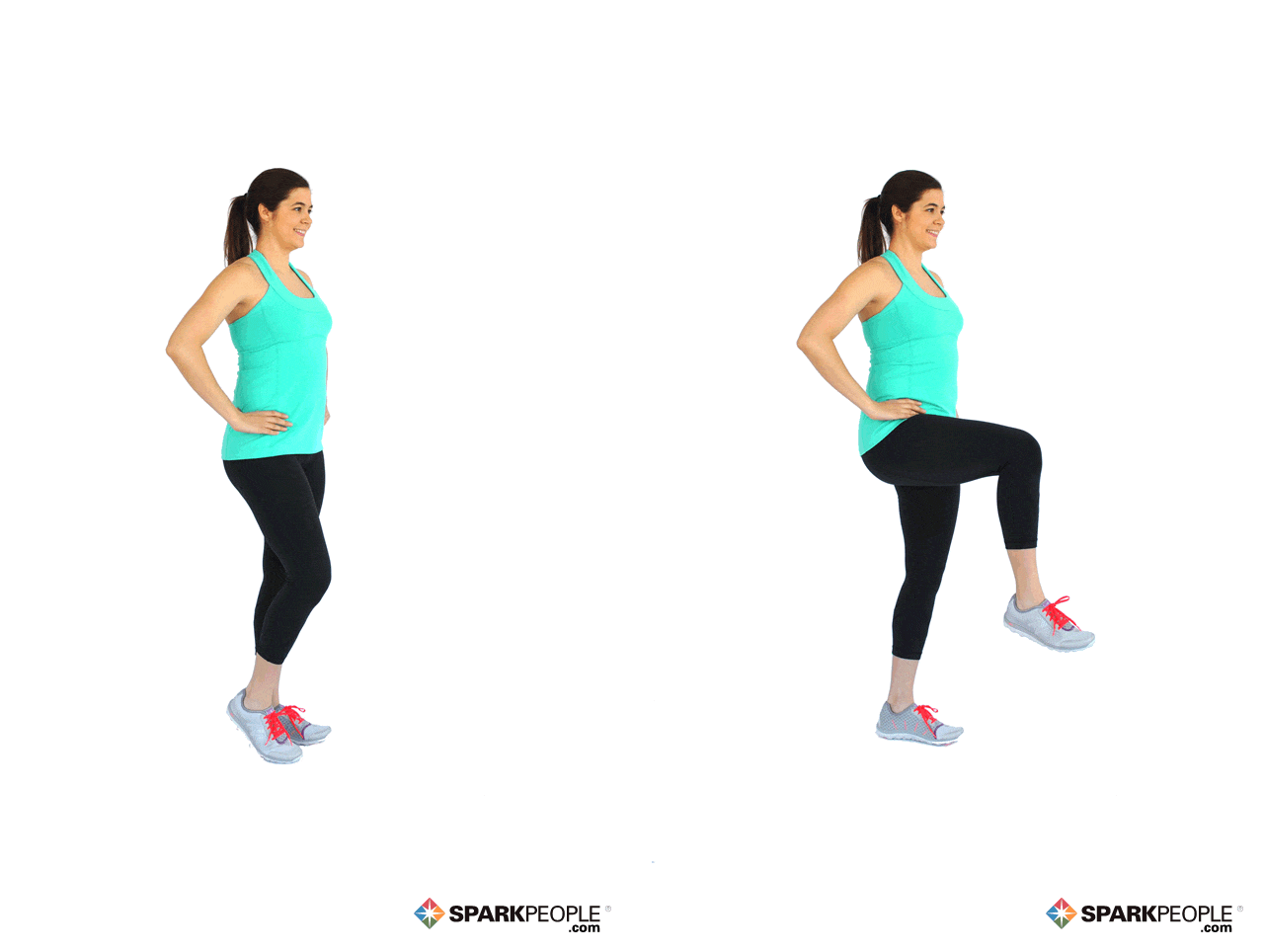
Standing hip flexion.

To perform this exercise start by standing upright and raising one knee to the height of your hip at a 90-degree angle. Squeeze your glutes to help you stabilize at the top. Hold that contraction for 5-10 seconds and lower your leg and repeat. This strength exercise targets your hip flexors, glutes, core, calves and the muscles of your feet.
 

Standing hip abduction.

To perform this exercise start by standing upright and shifting your weight to one leg. Slowly lift the opposite leg off the floor away from your body keeping the leg fully extended and the toes flexed. Make sure your toes are pointed ahead at all times to prevent your hip from externally rotating. The muscle primarily targets the hip abductor muscles located on the outside of the hip. This helps to promote strength and stability in the hip when walking or running.


Basic strength exercises for beginners with weak quads or hamstrings and glutes.

Lying glute bridges.

To perform this exercise start by lying flat on your back with your legs bent at 90 degrees and feet planted on the floor. Pull your pelvis into a neutral position by contracting your core and pulling your navel in towards your spine. From this position contract your glutes and lift your hips towards the ceiling. This exercise targets your erector spinae, transverse abdominis, glute medius and minimus (abductors), hamstrings and adductors.

Wall sits.

To perform this exercise start by standing upright with your feet shoulder-width apart and about 1 foot from the wall. Bring your back and shoulders against the wall and lower your body against the wall until your knees are at or near 90 degrees from your hips. Keeping your back, shoulders, arms and head against the wall hold this contraction for 10-15 seconds. Then release and repeat. This exercise targets your glutes, quadriceps, hamstrings and calves.

Strength exercises should improve function

Regardless of whether you are a beginner or experienced, strength training should always aim to improve your body’s function. When approached in this way, strength training can protect you against injury, heal muscular imbalances, improve your mobility, reduce your musculoskeletal aches and pains and greatly enhance your quality of life. The best part of all is it’s easy to get started. You can start off strength training from home without the need of any equipment. 

9 Most common workout mistakes & how you can avoid them

Workout mistakes may be hindering your progress

If you find yourself getting frustrated that you’re not seeing the results you desire from your training chances are there is something you’re doing wrong. Oftentimes people will jump into a new exercise routine without first assessing themselves to avoid any common workout mistakes. If you don’t know what you’re doing you can hinder your progress and even put yourself at risk for injury or set-backs.

9 Common workout mistakes to avoid

To figure out what you’re doing wrong check to see if any of these common workout mistakes apply to you:

  1. Inconsistency in your training. One of the most important factors in seeing results is maintaining consistency with your program. If you have a tendency to frequently start and stop a program or only periodically train you’re going to be hard-pressed to see progress. Without consistency, your body can’t adapt and master new skill-sets, which is what allows you to gain foot ground in your program. The more consistent you train per week the more volume you gain over time. This is what leads to progress. Ideally, you should aim to train at least 2-3x per week to gain the most benefits. However, it’s more important to train at a consistency you can maintain even if it’s only 1x per week. 

  1. Overtraining. Overtraining can lead to burn-out and injury. If you are seeing declines in your performance or if your muscle soreness recovery seems to linger chances are you are overtraining. To avoid overtraining schedule rest days in between your workouts and don’t do too much too quickly. When you put excessive demands on your body it could lead to muscle strain or injury.

  2. Improper form. If you’re doing an exercise with the improper form you risk targeting unintended muscles and putting your body in a compromised position. This can lead to injury. If you aren’t engaging the muscle correctly you’re not gaining the full benefit of the exercise. Always check yourself in the mirror or film yourself to ensure your form is correct.

  3. Not doing enough strength training. Strength training is important for improving motor skills, your body composition, your joint health, metabolism, muscular strength and endurance and more. By not following a consistent strength training program you are missing out on these many benefits to your health.

  1. Poor nutrition. It’s important to note that while exercise is key for making progress you are doing yourself a disservice if you aren’t also incorporating a well-balanced macro-friendly diet. No matter how hard you train, you can never outperform a bad diet. Calorie consumption is equally important here as it aids in having an optimal metabolism, which we break-down for you under our nutrition guide.

  2. Not progressing in your program. If you have been doing the same workout routine for weeks or months on end without adjusting your rep scheme, your level of resistance or exercise routine you have probably plateaued by now. Your body responds and adapts quickly to a consistent exercise program so it’s important that you make your exercises more demanding overtime. This forces your body to get stronger as it adapts to these new demands.

  3. Not incorporating a good stretching and mobility routine. Active and passive stretching is important for improving your ability to move each muscle through its full range of motion. Moving the muscle and joint through a full range of motion helps prevent injury and allow for maximum recruitment of muscle fibers. This allows you to train more efficiently.

  4. Not sleeping enough. Sleep is when your body recovers. When you’re not getting enough uninterrupted hours of rest per night it puts added stress on the body. Your muscles can’t build back up stronger if they haven’t first had the chance to recover. Lack of sleep can also contribute to joint pain and stiffness.

  5. Doing too much too soon. Always aim to master the basics in your program first. Start with building your foundation. Training calisthenics is important for understanding proper form and being able to manage your body weight in space. Bodyweight training teaches you coordination, balance, proprioception and self awareness.

Other key points to remember when training

If you’re avoiding all these common workout mistakes and still struggling to see results keep in mind results take time. Set realistic expectations for yourself. Give yourself at least 4-6 weeks following a consistent weekly program before you start evaluating any changes happening to your body. 

If you have hefty goals like to lose 40 lbs or being able to do an unassisted pull-up you should be thinking long-term. With long-term goals reevaluate yourself in 6 months. Real change does not happen overnight. Be patient with yourself and learn to trust the process. You should also keep in mind that success is not linear. Expect to face set-backs. This is a fact of life. The more you can enjoy the journey the more success you will find in the long run.

Hire a professional to help

If you are questioning whether you’re effectively avoiding these common workout mistakes you should seek help from a professional. Our certified trainers are equipped to design a program specifically to fit your needs. We are here to guide you through each workout to make sure you’re executing each exercise correctly. We also serve as your accountability partner. Having our support and expertise will help set you up for success and take the guesswork out of the equation for you. If you are interested in learning more about our services contact us today for a free phone consultation. 

Discover the 10 best benefits of group exercise classes

What are group exercise classes?

Group exercise classes is one style of training, which involves training in a group with other people. This service can be offered virtually or in person and can cater to all types of exercise such as yoga, HIIT, strength training and more. We offer virtual small group training as an affordable way to connect with others as you train from the comfort of your home!

Difference between individual and group classes​

Training in a group offers a community atmosphere for working out. Instead of working out solo with an instructor you have other peers to offer additional support and motivation.

Class settings also usually attract a diverse crowd. They can range broadly in size from two to hundreds of people of all different ages and fitness levels.

Because classes cater to a variety of fitness types workouts are less personalized, but instead are designed to match everyone’s fitness needs.

In a group setting the instructor leads the class oftentimes by doing the workout along with you to keep the energy up and everyone on pace. With solo training, all the focus is on you so the instructor is more attentive and hands-on critiquing your form and being attentive to your fitness needs.

Benefits of group exercise classes

  • Opportunity to meet new people: Training in a group allows you to connect with like-minded people. These are people who share common interests, struggles and goals. This connection makes you feel as if you are on this journey together.

  • Provides healthy competition: Working out with other similar types of people pushes you to work harder. You feed off of each other’s energy. When you see your peers doing extra reps you’re motivated to keep up.

  • More affordable: If you can’t afford a personal trainer for yourself, group classes is a great way to still hold yourself accountable at a cheaper cost.

  • Fun and entertaining: Group exercises classes are high energy, which makes working out fun. You cheer each other on! When you’re having fun you forget how hard you’re working.

  • Challenging way to learn and grow: You may not know what exercises you should be doing on your own and how hard to push yourself. Working out in a class teaches you about proper form and challenges you to do exercises you didn’t think you could do.

  • Combats exercise boredom: When you workout on your own it’s easy to become bored. Group classes provide variety to always keep you focused and engaged.

  • Bigger than yourself: Working out in a group provides community. It reminds you that you’re on this journey together. If you give up on yourself you’re not just letting yourself down, but the whole group.

  • Keeps you accountable. When you’re relying on your own motivation to workout it’s easy to fall off track. Enrolling in a group exercise class helps you build a  routine so that you  can remain consistent with your workouts.

  • Gives you variety in your workouts. Classes offer a unique variety to your workouts because every class is different. You can choose classes to match your goals and preferences such as HIIT, spin or yoga.

  • Builds self-confidence and camaraderie. Training in a group setting can make you less self-conscience because you have other people around you who are at a similar fitness level. It also allows you to lean on each other for support when you need it.

Why group training might be for you?

Group exercise classes can be a  great way to workout while making new friends. It’s a fun way to stay active and also work on improving your fitness. By working out in a group you also get to learn from and motivate each other!

We offer a virtual small group training class that meets every Wednesday at 5pm EST. You can join us from the comfort of your home! All of the workouts are tailored towards all fitness levels and we focus on total body functional, mobility and strength training. No equipment is needed to join. 

Sign up today to subscribe and save! You can unsubscribe at any time.