

Your core after pregnancy is going to be both an area of increased weakness and an area that requires a lot of attention. Most women will experience at least a mild case of diastasis recti as a result of pregnancy due to the increased demand put on the abdominal muscles during pregnancy and in labor. In some cases, this muscle separation in the abdominals can be so severe that surgery is required to correct it. However, most times this can be resolved with the proper training. It’s a good idea if you’re currently pregnant to do prenatal exercises to begin strengthening your transverse abdominis before delivery. This can help decrease your risk of developing severe diastasis recti.
Here are three core exercises that are great for postpartum exercise to help with strengthening and rebuilding your core.
- Pelvic tilt: For this exercise, you want to lie on your back with your feet planted and arms at your sides. Focus on inhaling as you tilt your pelvis forward forming an arch in your lower back and exhaling while contracting the core and pulling the pelvis in towards the floor. Repeat this sequence for 10-15 reps. This exercise is great for working on regaining proper pelvic alignment and strength and stability in your transverse abdominis.

- Side plank extension: For this exercise, you want to start on your side resting your bottom arm on your forearm. From here stack your feet and extend the legs. Then, drive the hips up towards the ceiling keeping your hips stacked on top of each other. Repeat this exercise for 10-15 reps on each side. This exercise is great for strengthening and stabilizing your transverse abominis and your oblique.

- Dead bug: To perform this exercise first lie on your back with your legs elevated above your hips and your arms above your shoulders. Then slowly lower the opposite arm and leg towards the floor while exhaling and contracting your core. Inhale and relax the core as you bring the arm and leg back up to the starting position. Repeat this exercise for 10 reps on each side. This exercise is great for strengthening and stabilizing your core as well as your spine and back muscles.

Here are four functional postpartum exercises you should be doing to work on building total body strength and conditioning.
- Push-ups: To modify this exercise you can start by doing wall push-ups and gradually work up to doing them from a lower incline until you can do them from the floor. To perform this exercise make sure your hands are positioned shoulder width apart and feet are hip width apart. Starting from a straight arm plank slowly lower your chest towards the wall or surface you’re on while bending the elbows back at 45 degrees. Make sure to keep a long neck and shoulders down and back. Try to perform 5-8 reps to start out. This exercise is great for targeting your chest, triceps, shoulders, core and serratus anterior muscles.

- Squat into overhead press: To modify this exercise you can start with body weight air squats or box squats. Gradually as you get stronger you can start doing weighted squats and then add in the overhead press. Start by standing with your feet hip width apart and practice squatting over a chair to ensure correct form. As you add in the weight make sure you’re keeping your chest open, shoulders down and back and core tight. You should press the weights overhead directly in alignment with your ears. Make sure to fully extend your elbows at the top of the press. You should aim for at least 8-1o reps with this exercise. This exercise is great for hitting hamstrings, glutes, quads, core and shoulders.

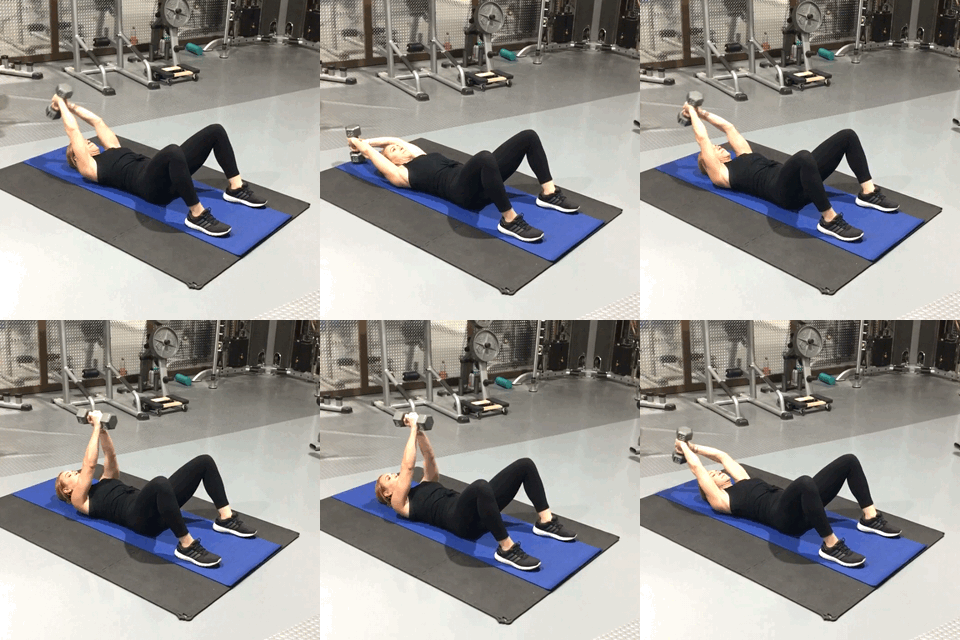
- Pull-overs: To modify this exercise start by using a light weight while lying on your back on the floor. Start with your feet planted and arms holding the weight above your chest. Slowly bring the weight overhead to tap the floor while flaring your elbows and keeping only a slight bend in the arm. As you bring the weight overhead pull your pelvis back by contracting your core and pressing your back into the floor. As you progress you can do this exercise from an elevated surface such as the bench to gain a bigger depth and stretch at the bottom of this motion. Aim to perform 10-15 reps of this exercise. This exercise is great for targeting the upper back including your lats, chest, triceps, serratus anterior and core muscles.
- Romanian deadlift with a row: This exercise can be modified by standing with your feet turned out slightly and using lighter weights. As you get stronger you can slowly increase the amount of weight you’re using and the number of reps and sets you’re doing. Start by standing with your feet about hip width apart and arm hanging down in front of the body. Then, slowly hinge forward with your chest by sitting back into your hips until your back is at a 45 degree angle. While keeping a flat back row the arms back towards your hips driving your elbows past your back. Repeat this exercise for 10-15 reps. This exercise targets your glutes, hamstrings, core, back and biceps.
